Languages
Saturday, October 17, 2026



News and Views from the Global South
Trade & Investment
Pacific Nations Need Help Away From Aid
Long-term dependence on development aid in Pacific Island nations, many of which have been independent for 30-40 years, continues to cause concern.
Q&A: Africa’s Tremendous Progress Amid War and Famine
The issue of peace and security, particularly in South Sudan and the Central African Republic, are expected to dominate the discussions at the African Union’s (AU) semi-annual summit being held in Addis Ababa, Ethiopia, this week.
Big Gap Surfaces in Davos
As self-appointed global leaders gather at the World Economic Forum (WEF) in Davos and discuss ‘The Reshaping of the World’, a stone's throw away non-governmental organisations named this year's winners for their dreaded Public Eye Awards.
Impoverished Cambodians For Sale
Many Cambodian women arrive in South Korea or China for marriage, only to find themselves being chosen as mistresses, say labour rights activists. While young Cambodian men, who travel to Thailand to work on fishing boats, often fall prey to drug abuse.
The Future According to Mr. Clean (Energy)
Jigar Shah likes math. It inspires him. After all, crunching numbers allowed him to convince wary investors of the money-making potential of solar energy, allowing him to ignite an industry that was crippled by roadblocks.
Elites Will ‘Consider Inequality’
With no acute crisis on the radar, this year's Annual Meeting of the World Economic Forum (WEF) will move away from the response mode of the past years and “look for solutions for the really fundamental issues,” its founder Klaus Schwab said at the pre-meeting press conference.Bali Package – Trade Multilateralism in the 21st Century
At the Ninth Ministerial Conference of the World Trade Organisation (WTO), held in Bali Dec. 3-7, a series of decisions was adopted aimed at streamlining trade, allowing developing countries more options for providing food security, boosting least developed countries' trade, and bolstering development in general.
Africa’s Billions that the Poor Won’t Touch
With its two-trillion-dollar economy, recent discoveries of billions of dollars worth of minerals and oil, and the number of investment opportunities it has to offer global players, Africa is slowly shedding its image as a development burden.
The Road to Myanmar Is Inviting but Potholed
Myanmar is flinging open the gates to foreign investment, seen as key to the southeast Asian country's future after decades of stagnation under military rule. From Coca-Cola and Unilever to Samsung and Fujitsu, the key brands of international companies can be seen hogging billboards.
Chinese Dominance in Kenyan Digital Migration Raises Alarm
Controversy and confusion have marked Kenya’s transition from analogue to digital television in keeping with the 2015 International Telecommunication Union deadline when all analogue signal transmission will cease.
Development Follows Devastation from Brazilian Dam
Valdenor de Melo has been waiting for 27 years for the land and cash compensation he is due because his old farm was left underwater when the Itaparica hydroelectric dam was built on the São Francisco river in Brazil’s semiarid Northeast.
Natural Disasters Add to Myanmar’s Troubles
As Myanmar nurses a fragile democracy after long years of military rule, a new danger has reared its head. Climate change, say experts, has the potential to spur migration and exacerbate conflict in the country.
Blackouts in Argentina Highlight Failings of Privatisation
Record temperatures at the start of the southern hemisphere summer in Argentina have been accompanied by highs on the thermometer of social discontent, as consumption peaks left thousands without electricity and threw into sharp focus the failings of the privatisation of the power industry in the 1990s.
Bike Paths, BRT Going Strong in Latin American Cities
Sustainable transport grew in the Latin American cities of Buenos Aires, Mexico City and Rio de Janeiro in 2013.
Hospitality, Agriculture Firms Vulnerable to Human Trafficking
Shareholders are calling on 15 U.S.-based multinational corporations to ensure that their global supply chains are not facilitating human rights abuses, particularly labour and sex trafficking.

Mexican Communities On Guard Against Thirst for Oil
The Terra 123 oil and gas well in the southeastern Mexican state of Tabasco was in flames since late October, just 1.5 km from a community of 1,500 Oxiacaque indigenous villagers, who were never evacuated.
OP-ED: NAFTA’s 20 Years of Unfulfilled Promises
Twenty years after it took effect, NAFTA has failed the vast majority of Mexicans.
Farmers in Mozambique Fear Brazilian-Style Agriculture
Rodolfo Razão, an elderly small farmer in Mozambique, obtained an official land usage certificate for his 10 hectares in 2010, but he has only been able to use seven. The rest was occupied by a South African company that grows soy, maize and beans on some 10,000 hectares in the northeast of the country.OP-ED: Bahraini Prime Minister Dodges Corruption Bullet, for Now
The recent collapse of the British Serious Fraud Office court case against Victor Dahdaleh has left the Bahraini prime minister’s reputation for corruption intact.
Mexico Needs a Bouncer at the Oil Industry Door
As Mexico is about to open its oil industry up to foreign investment, it will need penalties for negligence and regulations that force private firms to follow best practices in order to avoid problems like oil spills, analysts say.
Automation, Drones and Robots Lead to Guaranteeing Incomes for Humans
The debate over structural unemployment, automation and jobless economic growth began in the 1960s as car factories replaced workers with robots.« Previous Page — Next Page »





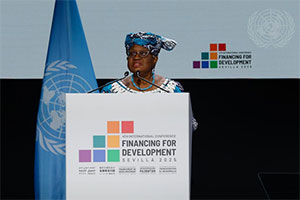 Opening of 4th International Conference on Financing for Development. Credit: UN Photo/Mariscal
International trade and investment are crucial elements of the world economy. While they can be powerful stimulators of development, they can also lead to global imbalances and dynamics of exploitation. In 2025, international trade entered a period of immense disruption, driven in part by a new wave of United States tariffs that reshaped global supply chains and investment flows. The increase in the US tariff rate, the highest since the 1930s, has forced bilateral renegotiations with global trading partners. Furthermore, the debt crisis in developing nations has accelerated while Official Development Assistance (ODA) has substantially dropped 7.3% in 2024.
In the 21st century, advancements in economic diversification in formerly colonized nations have propelled them into more central roles in the global economy. For example, both China and Mexico were able to develop their manufacturing sector and channel this development into booming export flows, thus advancing into the position of emerging economies. Foreign investment also plays an essential role in providing capital for developing countries, although they are oftentimes accompanied by social and environmental exploitation. For example, rising Chinese investments in natural resources in Latin America have often been met with tension as these investment projects fail to properly mitigate environmental risks and protect workers’ rights. In a more multifaceted vein, Sino-African relations have led to infrastructure development in Sub-Saharan Africa while also heightening the region’s economic dependency on China. IPS reports on global news in trade and investment, while shining a light on the nuanced nature of these endeavors.

The Week with IPS

NEXT STOP - SDGs
Tracking global progress towards a sustainable world
Tracking global progress towards a sustainable world
