Languages
Monday, October 19, 2026



News and Views from the Global South
Trade & Investment
Glaring Asymmetries in Bali Accord
As industrialised countries celebrate the World Trade Organisation’s Bali accord, the developing and the least-developed countries are forced to carry their battle to another day after securing only half-baked results and grandiose promises, said several trade ministers.
Mundurukú Indians in Brazil Protest Tapajós Dams
It took them three days to make the 2,000-km journey by bus from their Amazon jungle villages.
Changes Coming to South Africa’s Patent System
Paul Anley, chief executive officer of Pharma Dynamics, one of South Africa’s leading generic drug companies, wants to sell a cheaper version of popular birth control pill Yasmin. But he legally cannot because German multinational Bayer has patent protection on the drug in South Africa, even though its initial patent expired in 2010.
Throwing the Tanzania-Zambia Railway a Lifeline
Some say it's the journey, not the destination that matters. Hop aboard the Tanzania-Zambia Railway Authority (TAZARA) line at Tanzania's Dar es Salaam port and begin the 1,860-kilometre journey to Kapiri Mposhi, a small town in Zambia's Central Province, and you may find yourself pondering this adage.
U.S. “Bullying” TPP Negotiators Amid Failure to Agree
Internal government documents leaked Monday offer a sombre picture of ongoing negotiations towards a major free-trade area covering much of the Pacific Rim. The area is a key objective for the administration of President Barack Obama but has been harshly criticised by a broad spectrum of global civil society.
Where Is the Global Economy Heading?
In a passage in Charles Darwin’s The Voyage of the Beagle, he condemns an egalitarian native people at the tip of South America to remain primitive.
Food Security, Trade Facilitation Clash in Bali
The World Trade Organisation’s ninth ministerial meeting at Bali, Indonesia has morphed into a fierce battle between the countries seeking social safety nets for hundreds of millions of poor people and those insisting on having advanced import-facilitation programmes in the developing countries on par with the industrialised nations.
The Asia-Africa Link Is IT
Only 16 percent of Africa’s population of over a billion is online. But as Internet and mobile phone connectivity grows rapidly, the continent wants to join forces with Asian powerhouses to change its digital landscape.
WTO Urged Not to Treat Water Like Widgets
As government representatives gather Tuesday in Indonesia for what could be final negotiations towards a global trade agreement under the World Trade Organisation (WTO), environmentalists and social justice campaigners are urging them to specify that water resources cannot be treated as commodities.
Uruguay’s Mega-Mining Law in Place – Before the Minerals
The Uruguayan government, which recently passed a law on large-scale mining, does not actually have a clear idea of the country’s mineral wealth and has only just now proposed a geological study to find out.
Saving Children From Loggers
Logging is the largest industry in the Solomon Islands, an archipelago located northwest of Fiji, where 80 percent of the islands are covered in tropical rainforest. But, although timber accounts for 60 percent of this South Pacific nation’s export earnings, most local communities have experienced no beneficial development.
Egypt Begs Gulf for Rescue
“Subsidies from the Arab world are large and reflect Arabs’ love towards the Egyptian people, but we cannot depend on that to build an economy that can compete with other countries,” said economist Dr Alia el Mahdi.
Global Trade Winds Leave the Poor Gasping
For years, it was the power chamber at the headquarters of the World Trade Organisation (WTO) in Geneva - the Director General’s Conference Room, more popularly known as the Green Room, where a handful of delegates would gather for important discussions and meetings.
Aiming at NATO, Hitting Afghans
A blockade of NATO supplies to Afghanistan by cricketer-turned-politician Imran Khan’s party has ended up hitting Pakistan’s legal trade with its neighbour, say local traders and truckers.
Uganda’s First Female Funeral Director – From Taboo to Mainstream
Uganda may have the third-highest fertility rate in the world but where there is life, death is inevitable. And it is a certainty that Regina Mukiibi Mugongo made the most of when she became this East African nation’s first ever funeral director almost two decades ago.
‘Business Is Business, Moses Is Moses’
As civil war paralyses Syria’s transit routes and political flux in Egypt may affect security at the Suez Canal, Israel is busy repositioning itself as a transhipment hub and trade gateway to the Middle East.
Jobless Growth, the 21st Century Condition
The world’s poorest countries are rethinking economic policies that - even during periods of breakneck growth - have failed to provide quality employment capable of matching a demographic boom.
Legal Battles Against Opening Up Mexico’s Oil Industry
As Mexico moves towards a controversial reform that would be the largest opening of the oil industry to foreign investors in decades, local communities and non-governmental organisations are fighting in court against earlier contracts with foreign companies, which have been possible since 2008.
Côte d’Ivoire Poised at a Development Crossroad
All over the Ivorian economic capital, Abidjan, large cranes, involved in the construction of new buildings and highways, are dotted across the city skyline.
Indonesia’s Forest Communities Victims of ‘Legal Land Grabs’
Indonesia’s rainforests are facing “legal land grabs”, allege NGOs. Its ancient communities are finding that their ancestral lands are slipping into the hands of foreign companies for oil palm cultivation, as demand for the product grows in Europe, India and China.
Las Pavas Extracts a Miracle from God
The rural community of Las Pavas in northern Colombia received this year’s National Peace Prize Wednesday in recognition of its peaceful struggle for land that is claimed by an oil palm company, in a case that became an international symbol of the conflict over land in this country.« Previous Page — Next Page »





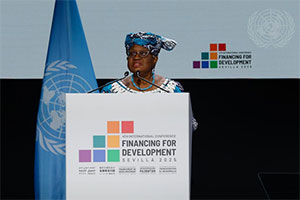 Opening of 4th International Conference on Financing for Development. Credit: UN Photo/Mariscal
International trade and investment are crucial elements of the world economy. While they can be powerful stimulators of development, they can also lead to global imbalances and dynamics of exploitation. In 2025, international trade entered a period of immense disruption, driven in part by a new wave of United States tariffs that reshaped global supply chains and investment flows. The increase in the US tariff rate, the highest since the 1930s, has forced bilateral renegotiations with global trading partners. Furthermore, the debt crisis in developing nations has accelerated while Official Development Assistance (ODA) has substantially dropped 7.3% in 2024.
In the 21st century, advancements in economic diversification in formerly colonized nations have propelled them into more central roles in the global economy. For example, both China and Mexico were able to develop their manufacturing sector and channel this development into booming export flows, thus advancing into the position of emerging economies. Foreign investment also plays an essential role in providing capital for developing countries, although they are oftentimes accompanied by social and environmental exploitation. For example, rising Chinese investments in natural resources in Latin America have often been met with tension as these investment projects fail to properly mitigate environmental risks and protect workers’ rights. In a more multifaceted vein, Sino-African relations have led to infrastructure development in Sub-Saharan Africa while also heightening the region’s economic dependency on China. IPS reports on global news in trade and investment, while shining a light on the nuanced nature of these endeavors.

The Week with IPS

NEXT STOP - SDGs
Tracking global progress towards a sustainable world
Tracking global progress towards a sustainable world
