Languages
Saturday, October 10, 2026



News and Views from the Global South
Trade & Investment

The “Secret Treasure” of Food Waste
Twenty-nine-year-old Andrzej W. and his partner lived for almost a year off of food found in the trash bin of the upscale supermarket Piotr i Pawel in Muranow, a neighbourhood near the centre of the Polish capital Warsaw. And they ate in style.
India Goes Bananas Over GM Crops
India’s environmental and food security activists who have so far succeeded in stalling attempts to introduce genetically modified (GM) food crops into this largely farming country now find themselves up against a bill in parliament that could criminalise such opposition.
Nicaragua Takes Decisive Step Towards Chinese Construction of Canal
A five-century wait could come to an end when the Nicaraguan government grants a concession this year to a Chinese company to build a canal between the Pacific and Atlantic oceans, despite local protests and international scepticism.
Developing Countries Lead Global Shift to Green Energy
Emerging economies such as Mexico and India are shifting energy investments into renewable resources while industrialised countries hesitate, noted two new United Nations reports released Wednesday in Nairobi, Kenya.
Is the 2030 Goal for Hunger Eradication Realistic?
With less than three years before a 2015 deadline, the developing world is largely expected to miss one of the U.N.'s key Millennium Development Goals (MDGs): halving the number of people living in extreme poverty and hunger.
Reforming U.S. Food Aid Would Eliminate 7,000-Mile Food Chain
Lawmakers attempted Wednesday to push along an ongoing effort to modernise U.S. international food aid policy amid mounting bipartisan support for the use of more locally grown food products over the long-standing practise of shipping U.S.-grown commodities.
Labour Violations Under Tight Wraps in Thailand
Next time you visit Walmart and throw that packet of frozen shrimp in your shopping cart, pause a moment.
U.S., Malaysia Lead Worldwide “Land Grabs”
Africa is the main target for "land grabs" by foreign investors, according to a new report on large-scale land acquisitions around the world released Monday.
Behind the Climate Finance Headlines
Developed countries report that they delivered more than 33 billion dollars in Fast Start Finance (known as FSF), beyond the pledges they made at COP 15 in Copenhagen in 2009. Recent analysis suggests that the funding delivered may have exceeded 38 billion dollars. But that is not the whole story.
Are Developing Countries Waving or Drowning?
More than five years since the outbreak of the global financial crisis, the world economy has shown few signs of stabilising and moving towards strong and sustained growth.
The Future of the Pacific Ocean Hangs in the Balance
The immense scale of the Pacific Ocean, at 165 million square kilometres, inspires awe and fascination, but for those who inhabit the 22 Pacific island countries and territories, it is the very source of life. Without it, livelihoods and economies would collapse, hunger and ill-health would become endemic and human survival would be threatened.Turkey’s Excessive Neo-liberalism Threatens ‘Peace at Home’
"Peace at home, peace in the world" is the official motto of the Turkish Republic. Coined in 1931 by the republic's founder, Mustafa Kemal Ataturk, it implies a causal relationship, but the events this week in Istanbul and dozens of other cities of Turkey suggest that causality can work in reverse order, too.
Quantitative Easing: Impact on Emerging and Developing Economies
The global economy is awash with successive waves of liquidity generated over the past few years by the four most advanced economies, viz., the United States, the European Union, (EU), Japan and the United Kingdom, known as the G4. This liquidity has taken the form of “quantitative easing” (QE).
Africa Leading the New Patterns of Growth
The old theories governing the way that countries produce and trade are being replaced. The pattern of trade is being transformed by increasingly sophisticated technology and innovations in transportation; and the topography of actors is shifting to reflect new poles of growth.
Japan Seeks to Remake Asia-Africa Relationship
Acutely aware of China’s strong presence in resource-rich Africa, Japan, the world’s third largest economy, is beefing up its relations with the continent. Participants at a high-level donor conference hosted by Japan this week stressed the need for closer engagement, not through the traditional grants and assistance loans that have hitherto defined the relationship, but rather through trade and investment led by the Japanese private sector.
Southern Africa Must Unite to Boost Tourism
Competing players in the tourism industry in southern Africa are putting aside their rivalry in pursuit of a common goal – a big boost in tourist numbers to the region.
U.S., China Seek Common Ground on North Korea
U.S. President Barack Obama is set to host his Chinese counterpart Xi Jinping on Jun. 7-8 for their first bilateral meeting as heads of state. Figuring on their agenda is how to address a precarious North Korea, which is armed with a small nuclear arsenal and vying for a bigger one.
Local Communities Invest Money – and Hope – in Ecotourism
Forty-five-year-old Serah Kei began building her artificial island and eco-lodge resort 26 years ago in Langa Langa Lagoon, located on the Solomon Island’s Malaita Province, about four hours by boat from the nation’s capital, Honiara. Kei, a single mother, paid for the construction by undertaking the laborious task of making and selling ‘shell money’ and finally opened Serah’s Lagoon Hideaway, which accommodates up to twelve visitors, in 2006.
Walmart, Gap Seek Separate Safety Standards for Bangladesh Factories
Top U.S. companies are now in negotiations to agree on new safety standards for their clothing-producing contractors in Bangladesh, a month after a garment factory’s collapse in Dhaka killed more than 1,100 workers.
India’s Maoists Are Far From Spent
They chopped down trees and used them to barricade the road, then retreated into the dense forests of the remote Sukma district, located in the central Indian state of Chhattisgarh, to await their quarry.Kazakhstan’s Green Zone on Slippery Slope
A group of flashmobbers took to the slopes in southeastern Kazakhstan on a crisp March morning this year to spell out a heartfelt SOS with their bodies.« Previous Page — Next Page »





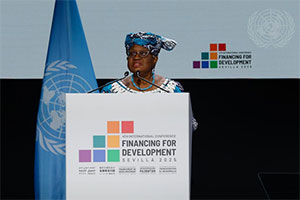 Opening of 4th International Conference on Financing for Development. Credit: UN Photo/Mariscal
International trade and investment are crucial elements of the world economy. While they can be powerful stimulators of development, they can also lead to global imbalances and dynamics of exploitation. In 2025, international trade entered a period of immense disruption, driven in part by a new wave of United States tariffs that reshaped global supply chains and investment flows. The increase in the US tariff rate, the highest since the 1930s, has forced bilateral renegotiations with global trading partners. Furthermore, the debt crisis in developing nations has accelerated while Official Development Assistance (ODA) has substantially dropped 7.3% in 2024.
In the 21st century, advancements in economic diversification in formerly colonized nations have propelled them into more central roles in the global economy. For example, both China and Mexico were able to develop their manufacturing sector and channel this development into booming export flows, thus advancing into the position of emerging economies. Foreign investment also plays an essential role in providing capital for developing countries, although they are oftentimes accompanied by social and environmental exploitation. For example, rising Chinese investments in natural resources in Latin America have often been met with tension as these investment projects fail to properly mitigate environmental risks and protect workers’ rights. In a more multifaceted vein, Sino-African relations have led to infrastructure development in Sub-Saharan Africa while also heightening the region’s economic dependency on China. IPS reports on global news in trade and investment, while shining a light on the nuanced nature of these endeavors.

The Week with IPS

NEXT STOP - SDGs
Tracking global progress towards a sustainable world
Tracking global progress towards a sustainable world
