Languages
Saturday, October 10, 2026



News and Views from the Global South
Trade & Investment

U.S., China Woo Caribbean “Friends” Just Days Apart
First it was U.S. Vice President Joe Biden, who travelled to Trinidad and Tobago Tuesday to speak with "our friends” in the Caribbean.
Brazil Floors Gas Pedal on Bus Rapid Transit
Brazil, and especially the city of Rio de Janeiro, is experiencing a boom in bus rapid transit (BRT), a public transport system that now has an internationally-recognised quality standard.
Youth Say Coca-Cola Is Easier to Find Than Condoms
“If I am thirsty and want a bottle of Coca-Cola I can get it, no matter where in the world I am. Why can’t I get contraceptives or sexual heathcare?” asked Carlos Jimmy Macazana Quispe, a youth representative from Peru currently in Kuala Lumpur for the third edition of the Women Deliver global conference on the "health and well-being of women and girls."
Africa “Net Creditor” to Rest of World, New Data Shows
Over the past three decades, Africa has functioned as a “net creditor” to the rest of the world, the result of a cumulative outflow of nearly a trillion and a half dollars from the continent.
Weather Forecasts Go Mobile in Thailand
It was another Monday afternoon in the remote Thai village of Baan Dong when an incoming text message lit up the black, dust-covered Nokia phone belonging to Eiem Sompeng.Activists Claim Win as Herakles Halts Cameroon Operation
After coming under fire from environmental and social justice organisations for violations of land protection laws, Herakles Farms, a New York-based agricultural company, has suspended a large, controversial palm oil project in Cameroon.
Australian Retailers Feel Heat of Bangladesh Tragedy
Australia’s largest textile workers’ union and activist groups are up in arms that the country’s leading retail chains, who source most of their fashion labels from Bangladesh, are refusing to sign a legally binding accord that will help to improve labour and safety standards in Bangladeshi garment factories.
Heroin Dulls Hardships for Afghan Women
Located on a narrow street in a quiet neighbourhood in Kabul, the Sanga Amaj Women’s Treatment Centre is the only one of its kind in Afghanistan: named after the 22-year-old journalist who was assassinated in 2007, the facility caters exclusively to Kabul’s massive population of female drug addicts.
Advocates Cheer Tightening of Extractives Transparency Standards
Development groups and corruption watchdogs are applauding landmark new standards adopted Wednesday by an international initiative focused on ensuring greater transparency among oil and mining companies operating particularly in developing countries.
Indian Gov’t on Collision Course With Civil Society
For years India’s pro-liberalisation, Congress party-led coalition government chafed at civil society groups getting in the way of grand plans to boost growth through the setting up of mega nuclear power parks, opening up the vast mineral-rich tribal lands to foreign investment and selling off public assets.
Groaning Under Power Cuts, Scorching Temps in Pakistan
Raheel Tauseef is feeling quite powerless this summer. Frequent power outages in the industrial city of Faisalabad in the Punjab province of eastern Pakistan, where the 29-year-old and his family run three hosiery factories, are taking a heavy toll on their business.U.S. Congress Moves Toward Full Trade Embargo on Iran
The U.S. Congress moved closer here Wednesday to imposing a full trade embargo against Iran and pledged its support to Israel if it felt compelled to attack Tehran’s nuclear programme in self-defence.
Chilean Development Still Tied to Copper Mining
Chile's position as the world's top producer of copper is not under threat, but the country faces the challenge of transforming its copper mining industry into social capital for the long term, and addressing high energy costs, which have grown seven-fold over the last decade, experts told IPS.
Can South Africa Help Nigeria to Industrialise?
The lack of economic diversification throughout sub-Saharan Africa means that despite South Africa’s pledges to help Nigeria make the automotive sector the West African nation’s flagship industrial target, it may be difficult to do so, experts say.
Survivors of Factory Collapse Speak Out
“It was dark and hot with choking dust all around. The air was filled with the smell of decomposing corpses,” recalled Nasima, a 24-year-old factory worker who spent four days buried under the rubble of an eight-storey building that collapsed in a suburb of Bangladesh’s capital Dhaka last month.
Official Bullying Lurks Behind Prep for Olympics in Brazil
As Brazil prepares to host several sporting mega-events, human rights abuses and authoritarian interventions by the authorities are going on behind the scenes, favouring major urbanisation projects and stadium remodelling, a study says.
Developing World to Dominate Global Investment by 2030
Over the next decade and a half, a major global shift will result in the developing world controlling roughly half of the world’s capital, up from less than a third today.Kyrgyz Officials Outline Restructuring Plan for Lucrative Gold Mine
As officials in Kyrgyzstan prepare to negotiate with their country’s largest investor in Bishkek this week, new details are emerging about how the Kyrgyz government wants to restructure the agreement covering operations at the country’s flagship gold mine.
U.S. Retailers Holding Out on Bangladesh Safety Agreement
Labour groups here are stepping up pressure on U.S. firms to sign a binding building safety agreement for Bangladeshi factories after 10 major European garment companies signed onto the landmark agreement.
WTO Chooses New Latin American Chief to Mark a Change in Course
Brazilian diplomat Roberto Carvalho de Azevêdo was named the new director general of the WTO with broad support from the developing world, beating out his Mexican rival Herminio Blanco, who was backed by the industrialised nations.
In Vietnam, Rhino Horns Worth Their Weight in Gold
At first glance, the poster appears to be a typical advertisement for an African safari: a large rhinoceros set against a rugged, open terrain. Then you take a closer look and realise something is amiss.« Previous Page — Next Page »





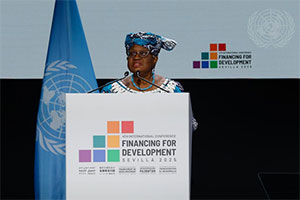 Opening of 4th International Conference on Financing for Development. Credit: UN Photo/Mariscal
International trade and investment are crucial elements of the world economy. While they can be powerful stimulators of development, they can also lead to global imbalances and dynamics of exploitation. In 2025, international trade entered a period of immense disruption, driven in part by a new wave of United States tariffs that reshaped global supply chains and investment flows. The increase in the US tariff rate, the highest since the 1930s, has forced bilateral renegotiations with global trading partners. Furthermore, the debt crisis in developing nations has accelerated while Official Development Assistance (ODA) has substantially dropped 7.3% in 2024.
In the 21st century, advancements in economic diversification in formerly colonized nations have propelled them into more central roles in the global economy. For example, both China and Mexico were able to develop their manufacturing sector and channel this development into booming export flows, thus advancing into the position of emerging economies. Foreign investment also plays an essential role in providing capital for developing countries, although they are oftentimes accompanied by social and environmental exploitation. For example, rising Chinese investments in natural resources in Latin America have often been met with tension as these investment projects fail to properly mitigate environmental risks and protect workers’ rights. In a more multifaceted vein, Sino-African relations have led to infrastructure development in Sub-Saharan Africa while also heightening the region’s economic dependency on China. IPS reports on global news in trade and investment, while shining a light on the nuanced nature of these endeavors.

The Week with IPS

NEXT STOP - SDGs
Tracking global progress towards a sustainable world
Tracking global progress towards a sustainable world
