Languages
Tuesday, October 27, 2026



News and Views from the Global South
Trade & Investment

Are Humans Responsible for the Himalayan Tsunami?
On the outskirts of Rudraprayag, a town in the northern Indian state of Uttarakhand whose many temples draw tourists and Hindu pilgrims with magnetic force, visitors often stop for a meal at a popular hotel built right on the river Alakananda.
Agriculture Leans on Japanese Women
Yukako Harada, an energetic 29-year-old, is part of a small but determined band of women farmers working hard to revitalise Japan’s moribund agricultural sector, which is feeling the crunch of an ageing population and a flood of cheap imports.
If Not Quantitative Easing, Then What?
It took world leaders some time to realise that the financial crisis initiated by the collapse of the subprime mortgage segment of U.S. financial markets in 2007 would not exhaust its effects in an ordinary recession.World Bank Formally Urged to Overhaul ‘Doing Business’ Report
An external review panel is calling on the World Bank to institute sweeping reforms to its widely cited annual “Doing Business” report, including doing away with a controversial ranking of countries on a variety of business-friendliness metrics.
Q&A: India to Make Food a Fundamental Right
As managing director of the National Agricultural Cooperative Marketing Federation (NAFED), India’s apex agriculture marketing organisation, Sanjeev Chopra is in the thick of planned legislation to cover 800 million Indians under the world’s biggest food subsidy programme.
Diversifying Income Helps Ease Climate Woes
When 45-year-old Kaswati joined an income-generating project in her village in Indonesia’s West Java province in 1999, all she hoped to do was supplement her family’s income at a time of erratic harvests.
Greeting Whales, Not Eating Them
After a two-year break, Iceland has resumed its hunting of fin whales. But environmental campaigners outside of Iceland are doing their best to stop it.CENTRAL ASIA: South Asia Energy Project a Pipe Dream?
In early June, a newspaper in Pakistan announced the Asian Development Bank would withdraw from a much-anticipated energy transmission project that aims to connect Central and South Asia. The report stated that security fears in Afghanistan were prompting the ADB to drop its 40 percent interest in the project.
Mining Benefits Fail to ‘Trickle Down’
With South-South trade on the rise and growth in emerging economies set to outstrip production in industrialised countries, the international mining sector has been quick to follow global trends.
India’s Food Security Rots in Storage
Shooing off a quartet of hens that come pecking, 24-year-old Kamala Batra sits guard over a sack of coarse rice spread out on the courtyard. After small black insects slowly crawl away in the sun’s heat, she gathers it to cook for the day’s free midday meal - a pan-India government food security scheme for students.
Dams Threaten Mekong Basin Food Supply
The future of food security in the Mekong region lies at a crossroads, as several development ventures, including the Xayaburi Hydropower Project, threaten to alter fish migration routes, disrupt the flow of sediments and nutrients downstream, and endanger millions whose livelihoods depend on the Mekong River basin's resources.
Q&A: “The Real Target Is Zero Hunger”
Under the leadership of Brazilian Director General (DG) José Graziano da Silva, the United Nations Food and Agricultural Organisation (FAO) has been engaged in a process of deep reform meant to make the organisation leaner and more effective in the fight against hunger.

U.N. Urges Turkish Police to Exercise “Restraint”
United Nations Secretary-General Ban Ki-moon and U.N. High Commissioner for Human Rights Navi Pillay have advised “maximum restraint” following media reports of a violent police crackdown on peaceful protestors in Istanbul’s Gezi Park.
Leasehold Forestry Brings a New Lease on Life
Nearly 300 km from Nepal’s teeming capital, Kathmandu, in a small village dug into the steep slopes of the mountainous Palpa district, 35-year-old Dhanmaya Pata goes about her daily chores in much the same way that her ancestors did centuries ago.U.S. and Rest of G8 Won’t Follow UK on Corporate Transparency
The United States is being singled out for criticism after the Group of Eight (G8) rich countries failed to adopt a plan pushed by British Prime Minister David Cameron to require the creation of public country-level registries with detailed information on corporate ownership and activity.
Opponents Question Proposed Trans-Atlantic Trade Deal
Controversy is building following the announcement that negotiations will soon begin on a free trade agreement between the United States and European Union, with critics warning that any such agreement could negatively affect a host of regulatory concerns.
Analysts Say Oil Could Help Mend U.S.-Venezuela Relations
A shift in U.S. foreign policy towards Venezuela may be pending as a bilateral rapprochement suddenly appears more possible than it has in years.
Corruption Eats Into India’s Food Distribution System
As India’s Parliament prepares to pass a bill to provide heavily subsidised food to 810 million people, there are misgivings over its implementation through a notoriously corrupt public distribution system (PDS).
Freeing Trade Between South Africa and Nigeria
If a Free Trade Area were to be negotiated between Africa’s two largest economies, South Africa and Nigeria, it would have a powerful effect on trade across the sub-continent and would challenge other countries to respond.
OP-ED: Social Protection Can Help Overcome Poverty and Hunger
The growing consensus, momentum and commitment to eradicate world hunger may seem overly ambitious in view of the slow progress in reducing the number of hungry people in the world in recent decades.
In Swaziland, Seeds Beat Drought
The overcast sky is a sign that it might rain, and Happy Shongwe, a smallholder farmer from rural Maphungwane in eastern Swaziland, is not exactly happy.« Previous Page — Next Page »





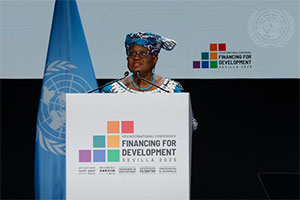 Opening of 4th International Conference on Financing for Development. Credit: UN Photo/Mariscal
International trade and investment are crucial elements of the world economy. While they can be powerful stimulators of development, they can also lead to global imbalances and dynamics of exploitation. In 2025, international trade entered a period of immense disruption, driven in part by a new wave of United States tariffs that reshaped global supply chains and investment flows. The increase in the US tariff rate, the highest since the 1930s, has forced bilateral renegotiations with global trading partners. Furthermore, the debt crisis in developing nations has accelerated while Official Development Assistance (ODA) has substantially dropped 7.3% in 2024.
In the 21st century, advancements in economic diversification in formerly colonized nations have propelled them into more central roles in the global economy. For example, both China and Mexico were able to develop their manufacturing sector and channel this development into booming export flows, thus advancing into the position of emerging economies. Foreign investment also plays an essential role in providing capital for developing countries, although they are oftentimes accompanied by social and environmental exploitation. For example, rising Chinese investments in natural resources in Latin America have often been met with tension as these investment projects fail to properly mitigate environmental risks and protect workers’ rights. In a more multifaceted vein, Sino-African relations have led to infrastructure development in Sub-Saharan Africa while also heightening the region’s economic dependency on China. IPS reports on global news in trade and investment, while shining a light on the nuanced nature of these endeavors.

The Week with IPS

NEXT STOP - SDGs
Tracking global progress towards a sustainable world
Tracking global progress towards a sustainable world
