Languages
Sunday, November 15, 2026



News and Views from the Global South
Active Citizens

Corruption Muddies the Waters in Argentina
Two corruption scandals - one homegrown and the other originating in Spain – are again highlighting the connections in Argentina between irregular investments, the misuse of environmental remediation projects for private gain, and plans that contribute to the degradation of natural resources.
U.S. ‘Divestment’ Movement Gaining Momentum
A months-old national campaign to convince U.S. colleges, universities and city governments to withdraw investments from the world’s largest oil and gas companies has seen some notable initial successes.Tunisia PM to Dissolve Government Amid Crisis
Tunisia's prime minister has said that he will dissolve the Islamist-led government and form a national unity administration, following the killing of prominent secular opposition figure Shokri Belaid in front of his home.Death Speeding Down El Salvador’s Roads
The combination of widespread disregard for traffic regulations and poor vehicle and road controls puts El Salvador among the countries of Latin America with the highest rates of traffic-related deaths.
New Regime, Same Police Brutality
Graphic video footage of an Egyptian man being dragged naked across a street and beaten by riot police during a protest in Cairo has sparked outrage in Egypt and heightened calls for police reform, a key demand of the 2011 uprising that toppled dictator Hosni Mubarak.‘Tsunami’ of Diseases Waiting to Hit
A tsunami is looming on the horizon and the world is unprepared for it. This one won’t be a massive wall of water but a tidal wave of disease – and experts say the international community needs to act fast to keep it from crashing.Davos Puts Protests Behind
Barbed wire and safety fences are dismantled, the police and army are withdrawn and freedom of movement is restored. The 43rd annual meeting of the World Economic Forum (WEF) ended last month with negligible protests against the 'global leaders'.
World Social Forum Faces Criticism, Tragedy and the Arab Spring
The tragedy at the Kiss nightclub cast a dark shadow on proceedings at the Thematic Social Forum held in Porto Alegre, the southern Brazilian city renowned for hosting the first World Social Forum in 2001.
U.S. Prison Population Seeing “Unprecedented Increase”
The research wing of the U.S. Congress is warning that three decades of “historically unprecedented” build-up in the number of prisoners incarcerated in the United States have led to a level of overcrowding that is now “taking a toll on the infrastructure” of the federal prison system.Israeli Activists Invite Palestinian Vote
Unknown to the Israeli government or the Israeli electorate, hundreds of Palestinians from the West Bank and Gaza took part in the recent Israeli elections by default thanks to an act of civil disobedience by Israeli peace activists.
Starting Tsunami Reconstruction Now
Funding for reconstruction is beginning to decline after the tsunami almost two years ago - but in large parts of Japan's north-eastern region reconstruction has yet to begin. More and more young Japanese are now moving into this area for reconstruction in a new way.
Waves of Resistance Never End at Nuclear Plant
An indefinite struggle continues against the Kudankulam nuclear power plant in the southern Indian state Tamil Nadu despite a government crackdown on protests.This Is What a Humane Economy Looks Like
The severe crisis crippling Spain is also sparking some creative responses, such the Okonomía project, a teaching initiative that helps individuals and communities to understand the workings of the economy and make more informed decisions to manage their finances.Cold War Policies Revived by Honduran Intelligence Law
The doctrine of national security imposed by the United States on Latin America, which fostered the dictatorships of the 1970s and 1980s, is making a comeback in Honduras where a new law is combining military defence of the country with police strategies for maintaining domestic order.
New U.S. Biofuel Proposals Could Draw Heavily from Food Sources
New biofuel requirements proposed by the U.S. Environmental Protection Agency (EPA) are being met with concern by a spectrum of interest groups from environmentalists to the oil industry, with some warning that a gap between the proposal and existing law could force the government to draw on food-based alternative fuels.
Turkey’s EU Hopes Could Free Media
As negotiations in Turkey’s efforts to join the European Union remain stalled, many worry that the Turkish government has little incentive to curb its ongoing crackdown on media freedoms and freedom of expression.
Preparing to Fight Off Doomsday
The International Campaign to Abolish Nuclear Weapons (ICAN) has adopted a new strategy to involve citizens and politicians more actively to push for a global ban on nuclear weapons.
Murder of Landless Workers’ Leader Recalls Brazil’s Dictatorship
The execution-style killing of a leader of the Landless Workers' Movement in a sugarcane plantation in the southeastern Brazilian state of Rio de Janeiro, where bodies of opponents of the dictatorship were incinerated in the 1970s, recalls one of the most tragic chapters in this country's history.
FILM: Mumia, the Man Behind the Prisoner
Mumia Abu-Jamal is without doubt the United States' most well-known prisoner. After living on death row for 30 years, Abu-Jamal's sentence was commuted to life imprisonment in early 2012 after decades of advocacy by anti-death penalty and anti-racist activists.
A Tale of Love Letters and Poison Pens
Several dozen people filled the seats in a downtown storefront Tuesday night to plan how to save a landmark they say belongs to the community - a 99-year-old post office the United States Postal Service wants to sell.
The Open and Rocky Road Post-2015
What values does a Yemeni journalist who fuelled the Arab Spring hold in common with a former principal of the U.S. National Security Council? And how in turn will they see eye to eye with a Jordanian queen, or the president of Indonesia?« Previous Page — Next Page »


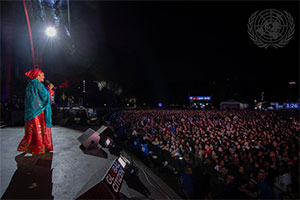 Global Citizen Festival in New York. Credit: UN Photo/Eskinder Debebe
Active citizens are committed to social change because they know that it is achievable. However, major political challenges face active citizens across the world. For example, in authoritarian regimes in Latin America where the hegemonic party has been in power for decades on end, protestors and human rights activists face enormous repression and struggle to materialize their advocacy into concrete results. The same can be said for Africans, where a shift towards elected government in recent decades has yet to translate into an effective voice in decision-making. Now, the Strengthening Citizen Demand for Good Governance, which uses evidence-based approaches – funded by DFID's Governance and Transparency Fund – seeks to raise their voices.
In 2025, the CIVICUS Monitor’s People Power Under Attack report revealed that civic freedoms are severely limited in 122 of 198 countries and territories, and only 7.2% of the global population now lives in countries where civic space is open. Through partnership with the Overseas Development Institute (ODI) and CIVICUS, IPS reporters across the continent will seek to define the extent and limits of state capability, government accountability and the responsiveness of leaders to the needs of citizens.

The Week with IPS

NEXT STOP - SDGs
Tracking global progress towards a sustainable world
Tracking global progress towards a sustainable world
