Languages
Thursday, October 8, 2026



News and Views from the Global South
Active Citizens

Solar Energy Begins to Light Up Favelas in Rio de Janeiro
 “We can’t work just to pay the electric bill,” complained José Hilario dos Santos, president of the Residents Association of Morro de Santa Marta, a favela or shantytown embedded in Botafogo, a traditional middle-class neighborhood in Rio de Janeiro.
Family Farming Wages a Difficult Battle in Argentina
"Our philosophy is based on two principles: zero tolerance of pesticides or bosses," says Leandro Ladrú, while he puts tomatoes and carrots in the ecological bag held by a customer, in a large market in the Argentine capital, located between warehouses and rusty old railroad cars.
Local Innovation Facilitates Solidarity-Based Biogas Networks in Cuba
Black plastic pipes, readily available on the mainly empty shelves of Cuba’s shops, distribute biogas to homes in the rural town of La Macuca, buried under the ground or running through the grass and stones in people’s yards.
Mexico’s Forests, Both Victims of and Solution to Climate Change
"I dream of a healthy, sustainable, well-managed forest," says Rogelio Ruiz, a silviculturist from southern Mexico, who insists that "we have to clean it up, take advantage of the wood, and reforest.”
Women in Argentina Are Empowered as They Speak Out Against Gender Violence
"In 2001 I was raped. I was 31 years old, had two university degrees and was still doing postgraduate studies, I had family, friends, a job. Many more resources than most rape victims have. Even so, it was the start of an ordeal whose scars I still feel today."
Local Communities in Mexico Question Benefits of Mayan Train
"If thousands of people flock to this town, how will we be able to service them? I'm afraid of that growth," Zendy Euán, spokeswoman for a community organisation,said in reference to the Mayan Train (TM) project, a railway network that will run through five states in southern Mexico.
Tunisia – the Exception
Eight years have passed since the Arab Spring. In many countries, the uprising was crushed, but in Tunisia democracy gained a foothold. Arbetet Global travelled to the small country town Side Bouzid to find out why.
Global Migration Compact May Help Combat the Myth that Migrants are Liabilities
In August 2018, French President Emmanuel Macron, German Chancellor Angela Merkel and British Prime Minister Theresa May visited countries in Africa, sparking hope of increased foreign direct investments (FDI) in the continent.
Not Just the Big Guys Are Against the Compact
A few hours after the adoption of the United Nation’s Global Compact on Safe, Orderly and Regular Migration in Marrakech, a consortium of Moroccan human rights organisations—La Vie Campesina—held a sit in protest in front of Marrakech’s Grand Post Office. In the statement issued on December 11, the leaders of the 15 organisations denounced the compact.
AI to map Chinese strikes
29 years ago, Han Dongfang survived the hail of bullets at Tiananmen Square. Now, he lives in Hong Kong and maps Chinese labour market strikes. Arbetet Global caught up with him at the ITUC World Congress in Copenhagen.
Water, an Environmental Product of Agriculture in Brazil
For the first time in her life, retired physical education teacher Elizabeth Ribeiro planted a tree, thorny papaya, native to Brazil's central savanna.
Citizen Action in Europe’s Periphery: “An Antidote to Powerlessness”
Unjustified extra charges on drinking water, exploitation of labourers in the countryside and uncontrolled property speculation. In Europe’s periphery, citizens' initiatives show how all too prevalent modern-day ailments can be tackled successfully. More often than not with the help of artists.
Central America: Eradicating Gender Violence is Vital to State Security
María is a 35-year old Salvadoran woman with three young children. Growing up, María knew her mother but never met her father. When María was six, she started working at the Central Market of San Salvador and at the age of 12 she was raped and became pregnant for the first time.
Thermal Houses Keep People Warm in Peru’s Highlands
Thirty families from a rural community more than 4,300 meters above sea level will have warm houses that will protect them from the freezing temperatures that each year cause deaths and diseases among children and older adults in this region of the southeastern Peruvian Andes.
Legal Weapons Have Failed to Curb Femicides in Latin America
Left blind by a beating from her ex-husband, Susana Gómez barely managed to avoid joining the list of nearly 2,800 femicides committed annually in Latin America, but her case shows why public policies and laws are far from curtailing gender-based violence in the region.
President-Elect’s Security Plan Disappoints Civil Society in Mexico
"Setback" and "disillusionment" were the terms used by Yolanda Morán, a mother whose son was the victim of forced disappearance, to describe the security plan outlined by Mexican president-elect Andrés Manuel López Obrador, who takes office on Dec. 1.
‘A Turtle is Worth More Alive Than Dead’
On the north-eastern shores of Trinidad and Tobago, on the shoreline of Matura, more than 10,000 leatherback turtles climb the beaches to nest each year. But there the local community is keenly area of one thing: ‘a turtle alive is worth more than a turtle dead.”
Solar Energy Drives Social Development in Brazil’s Favelas
"We can't work just to pay the electric bill," complained José Hilario dos Santos, president of the Residents Association of Morro de Santa Marta, a favela or shantytown embedded in Botafogo, a traditional middle-class neighborhood in Rio de Janeiro.
Women Make the Voice of Indigenous People Heard in Argentina
The seed was planted more than 20 years ago by a group of indigenous women who began to gather to try to recover memories from their people. Today, women are also the main protagonists of La Voz Indígena (The Indigenous Voice), a unique radio station in northern Argentina that broadcasts every day in seven languages.
Climate of Repression a Dark Cloud over Upcoming Elections in Fiji
Powdery white beaches. Crystal clear turquoise water. Palm trees swaying in the breeze. This is the postcard picture of paradise that comes to mind when tourists think of Fiji. But for many citizens of the South Pacific’s largest island nation, and its media, the reality is anything but blissful.
Empowering Women in Post-Conflict Africa
While its conflict ended in 2007, Northern Uganda struggles with its legacy as one of the most aid-dependent regions in the world.« Previous Page — Next Page »





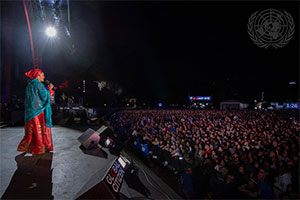 Global Citizen Festival in New York. Credit: UN Photo/Eskinder Debebe
Active citizens are committed to social change because they know that it is achievable. However, major political challenges face active citizens across the world. For example, in authoritarian regimes in Latin America where the hegemonic party has been in power for decades on end, protestors and human rights activists face enormous repression and struggle to materialize their advocacy into concrete results. The same can be said for Africans, where a shift towards elected government in recent decades has yet to translate into an effective voice in decision-making. Now, the Strengthening Citizen Demand for Good Governance, which uses evidence-based approaches – funded by DFID's Governance and Transparency Fund – seeks to raise their voices.
In 2025, the CIVICUS Monitor’s People Power Under Attack report revealed that civic freedoms are severely limited in 122 of 198 countries and territories, and only 7.2% of the global population now lives in countries where civic space is open. Through partnership with the Overseas Development Institute (ODI) and CIVICUS, IPS reporters across the continent will seek to define the extent and limits of state capability, government accountability and the responsiveness of leaders to the needs of citizens.

The Week with IPS

NEXT STOP - SDGs
Tracking global progress towards a sustainable world
Tracking global progress towards a sustainable world
