Languages
Tuesday, November 10, 2026



News and Views from the Global South
Active Citizens

Solar Energy in Social Housing, a Discarded Solution in Brazil
“Our main challenge is to get the project back on track," agreed the administrators of two affordable housing complexes, where a small solar power plant was installed for social purposes in Juazeiro, a city in northeast Brazil.
Farmers from Central America and Brazil Join Forces to Live with Drought
Having a seven-litre container with a filter on the dining room table that purifies the collected rainwater, and opening a small valve to fill a cup and quench thirst, is almost revolutionry for Salvadoran peasant farmer Víctor de León.
Afghan Electorate: Basic Needs Must be met Before Political Progress can be Ensured
After four decades of perpetual conflict, Afghanistan rolls into two consecutive election years – parliamentary this year, presidential the next. But the country and its people are going through even tougher times than usual with continued displacement and a looming hunger crisis.
South African Lawsuit Could Bring Sweeping Changes to Land and Mining Rights
South Africans await judgement to be handed down in a court case that could set a sweeping precedent by empowering communities on communal land with the right to reject new mining projects.
Plastic Tsunamis Threaten Coast in Latin America
Although Latin America produces just five percent of the world's plastic, it imports billions of tons annually for the use of all kinds of products, some of which end up in the sea as garbage.
Putting Tortillas on Mexico’s Tables Again
Agronomist Irene Salvador decided to learn the process of making corn tortillas in order to preserve and promote this traditional staple food in the Mexican diet, which has lost its presence and nutritional quality.
Chile Debates Whether Citizens Should Profit from Generating Energy
Chile has become a model country for its advances in non-conventional energy, and is now debating whether citizens who individually or as a group generate electricity can profit from the sale of the surplus from their self-consumption - a factor that will be decisive when it comes to encouraging their contribution to the energy supply.
Energy Cooperatives, Fogged Mirrors for Latin America
“It made me angry that a company from outside the region was making money from renewable energy and I wondered why people weren't getting involved," says Petra Gruner-Bauer, president of the German co-operative SolixEnergie.
Indigenous Peoples Recover Native Languages in Mexico
Ángel Santiago is a Mexican teenager who speaks one of the variations of the Zapotec language that exists in the state of Oaxaca, in the southwest of Mexico. Standing next to the presidential candidate who is the favorite for the July elections, he calls for an educational curriculum that "respects our culture and our languages."
Protests Fuel Harassment Faced by Media in Nicaragua
Assaults on journalists, persecution of press workers' unions, direct censorship and smear campaigns are a high cost that freedom of expression has paid in Nicaragua since demonstrations against the government of Daniel Ortega began in April.
Optimal Use of Water Works Miracles in Brazil’s Semi-Arid Region
Cattle ranching has been severely affected by drought in Brazi's Northeast region, but it has not only survived but has made a comeback in the Jacuípe river basin thanks to an optimal use of water.
From the Syrian War to Argentina – Or How to Start a New Life
Fares al Badwan moved to Buenos Aires alone, from Syria, in 2011. He was 17 years old then and the armed conflict in his country had just broken out. Since then he has managed to bring over his whole family and today he cannot imagine living outside of Argentina. "I like the people here. No one makes you feel like a foreigner," he said.
Protests, Strikes, Solidarity – France Revisits May ‘68
“It’s good to be in Paris on a sunny May day and see many universities occupied … and the strikes against neo-liberalism,” declared British Pakistani writer and activist Tariq Ali at an event in the Paris suburb of Nanterre on May 3. “That’s very pleasing.”
Central Americans Demand to be Consulted About Mining Projects
Rosa Dávila is busy cooking ears of corn, to be eaten by the men and women who have set up a checkpoint on the side of the road to block the passage of supplies sent to a mining company that operates in the area.
Steady Old Hand of Repression Seeks to Strangle New Media in East Africa
In African countries where journalists are targeted with killings and beatings while traditional news outlets have been muzzled by governments and other actors unhappy with criticism, bloggers and social media users have become the new independent media by providing much-needed coverage, commentary and analysis.
African Governments Mark World Press Freedom Day with Crackdown Against Online Journalism
When Uganda in April ordered Internet service providers to shut down all news sites that had not been authorized by the communications regulator (pdf), it was the latest attempt by President Yoweri Museveni’s government to constrict the space for independent media.
Free Media Under Threat Globally
Buoyed on by the likes of United States’ President Donald Trump, a growing number of political leaders are encouraging hostility towards news media and journalists across the globe are finding it harder than ever to do their jobs. This is among the main findings in Reporters Without Borders’ (RSF) annual World Press Freedom Index which examines 180 countries and their relationship with the media.
Mexico’s Solidarity Towards Haitians Only Goes So Far
In the airport of this Mexican city, on the border with the United States, customs agents warn that they will carry out a "random" inspection. But it's not so random. The only people who are stopped and checked have dark skin and kinky hair, and virtually do not speak a word of Spanish.
Press Freedom & Enforced Disappearances: Two Sides of the Same Coin in Sri Lanka
When Sri Lankan journalist Richard de Zoysa was abducted from his home in Colombo on the night of February 18th, 1990, his family knew there would be dark days ahead. The population was still reeling from one of the bloodiest episodes in the island nation’s history – a government counterinsurgency campaign to crush a Marxist rebellion in southern Sri Lanka, which left between 30,000 and 60,000 people dead at the hands of government death squads.
Women Farmers in Peru Bring Healthy Meals to Local Schools
Getting children and adolescents to replace junk food with nutritious local organic foods is the aim of a group of women farmers in a rural area of Piura, on Peru’s north coast, as they struggle to overcome the impact of the El Niño climate phenomenon.
“Fake News” a Growing New Threat to Press Freedom
When a Malaysian politician of a bygone era was asked about the “leading newspapers” in his country, he shot back: “We don’t have any leading newspapers in our country because all our newspapers are misleading.”« Previous Page — Next Page »





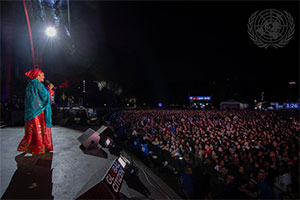 Global Citizen Festival in New York. Credit: UN Photo/Eskinder Debebe
Active citizens are committed to social change because they know that it is achievable. However, major political challenges face active citizens across the world. For example, in authoritarian regimes in Latin America where the hegemonic party has been in power for decades on end, protestors and human rights activists face enormous repression and struggle to materialize their advocacy into concrete results. The same can be said for Africans, where a shift towards elected government in recent decades has yet to translate into an effective voice in decision-making. Now, the Strengthening Citizen Demand for Good Governance, which uses evidence-based approaches – funded by DFID's Governance and Transparency Fund – seeks to raise their voices.
In 2025, the CIVICUS Monitor’s People Power Under Attack report revealed that civic freedoms are severely limited in 122 of 198 countries and territories, and only 7.2% of the global population now lives in countries where civic space is open. Through partnership with the Overseas Development Institute (ODI) and CIVICUS, IPS reporters across the continent will seek to define the extent and limits of state capability, government accountability and the responsiveness of leaders to the needs of citizens.


The Week with IPS

NEXT STOP - SDGs
Tracking global progress towards a sustainable world
Tracking global progress towards a sustainable world
