Languages
Tuesday, November 10, 2026



News and Views from the Global South
Editors' Choice

Transgender People Gain Their Place in Argentine Society
"At the age of 35, with a document that says who I really am, I went back to school and finished my studies, which I had left at 14 because I could no longer bear the bullying and mistreatment," said Florencia Guimaraes, a transgender woman whose life was changed by Argentina's Gender Identity Law.
Missing Women in Peru – Pain that Never Ends
"They mustn’t stop looking for her," said Patricia Acosta, mother of Estéfhanny Díaz, who went missing on Apr. 24, 2016, along with her five-year-old and eight-month-old daughters, after attending a children's birthday party in Mi Perú, a town in the coastal province of Callao, next to the Peruvian capital.
Urgent Global Call to Save 222 Million Dreams for Children Impacted by Crises
It is not enough that they were robbed of their childhoods and their shattered young lives defined by bombs, bloodshed and death. Now, crisis-impacted school-aged children are falling off the academic bridge that could lead them out of the carnage.
Expensive Energy from Cheap Sources Hampers Brazil’s Economy
Brazil has abundant low-cost energy, but by the time it reaches the consumer it is one of the most expensive in the world. This contradiction hinders the country's human and economic development and the “solutions” found have actually aggravated the problem.
Tobacco Consumption Slows in the West, Grows in Africa, say Researchers
Cigarette smuggling has emerged as one of the most lucrative enterprises between Zimbabwe and South Africa, with border authorities seizing contraband worth millions of dollars in recent years.
War in Ukraine Triggers New International Non-Alignment Trend
Numerous countries of the developing South are distancing themselves from the contenders in the war in Ukraine, using the debate on the conflict to underscore their independence and pave the way for a kind of new de facto non-alignment with regard to the main axes of world power.
Small-Scale Fishers in Central America Demand Social Security Policies
At the pier, Salvadoran fisherman Nicolás Ayala checked the pocket of his pants to make sure he was carrying the hypertension pills he must take when he is at sea on a 24-hour shift. He smiled because he hadn’t forgotten them.
Bilingual Intercultural Education, an Endangered Indigenous Right in Peru
"I always express myself in Quechua and I don't feel I’m less of a person," said Elías Ccollatupa, 47, who has been a bilingual intercultural teacher for more than two decades in the Chinchaypujio district, one of the nine that make up the province of Anta, in the department of Cuzco, in the southern Andean region of Peru.
Disability Inclusion Lifts Rural Ugandan Families From Poverty
Lawrence Akena was born 32 years ago with microcephaly. Because of his neurological condition, he didn't go to school or benefit from skills training.
Southern Winds in Magallanes Fuel Green Hydrogen in Chile
Patagonia’s strong winds are driving projects that will place Magallanes, in the extreme south of Chile, in a privileged position to produce and export green hydrogen and help the country move towards carbon neutrality.
Farmers in Senegal Adopt Farming as a Business to Beat Climate Change
Onions and rice are a conspicuous part of every meal in Senegal, including the famous Poulet Yassa. However, climate change makes it hard for smallholder farmers to grow enough staple food with extra to sell for income.
Youth must be Equal Partners in Digital Decision Making – ITU Youth Summit
"50 percent of the present, but 100 percent of the future," was the refrain at the first-ever Generation Connect Global Youth Summit.
Cities in Brazil Reap Floods after Hiding Their Rivers Underground
Acaba Mundo has fallen into oblivion, despite its apocalyptic name – which roughly translates as World’s End - and historical importance as an urban waterway. It is a typical victim of Brazil’s metropolises, which were turned into cemeteries of streams, with their flooded neighborhoods and filthy rivers.
Poor Families Clash over Water with Real Estate Consortium in El Salvador
Alex Leiva woke up at 4:00 a.m. to perform a key task for his family’s survival in the Salvadoran village where he lives: filling several barrels with the water that falls from the tap only at that early hour every other day.
Over Two Decades of Impunity for Environmental and Health Disaster in Peruvian Village
"We are not asking for money, but for our health, for a dignified life," is the cry of the people of Choropampa, which lawyer Milagros Pérez continually hears 22 years after the environmental disaster that occurred in this town in the department of Cajamarca, in Peru´s northern Andes highlands, on the afternoon of Jun. 2, 2000.
Rivers Have no Borders: The Motto of Their Defenders in Peru
"Water is part of our culture, it is intrinsic to the Amazon," said José Manuyama, a member of a river defense committee in his native Requena, a town located in the department of Loreto, the largest in Peru, covering 28 percent of the national territory.
COVID and Discrimination Aggravated Maternal Mortality in Latin America
Brazil had the dubious distinction of champion of maternal mortality in Latin America during the COVID-19 pandemic, with a 77 percent increase in such deaths between 2019 and 2021.
Child Labour Survivor Has a Dream of Freeing Others
Selimatha Dziedzorm Salifu was just seven years old when she went to work for the first time to support her family. Born in the fishing village, Kpando-Torkor, in Ghana, Salifu, was forced to go out and work in the local fishing industry when her father Seidu died, leaving her mother, Mary, with six children to feed, clothe and shelter. The industry is well documented for child slavery and trafficking.
Employee-run Companies, Part of the Landscape of an Argentina in Crisis
"All we ever wanted was to keep working. And although we have not gotten to where we would like to be, we know that we can," says Edith Pereira, a short energetic woman, as she walks through the corridors of Farmacoop, in the south of the Argentine capital. She proudly says it is "the first pharmaceutical laboratory in the world recovered by its workers."
Youth Survivors, Activists Will Hold Governments Accountable to Call to Action on Ending Child Labour
Governments of the world must focus on providing quality free education and prosecuting corrupt officials and people who siphon state and donor funds as crucial steps towards taking decisive action to fight child labour across the globe.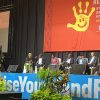
Youth Demand a Voice in Call-To-Action on Child Labour
Ashley has vast work experience. She has laboured by the sweat of her brow in the blistering sun on the streets of Guatemala, in the open fields on farmlands and indoors, toiling for long hours to the hum of a sewing machine. Her work resume might be impressive to some – street trader, farmworker and tailor – but she, like 160 million children around the world, is trapped in child labour, working desperately to support her impoverished family and provide for her education.« Previous Page — Next Page »





The Week with IPS

NEXT STOP - SDGs
Tracking global progress towards a sustainable world
Tracking global progress towards a sustainable world
