Languages
Saturday, November 28, 2026



News and Views from the Global South
Food and Agriculture

BRAZIL: Oil Palm Plantations Expand on Degraded Land in Amazon
Brazil hopes to eventually become a major producer of palm oil, thanks to the expansion of this new exotic monoculture crop in the eastern Amazon jungle, where eucalyptus plantations are also mushrooming on broad swaths of already deforested land.
AGRICULTURE – SOUTH AFRICA: Small Scale Farmers Face Uphill Battle
Just before sunrise 39-year -old Alan Simons, an emerging small-scale farmer, gets ready for his usual nine-hour day of harvesting, packing and deliveries. In his black Nissan van he drives ten kilometres to the seaside town of Strand outside of Cape Town to pick up his six workers, all of who are women.
GAMBIA: Families Left Homeless by Floods
Amie Manneh and her family lived securely in their single-bedroom home in Bundung, 15 kilometers from the capital, Banjul. Then their home was destroyed by heavy rainfall in September. Since then Amie, her husband and six children have been living in the damaged house.
FOOD CRISIS: Two New Varieties of Vegetables on Kenyan Food Market
Agriculture remains one of the most significant economic activities in Kenya. It accounts for over 24 percent of Gross Domestic Product (GDP) with an estimated 70 percent of total production coming from small scale farmers who typically have about 2-5 acres of land, depending on the region.
AGRICULTURE: Desperation Over Subsidies
As the rains start to fall in Malawi, marking the beginning of the growing season, government is continuing to implement the fertiliser and seed subsidy programme which has since made the country a bread basket in the Southern African Development Community, SADC.
SOUTH AMERICA: Rain May Disappear from the World’s Breadbasket
South America still has vast extensions of land available for growing crops to help meet the global demand for food and biofuels. But the areas of greatest potential agricultural production -- central-southern Brazil, northern Argentina, and Paraguay -- could be left without the necessary rains.
POLITICS: Human Suffering Escalates in Cote d’Ivoire
For three days, 25-year-old Ousmane Traoré attended the private clinic in the populous district of Abobo, north of Abidjan. Suffering from gunshot wounds to the head and abdomen as a result of the Ivorian opposition demonstrations, he was forced to leave the main hospital in Treichville, south of Abidjan, due to a lack of assistance.
INDIA: Wonder Irrigation Pump Goes A Long Way
Just two years ago, Ratha Majhi was at his wits’ end trying to eke out a decent living from his modest vegetable farm.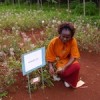
AGRICULTURE: Kenyan Researchers Say Traditional Vegetables Can Improve Food Security
According to Vision 2030, which is a government strategic plan on how to boost growth and development in Kenya, there are an estimated five million out of an estimated eight million households who depend directly on agriculture, despite the fact that agriculture continues to be one of the most under-budgeted ministries.
India-EU Deal Threatens Mom-and-Pop Retail
Retail giants pushing the European Union-India free trade deal promise consumers a "new and dynamic retail experience" but ignore the fate of India’s "mom-and-pop" stores and some 40 million people they employ.
ECUADOR: Farming in the Shadow of the Volcano
On a clear day, hundreds of families pull over in their cars and snap pictures of the column of smoke spewing out of the Tungurahua volcano in central Ecuador.
Dire Development Issues Converge in the Drylands
Few are aware that close to one billion people in over 100 different countries are suffering from or severely threatened by intense desertification. Yet awareness is crucial, for it is human behaviour that has led to the proliferation of hyper- arid, uncultivable drylands over the past few decades.
OP-ED: The EU Must Start Fishing Responsibly Now
The loss of marine biodiversity is hurtling forward at an unprecedented rate. At present, the FAO calculates that nearly 80 percent of the world's fishery resources are fully exploited, overexploited or depleted. Furthermore, marine scientists have suggested that if the current pace of exploitation continues, all fish stocks will have collapsed or disappeared by 2048.
COLOMBIA: New Boost for Rural Women
"It sounds nice, but it’ll be tough to implement"; "the most important thing is to translate into reality": These statements by rural women leaders in Colombia sum up the reaction of activists to the government’s decision to revive and refinance a special fund for projects in the countryside led by women.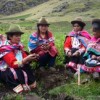
LATIN AMERICA: Rural Women, Success Stories and Exploitation
The traditional image of rural women in Latin America is shifting, from one of subsistence farmers raising their families to that of women playing a growing role in small- and large-scale commercial and productive activities. But behind that change lie both success stories and exploitation.Africa’s Future Lies in a Green Energy Grid
Development in Africa could falter as climate change grips the continent, increasing the length and severity of droughts and floods by altering precipitation patterns, among other impacts.
Drought Hits Middle East Farmers, Again
Anxious farmers gather in their field on a warm, clear day in Syria’s arid northern region of Al-Raqqa, near the banks of the Euphrates River. The ground in this corner of the ‘fertile crescent’ is barren, save for a small herd of sheep on the ten-hectare farm.GUATEMALA: Forgotten Promises Leave Indigenous Peoples Poorer and Hungrier
Nearly three years into President Álvaro Colom's four-year term, Guatemala's indigenous people have seen little improvement in their lives -- and they represent approximately half the country's population.
Niger Herders Count Losses, Plan For the Future
Bacharou Gorel had 300 head of cattle before the food security crisis began in Niger. Today he has only 53 left.
Q&A: Revitalising Agriculture Starts in a Small Field
In countries around the world, small farmers are trapped in a vicious circle - hard-pressed governments don't invest enough money in local agriculture, and local producers find themselves driven off their lands and into urban slums, where they sink even deeper into poverty.
Latin America Puts Bamboo’s Climate Virtues to the Test
While a global agreement to fight the climate crisis may be off the table for now, many activists and experts are focusing on options for mitigating climate-changing gas emissions and the impacts of increasingly extreme weather. One such alternative is bamboo.« Previous Page — Next Page »


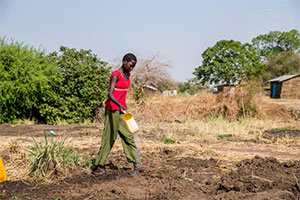 Farming on the Outskirts of Juba. Credit: UN Photo/JC McIlwaine
Promoting human and planetary health is a central focus of the United Nations, as laid out in the 2030 Sustainable Development Goals (SDGs). World hunger and unsustainable farming practices continue to be pressing concerns for the world. According to the 2025 State of Food Security and Nutrition in the World report by the Food and Agriculture Organization (FAO), 673 million people faced hunger in 2024. There are stark regional disparities, with the FAO projecting that 60% of the world population facing hunger will reside in Africa by 2030. Globally, the prevalence of food insecurity has remained consistently higher for women than men.
Sustainable and efficient national food systems are essential in preserving health, education, environmental well-being, peace, economy, and security. However, creating sustainable food systems can be a challenging endeavor, as food production takes a heavy toll on the environment. The agricultural sector accounts for a significant portion of greenhouse gases. Finding safe, sustainable, and ethical strategies to feed the world is crucial in ensuring planetary longevity. A recent initiative from 2023, the EU Regulation on Deforestation-free Products (EUDR), seeks to advocate for sustainable food systems. The main driver of deforestation is the expansion of agricultural land used to produce commodities like cattle, wood, cocoa, coffee, etc. The EUDR is part of the 2020 European Green New Deal and the EU Biodiversity Strategy for 2030 and aims to limit Europe’s consumption of products linked with deforestation by requiring that companies prove that their products are deforestation-free. Despite aiming to achieve major strides in sustainability, policies such as EUDR also raise socioeconomic concerns for targeted countries. Many emerging Latin American economies are impacted by the policy, and have raised the question of how developing countries can grapple with the tensions between economic development and advancing sustainability.
IPS has been at the forefront of providing compelling and insightful stories on communities facing hunger as well as the cost of food production. IPS uses statistics from FAO, the World Food Programme (WFP) and the International Fund for Agricultural Development (IFAD) to bring relevant and hard-hitting facts to readers. This gathering of information and data from such organizations helps bring the best stories from IPS journalists working in the different regions in consultation with experts on the ground.

The Week with IPS

NEXT STOP - SDGs
Tracking global progress towards a sustainable world