Languages
Friday, November 13, 2026



News and Views from the Global South
Labour
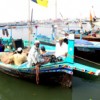
PAKISTAN: Too Many Nets, Too Little Fish
The last time Moazzam Khan saw sawfish in the Arabian Sea was in 1984. "At one time, salted and dried fish formed a large part of our exports," recalls Khan, director general of the Karachi Fisheries Department. "In the last 30 years, there may be other marine life that may have vanished of which we may not be aware."
CENTRAL AMERICA: Big Steps Forward for Nascent Recycling Industry
Waste recycling as a way to save money, create jobs and take care of the environment is finding footing in Central America, where hundreds of tonnes of paper, plastic, tyres and other products are now being marketed through innovative initiatives.Migrant Population on Track to Hit 400 Million
The population of migrants worldwide could rise above 400 million by 2050 if present rates of growth continue, says a report by the International Organisation for Migration released Monday.CAMBODIA: EU Trade Access Goes A Long Way
When the European Union slapped crippling anti-dumping duties on Vietnamese bicycle exports in 2006, one factory’s Taiwan- based owner decided enough was enough.CHINA: ‘Hukou’ Registration System Trips Over Inequity
Yu Mengxiang is a 24-year-old office manager at a foreign company in Beijing. Although he looks and acts like a typical urban male, his household registration – or ‘hukou’ – is in a village in north-east Liaoning province, which means he isn’t entitled to government benefits in the capital. Bucking conventional wisdom, he doesn’t want any.
CONGO: Beninois Fishing Community Evicted
The Autonomous Port of Pointe-Noire has evicted 8,000 residents of a fishing village to make way for expanded facilities. The move is a blow to the community's livelihoods, as well as closing down the market that supplied the city's poor with affordable protein.
Recycling for Hope and Dignity on Paraguay’s Streets
"I go out with my cart and collect plastic bottles, cardboard, paper, plastic bags; that is my work," said Laura Cardozo, proud member of a recycling group that works the Paraguayan capital's streets.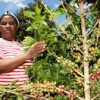
KENYA: A Brand New Constitution, But Can Women Enjoy Land Rights?
Mary Kimani wishes her husband were still alive. Holding her one-year-old son in one hand and a hoe in the other, she recounts with bitterness how she and her children lost their livelihood to her husband’s family.
ECONOMY-ZIMBABWE: Consumers May be Happy But Workers Aren’t
South African retail giant Pick-‘n-Pay increased its stake from 25 to 49 percent in TM Supermarkets – Zimbabwe’s largest grocer – in October in a deal worth about 13 million dollars. But, while the champagne corks pop in the boardroom, employees are not upbeat.TAIWAN: Debate Far from Over On Decriminalisation of Sex Trade
The Taiwanese government’s plans to partially decriminalise the sex trade has revived deep divisions within society, including between advocacy groups who stress the need for equal treatment and ‘autonomy’ for sex workers and those worried about the impact of such a move on human trafficking and child prostitution.
Lebanon Pressured to Improve Palestinians’ Lot
Abu Yussif doesn't want to talk about his work any more. "It's not going to help and nothing will change anyway," he says. The tall, white-haired Palestinian has just returned from work and relaxes in his little garden in the refugee camp Bourj ash-Shamali near the southern Lebanese city of Tyre.Congolese Women Refuse Poverty
To see how women's associations in the Democratic Republic of Congo are helping their members improve their livelihoods, just follow the hubbub you can hear from Justine Kakesa's office: the Kikwit 2 market is bursting with merchandise made by women.
SRI LANKA: Death Sentence Highlights Risks for Migrant Workers
When a relative approached Mohamed Nafeek in 2005 to explore the possibility of sending his eldest daughter, Rizana, to the Middle East as a domestic worker, the family thought its luck had finally turned for the better.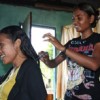
TIMOR-LESTE: Snipping Away at Youth Unemployment
In a small city where most of the 22,000 inhabitants rely on subsistence farming to put food on the table, one young woman has gone against the grain with a business venture that embodies the changing times in Timor-Leste, South-east Asia's newest and poorest nation.RIGHTS-CHINA: Stagnant Wages, Inflation Point to More Labour Unrest
Labour unrest appears to be far from over in southern China, although striking workers at the Japanese-owned Ricoh Elemex factory in Bao’an district in this city were recently forced back to work by local officials accompanied by around 400 armed police officers.
HAITI: “Cash-for-Work” Seen as a Double-Edged Sword
All across Haiti, United Nations, bilateral and non- governmental agencies are running scores of "cash-for-work" programmes. But are they "working"?
LABOUR-SWAZILAND: Jobs to be Cut to Secure International Loan
Thousands of public servants in Swaziland are due to lose their jobs in cutbacks as part of a government bid to gain approval from the International Monetary Fund for a loan. But some Swazis would rather see the budget slashed for the country’s autocratic royals.ARGENTINA: Worker-run Companies Quietly Surviving
After the late 2001 financial and political meltdown in Argentina, thousands of companies were abandoned by their owners in a sea of debt. But some of them were taken over and reopened by their employees. Today, as the economy continues to grow, these worker-run factories are still going strong.Nicaragua on Obstacle Course to Women’s Equality
Nicaragua has made some progress promoting gender equity and the empowerment of women, but it will have to step up efforts and overcome a number of hurdles if it is to eliminate inequalities between the sexes at all levels by 2015.
BRAZIL: Battle Between Jungle and Livestock in the Amazon
"Put yourself in God's hands," his mother told him just before she died. Only later did he understand that as she was dying of kidney failure, she was urging him to continue her work as a Catholic evangelist.
INDIA: Developing Self-sufficiency For Poorest Women
When Anarahim Laskar, a worker at Sealdah rail station, tripped and fell with while carrying a heavy head load in 2007, he could have easily shattered more than his hipbone.« Previous Page — Next Page »


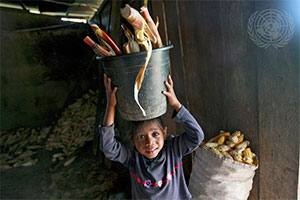 Timorese Girl with Fresh-Picked Corn. Credit: UN Photo/Martine Perret
A global common denominator is the need for a decent job. The economic realities of each country determine just how difficult it is to find one. Despite the labour movement's achievements, serious challenges persist: gender discrimination, child labour, worker migration, the digital divide and AI automation, evaporating pensions, unsafe workplaces, corporate pressure against union organising, negative impacts of trade agreements, and the precariousness of informal employment. The 2025 UN SDG Report identifies jobs and social protections as one of the six priority areas requiring urgent action, with progress either stalled or reversing in many developing nations.
In recent years, the fight to protect labour equality has taken on new dimensions with the rise of Environmental, Social and Governance standards. With the Social aspect aiming to promote equality and human rights, ESG principles have strengthened labour advocacy within corporate and governmental regulatory landscapes. In particular, ESG has become much more institutionalized in emerging economies such as Brazil and China. IPS follows the world’s workers as they confront these challenges - their setbacks and their successes.

The Week with IPS

NEXT STOP - SDGs
Tracking global progress towards a sustainable world
Tracking global progress towards a sustainable world
