Languages
Friday, November 13, 2026



News and Views from the Global South
Natural Resources

The Coming Plague
A climate plague affecting every living thing will likely start in 2020 in southern Indonesia, scientists warned Wednesday in the journal Nature. A few years later the plague will have spread throughout the world's tropical regions.
Building a Better World, One Block at a Time
One evening in the small village of Ashton Hayes in Cheshire, England, someone started a conversation about climate change and energy at the local pub. It was 2005. Two years later, residents had cut their carbon dioxide emissions and energy costs by 20 percent.
Chile’s Mining Industry Turns to Sunlight to Ease Energy Shortage
The mining industry in the north of Chile, the world’s leading producer of copper, is trying to partially satisfy its insatiable appetite for energy with a renewable, ever-available source: the sun.
Treaty Poised to Cut Toxic Mercury Pollution
A new international convention opening for signatures this week will for the first time offer an agreed-upon roadmap by which to significantly decrease the global use of mercury while offering stronger safeguards for both human health and the environment.
Small Island Economies Battered by Erratic Weather
Malcolm Wallace always knew on which side his bread would be buttered.
How to Tell the Biggest Stories of Our Times
What does gorilla conservation have in common with the provision of contraceptives to women? How does rural-urban migration contribute to global warming? What does city planning in Kenya have to do with coastal erosion in the Philippines?
U.S.-Africa Trade Mostly Benefits Oil, Textiles
With a key U.S.-Africa trade agreement up for renewal in 2015, advocates on all sides of the issue say current policies are rife with shortcomings that leave many African businesses out in the cold.
Push for Transparency in U.S.-Mexico Drilling Agreement
As lawmakers here prepare to take up legislation that would green-light a U.S.-Mexico agreement on oil-and-gas drilling in the Gulf of Mexico, development and rights groups are urging them to reject a proposal that would exempt involved companies from new disclosure requirements.
CO2 Reshaping the Planet, Meta-Analysis Confirms
Greenland will eventually truly become green as most of its massive ice sheet is destined to melt, the authoritative U.N. Intergovernmental Panel on Climate Change (IPCC) reported Friday.
Making Local People Stewards of the Earth
The lack of land rights is a crisis not just for local people but for all of humanity, warned organisers at an international conference here.
Trinidad Cracks Down on Destructive Shrimp Trawling
Dianne Christian Simmons recalls the days when she would head out with her husband on fishing expeditions in the Gulf of Paria, a 3,000-square-mile shallow inland sea between Trinidad and Tobago and the east coast of Venezuela.
Forest Communities Draw a REDD Line
As the ink dries on a 3.6 million dollar agreement between Uganda and the World Bank to support the country's preparations for REDD, some analysts are pessimistic over the mechanism's potential.
Street Power Takes On Gold
Street protests are snowballing in Romania against a Canadian-led gold mining project in the Rosia Montana area in the Apuseni Mountains. More than 20,000 people joined a protest march in Bucharest on Sunday, and thousands in other Romanian cities took to the streets.
“The Oil Is Ours” – But Its Secrets Are the NSA’s
Reported U.S. spying on Brazil’s Petrobras oil firm revived the controversy over opening up the company, a symbol of Brazilian sovereignty since the 1950s, to foreign investment.
Scarcity Reveals an Inaccessible Excess
For decades Zakayo Ekeno has walked Turkana County’s arid land, herding his livestock, and his father’s before that. Yet nothing about the persistently drought-stricken land in northern Kenya could have given him an indication of the wealth beneath it.
U.S. Debates Climate Impact of Development Investments
A debate is heating up here over the extent to which U.S. government-facilitated private-sector development investments should be required to take into account how those ventures impact on climate change.
Dwindling Water Supplies Make Every Drop Count
Drought and chronic water shortages played a significant role in sparking Syria's civil war and in unrest throughout much of the Middle East, water experts now believe.
Squatting on Kenya’s Mineral Wealth
Zeinab Mohamed is a 70-year-old squatter in Kwale County, in Kenya’s Coast Province. Like many other Coast Province residents, for decades, Mohamed has lived in what squatters call “floating houses”.
Brazilian Hydroelectricity Giant Promotes Biogas
The massive Itaipú hydroelectric dam, shared by Brazil and Paraguay, has now become a model for the micro-scale production of an energy source that is not only clean, but also helps to reduce pollution and promote local development: biogas.
Water Scarcity Could Drive Conflict or Cooperation
When the General Assembly declared 2013 the International Year of Water Cooperation (IYWC) three years ago, the U.N.'s highest policy-making body was conscious of the perennial conflicts triggered by competition over one of the world's most critical finite resources.
Native Americans Take Lead in Tar Sands Resistance
Native American tribes in the United States have taken the lead in opposing the expansion of the Athabasca Tar Sands in Alberta, Canada, engaging in civil disobedience to the point of arrest and attempting to physically block shipments of construction equipment from passing through their native lands.« Previous Page — Next Page »


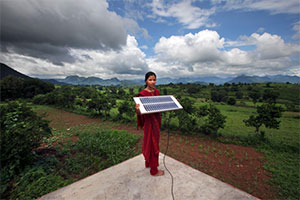 Bringing clean energy to rural India. Credit: Abbie Trayler-Smith / Panos Pictures / Department for International Development
Large reserves of oil, gas and minerals in developing countries generate opulent revenues. They could be used to stimulate economic growth and reduce poverty, but often result in environmental destruction and conflict, benefiting large companies and corrupt governments. Furthermore, competition over natural resources often manifests through geopolitical conflict. For example, before the US-Iraq war, Iraq’s domestic oil industry was nationalized. With US aggression came weakened Iraqi institutions and foreign intervention, thus eventually leading to the privatization of Iraqi oil, leaving the industry now largely dominated by Western companies. As another example, China’s rising investments within the lithium sector in South America are increasing the US-China rivalry across the Western Hemisphere. Notably, Bolivia has the largest reserves of lithium in the world, and the nation’s state-owned lithium extraction firm recently signed a contract with China’s CBC Consortium, while rejecting the entry of Western firms into the nation. In Bolivia’s case, rising Chinese investment in the nation’s lithium sector also raises concerns about environmental sustainability and the sociopolitical rights of Indigenous communities. More broadly, Sub-Saharan Africa holds nearly 30% of global reserves of critical minerals required for low-carbon technologies. Despite this, the region attracts less than 10% of global exploration investment, depicting a critical barrier to both the clean energy transitions and Sub-Saharan Africa’s economic development. Furthermore, resource wealth continues to fuel conflict like Sudan’s civil war, which has led to 9.1 million internally displaced people and is intensely connected to competition over gold, water, and agricultural land. IPS covers news about major oil, gas, and mining projects, their effects on the environment and local communities, and the ideas and actions of the interest groups involved.

The Week with IPS

NEXT STOP - SDGs
Tracking global progress towards a sustainable world
Tracking global progress towards a sustainable world
