Languages
Sunday, November 15, 2026



News and Views from the Global South
Natural Resources
Is the 2030 Goal for Hunger Eradication Realistic?
With less than three years before a 2015 deadline, the developing world is largely expected to miss one of the U.N.'s key Millennium Development Goals (MDGs): halving the number of people living in extreme poverty and hunger.
Climate Change Threatens Water and Food Security in Antigua
With their islands devoid of rivers or streams, farmers in Antigua and Barbuda have been building dams and ponds for centuries, harvesting rainwater to irrigate their crops and provide drinking water for their livestock.
Q&A: U.N. Looks to High Seas to Alleviate Food Crisis
The Food and Agriculture Organisation (FAO) is convinced there is sufficient global capacity to produce enough food to adequately feed the world's seven billion people.
When the Train Passes, But Never Arrives
José "Goyo" Hernández has never been given a mask to keep him from breathing in the coal dust blowing off the 13 trains that pass daily through this village in the municipality of Zona Bananera in the northern Colombian department of Magdalena, during his 12-hour shift at the railway crossing.
U.S., Malaysia Lead Worldwide “Land Grabs”
Africa is the main target for "land grabs" by foreign investors, according to a new report on large-scale land acquisitions around the world released Monday.
Iceland Renews Push for Aluminium Plant
The new Icelandic government was only a day old when it announced in mid-May that it would do all it could to push ahead with the Helguvik aluminium smelter. Construction for the smelter began in in 2008 but since then has met with a variety of problems, mostly energy-related.
The Future of the Pacific Ocean Hangs in the Balance
The immense scale of the Pacific Ocean, at 165 million square kilometres, inspires awe and fascination, but for those who inhabit the 22 Pacific island countries and territories, it is the very source of life. Without it, livelihoods and economies would collapse, hunger and ill-health would become endemic and human survival would be threatened.
In Southern Tunisia, Pollution No Longer Swept Under the Rug
The story of Gabès and the local phosphate industry follows a plot that is all too familiar: an underdeveloped town located in an industrial region boasts one major lucrative industry with high output and export values, but the local population and surroundings experience alarming levels of illness and environmental blight.
Landgrabbing to Provide Horn of Africa with Electricity
Ethiopia’s long-term hydropower strategy is proving to be both a source of economic sustenance and contention. In becoming Africa’s leading power exporter through the construction of a series of dams across the country, Ethiopia could threaten the lives of millions who depend on the Nile River’s waters.
For First Time, U.S. to Lease Offshore Wind Blocks
The U.S. government announced Tuesday that it would be going forward with long-discussed plans to auction federal leases off the Atlantic Ocean coast for the development of offshore wind energy.
Africa Leading the New Patterns of Growth
The old theories governing the way that countries produce and trade are being replaced. The pattern of trade is being transformed by increasingly sophisticated technology and innovations in transportation; and the topography of actors is shifting to reflect new poles of growth.
Japan Seeks to Remake Asia-Africa Relationship
Acutely aware of China’s strong presence in resource-rich Africa, Japan, the world’s third largest economy, is beefing up its relations with the continent. Participants at a high-level donor conference hosted by Japan this week stressed the need for closer engagement, not through the traditional grants and assistance loans that have hitherto defined the relationship, but rather through trade and investment led by the Japanese private sector.
India’s Maoists Are Far From Spent
They chopped down trees and used them to barricade the road, then retreated into the dense forests of the remote Sukma district, located in the central Indian state of Chhattisgarh, to await their quarry.
U.S. Urged to Reject Genetically Engineered Trees
Consumer advocates and environmentalists this week are taking advantage of an industry conference to highlight concerns over the U.S. government’s pending approval of a genetically modified eucalyptus tree.
Native People More Than Just Park Rangers
Some good-byes can actually mean the start of a long road working together. That was how it felt at the end of the World Indigenous Network (WIN) conference in this northern Australian city.
U.S., China Woo Caribbean “Friends” Just Days Apart
First it was U.S. Vice President Joe Biden, who travelled to Trinidad and Tobago Tuesday to speak with "our friends” in the Caribbean.
Chevron Rejects Shareholder Demands to Explain Record Political Spending
At an annual shareholder meeting held Wednesday, upper-level management for the oil conglomerate Chevron faced renewed questioning over its record-setting political contributions during last year’s national election.
Ramping Up Renewable Energy in the Philippines
As the Philippines grapples with frequent power outages and a growing demand for energy, government agencies and private groups say the answer to the country’s power needs may lie in alternative sources.
The Bitter Taste of Liberia’s Palm Oil Plantations
Sackie Qwemie works for Equatorial Palm Oil, the company that took his land in northwestern Liberia.
Africa “Net Creditor” to Rest of World, New Data Shows
Over the past three decades, Africa has functioned as a “net creditor” to the rest of the world, the result of a cumulative outflow of nearly a trillion and a half dollars from the continent.
Key Land Reform Accord in Colombia’s Peace Talks
Colombian government and guerrilla delegates have announced an agreement on the question of land reform – an important step in the peace talks that began six months ago in Havana.« Previous Page — Next Page »


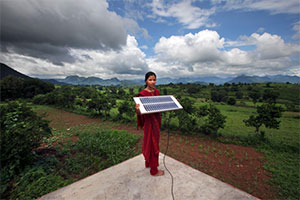 Bringing clean energy to rural India. Credit: Abbie Trayler-Smith / Panos Pictures / Department for International Development
Large reserves of oil, gas and minerals in developing countries generate opulent revenues. They could be used to stimulate economic growth and reduce poverty, but often result in environmental destruction and conflict, benefiting large companies and corrupt governments. Furthermore, competition over natural resources often manifests through geopolitical conflict. For example, before the US-Iraq war, Iraq’s domestic oil industry was nationalized. With US aggression came weakened Iraqi institutions and foreign intervention, thus eventually leading to the privatization of Iraqi oil, leaving the industry now largely dominated by Western companies. As another example, China’s rising investments within the lithium sector in South America are increasing the US-China rivalry across the Western Hemisphere. Notably, Bolivia has the largest reserves of lithium in the world, and the nation’s state-owned lithium extraction firm recently signed a contract with China’s CBC Consortium, while rejecting the entry of Western firms into the nation. In Bolivia’s case, rising Chinese investment in the nation’s lithium sector also raises concerns about environmental sustainability and the sociopolitical rights of Indigenous communities. More broadly, Sub-Saharan Africa holds nearly 30% of global reserves of critical minerals required for low-carbon technologies. Despite this, the region attracts less than 10% of global exploration investment, depicting a critical barrier to both the clean energy transitions and Sub-Saharan Africa’s economic development. Furthermore, resource wealth continues to fuel conflict like Sudan’s civil war, which has led to 9.1 million internally displaced people and is intensely connected to competition over gold, water, and agricultural land. IPS covers news about major oil, gas, and mining projects, their effects on the environment and local communities, and the ideas and actions of the interest groups involved.

The Week with IPS

NEXT STOP - SDGs
Tracking global progress towards a sustainable world
Tracking global progress towards a sustainable world
