Languages
Saturday, November 14, 2026



News and Views from the Global South
Natural Resources

Mining Benefits Fail to ‘Trickle Down’
With South-South trade on the rise and growth in emerging economies set to outstrip production in industrialised countries, the international mining sector has been quick to follow global trends.
India’s Food Security Rots in Storage
Shooing off a quartet of hens that come pecking, 24-year-old Kamala Batra sits guard over a sack of coarse rice spread out on the courtyard. After small black insects slowly crawl away in the sun’s heat, she gathers it to cook for the day’s free midday meal - a pan-India government food security scheme for students.Climate Change Promises Tough Times for Asia and Africa – Report
Extreme heat, flooding and water and food shortages will rock South Asia and Africa by 2030 and render large sections of cities inhabitable, if the world continues to burn huge amounts of coal, oil and gas, the World Bank is warning.
Dams Threaten Mekong Basin Food Supply
The future of food security in the Mekong region lies at a crossroads, as several development ventures, including the Xayaburi Hydropower Project, threaten to alter fish migration routes, disrupt the flow of sediments and nutrients downstream, and endanger millions whose livelihoods depend on the Mekong River basin's resources.
Q&A: “The Real Target Is Zero Hunger”
Under the leadership of Brazilian Director General (DG) José Graziano da Silva, the United Nations Food and Agricultural Organisation (FAO) has been engaged in a process of deep reform meant to make the organisation leaner and more effective in the fight against hunger.

Straightening Out Accounts on Deforestation in the Brazilian Amazon
The bold strategy implemented by the Brazilian government has achieved an 84 percent reduction in deforestation in the Amazon rainforest in the last eight years. But when the natural resources and pesticides used in agricultural production are taken into account, the environmental progress made is not so impressive.
Fishing Undercuts Kiribati President’s Marine Protection Claims
A growing chorus of politicians, scientists and environmentalists are urging President Anote Tong of Kiribati to actually do what he claims was already done in 2008: create the world's most effective marine protected area in a remote archipelago in the Central Pacific Ocean.
Leasehold Forestry Brings a New Lease on Life
Nearly 300 km from Nepal’s teeming capital, Kathmandu, in a small village dug into the steep slopes of the mountainous Palpa district, 35-year-old Dhanmaya Pata goes about her daily chores in much the same way that her ancestors did centuries ago.
FAO Highlights Inseparable Links Between Food and Water
Since food and water are so closely interlinked, there is a lingering fear based on the assumption, if there is no water, there will be no food.
Rural Mexican Communities Protest Wind Farms
"We can't sow our fields, which they have rented for next to nothing. What good do we get out of it?" Guadalupe Ramírez complained about wind farms operating in the southern Mexican state of Oaxaca.
Diamond Mining Could Push Angola’s Antelope to Extinction
Environmental campaigners are urging the Angolan government to halt plans to mine diamonds inside a national reserve that is home to the world’s last wild population of a rare antelope, the Giant Sable.
Analysts Say Oil Could Help Mend U.S.-Venezuela Relations
A shift in U.S. foreign policy towards Venezuela may be pending as a bilateral rapprochement suddenly appears more possible than it has in years.
Stealing Gas from the Poor to Power the Rich
In Kilwa District in southern Tanzania local community leader and fisherman Salim Riziki stands next to a set of turbines, newly imported from Dubai, talking about the gas finds on Songo Songo, an island 15 km off the mainland.
Small Ponds Bring Bumper Harvests
“I would never have believed it possible to get a bumper rice harvest during the drought season,” 43-year-old Mohammad Shajahan Ali, a farmer hailing from the village of Magtapur in Bangladesh’s northern Chapainawabganj district, told IPS.
Small Farmers Buffeted by Climate Change
The U.N. Food and Agriculture Organisation (FAO) has long warned that a quarter of the world’s farmland is “highly degraded".
In Swaziland, Seeds Beat Drought
The overcast sky is a sign that it might rain, and Happy Shongwe, a smallholder farmer from rural Maphungwane in eastern Swaziland, is not exactly happy.
Sowing a Healthier Future
“If there was enough political will to defeat hunger, we would defeat it right now - immediately,” says Enrique Yeves, chief of corporate communications at the U.N. Food and Agriculture Organisation (FAO).
U.S. Moving Toward Controversial New Role in Global Energy Market
Energy specialists say that advancements in fossil fuel extraction technologies have sparked a "revolution" in U.S. energy production, especially given radical recent changes in the global energy market and the U.S. role within it.
Q&A: Of Riots and Rice in Africa
Thanks to food riots in several African cities fuelled by high rice prices between 2007 and 2008, sub-Saharan Africa is growing and eating more rice after governments were forced into ambitious production programmes.
Zimbabwean Farmers Adrift Amid Power Struggles
For the past five years, farmer Melusi Mhlanga has spent nearly 200 dollars each season for inputs, but the maize yields have not matched his investment.
Developing Countries Lead Global Shift to Green Energy
Emerging economies such as Mexico and India are shifting energy investments into renewable resources while industrialised countries hesitate, noted two new United Nations reports released Wednesday in Nairobi, Kenya.« Previous Page — Next Page »


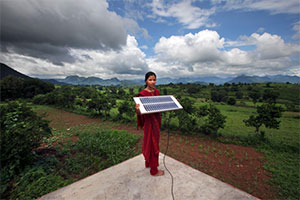 Bringing clean energy to rural India. Credit: Abbie Trayler-Smith / Panos Pictures / Department for International Development
Large reserves of oil, gas and minerals in developing countries generate opulent revenues. They could be used to stimulate economic growth and reduce poverty, but often result in environmental destruction and conflict, benefiting large companies and corrupt governments. Furthermore, competition over natural resources often manifests through geopolitical conflict. For example, before the US-Iraq war, Iraq’s domestic oil industry was nationalized. With US aggression came weakened Iraqi institutions and foreign intervention, thus eventually leading to the privatization of Iraqi oil, leaving the industry now largely dominated by Western companies. As another example, China’s rising investments within the lithium sector in South America are increasing the US-China rivalry across the Western Hemisphere. Notably, Bolivia has the largest reserves of lithium in the world, and the nation’s state-owned lithium extraction firm recently signed a contract with China’s CBC Consortium, while rejecting the entry of Western firms into the nation. In Bolivia’s case, rising Chinese investment in the nation’s lithium sector also raises concerns about environmental sustainability and the sociopolitical rights of Indigenous communities. More broadly, Sub-Saharan Africa holds nearly 30% of global reserves of critical minerals required for low-carbon technologies. Despite this, the region attracts less than 10% of global exploration investment, depicting a critical barrier to both the clean energy transitions and Sub-Saharan Africa’s economic development. Furthermore, resource wealth continues to fuel conflict like Sudan’s civil war, which has led to 9.1 million internally displaced people and is intensely connected to competition over gold, water, and agricultural land. IPS covers news about major oil, gas, and mining projects, their effects on the environment and local communities, and the ideas and actions of the interest groups involved.

The Week with IPS

NEXT STOP - SDGs
Tracking global progress towards a sustainable world
Tracking global progress towards a sustainable world
