Languages
Saturday, November 14, 2026



News and Views from the Global South
Natural Resources

Russia Contests U.S. Proposal for Major Antarctic Conservation Zone
International negotiations between more than two-dozen countries to set up conservation areas in the Antarctic seas were thrown into confusion Monday when the Russian and Ukrainian delegations questioned the body’s legal standing to make such designations, despite previous precedent.
Caribbean Bananas: Organic Production vs. Disease Control
FAO is currently supporting two seemingly contradictory projects in Caribbean countries: while one seeks to promote organic production, the other involves the use of chemical fungicides to fight black sigatoka, the worst enemy of this key food crop.
REDD a ‘False Solution’ for Africa
REDD – reducing emissions from deforestation and forest degradation – would seem to be a mitigation strategy that perfectly matches Africa's needs.
EU Bank ‘Funding Polluters’
The European Investment Bank, the largest institutional bank in the world, is facing criticism for its funding of fossil fuel projects and for weaker standards for lending to coal plants than currently proposed in both the U.S. and Canada.
Saving Côte d’Ivoire’s Fragile Forests and People
As the Côte d’Ivoire government clears its protected forests of illegal occupiers, particularly in the Dix-Huit Montagnes region, environmentalists say that this crucial move might lead to conflict in an already tense region.
U.S. Has “Largely Failed” to Protect Marine Species
Environmentalists on Monday filed a petition with the U.S. government requesting regulatory safeguards for 81 particularly vulnerable marine wildlife species, from corals to sharks.
Over a Barrel, Caribbean Seeks Finance for Clean Energy
When James Husbands, a 24-year-old Barbadian businessman, began weighing the possibility of manufacturing solar water heaters, there was already a prototype on the island that had been designed and installed by an Anglican priest living there in the early 1970s.
Living Laboratory for Coping with Drought in Brazil
The first surprise on arriving at Abel Manto's farm is how green it is, in contrast with the dry brown surroundings. His beans and fruit trees seem oblivious to the persistent drought in the semi-arid hinterland of northeast Brazil, the worst in 50 years.
Leasehold Forestry Breathes New Life into Nepal
 Over 40 percent of Nepal is covered in thick forest, but most of it has been degraded. Rural communities that have traditionally relied on the forests for survival now live in abject poverty, struggling to secure the food necessary for survival. Most men have migrated to the Gulf in search of employment.

U.S. Court Overturns Key Extractives Transparency Rule
A federal judge here on Tuesday struck down a key new regulatory provision that would require large U.S.-listed extractives companies to disclose payments made to foreign governments, a rule that rights groups had long pushed as a way to cut down on corruption in developing countries.
Edible Insect Market Hindered by Legal and Cultural Barriers in Spain
A 280-square-metre warehouse in Coín, a municipality in the southern Spanish province of Málaga, is home to a unique type of farm, where insects are raised for human consumption and the production of animal feed. But despite FAO’s endorsement of insects as food, there are numerous obstacles holding back the development of this industry.
Latin America Can Feed the World
With its abundant natural resources, productive capacity and rising investment, Latin America looks set to become of the main suppliers to meet the growing, diverse and increasingly sophisticated global demand for food.
World Bank to “Cease Providing” Funding for New Coal Projects
The World Bank is set to consider dramatically cutting down its funding for coal-related power projects, according to a draft strategy document leaked this week.
Presidential Hopefuls in Chile Speak Out Against Wilderness Dam
Diversifying the energy mix and the spectre of energy shortages in Chile are central issues in the campaign for the primary elections this Sunday Jun. 30, when presidential candidates will be nominated for the Nov. 17 elections.
Are Humans Responsible for the Himalayan Tsunami?
On the outskirts of Rudraprayag, a town in the northern Indian state of Uttarakhand whose many temples draw tourists and Hindu pilgrims with magnetic force, visitors often stop for a meal at a popular hotel built right on the river Alakananda.
Locals Risk Their Lives Fighting Mining in Mexico
"They brutally repressed us. The mining company buys off people’s consciences, it divides the community, but we’ll keep fighting it. Some people have had to flee the community,” Rosalinda Dionisio, a Zapoteca indigenous woman in the southern Mexican state of Oaxaca, told IPS, sobbing.
Obama Unveils Plan to Circumvent Congress on Climate Change
Stymied by the U.S. Congress, President Barack Obama on Tuesday unveiled his vision to reset the United States' incoherent national plan to combat climate change, offering dozens of regulatory tweaks and targets that his administration could now implement without Congressional approval.
Farming in the Mauritian Sea
“No fighting, please. Everybody will get their fish. Give us time to empty the crates and weigh today’s catch,” Patrick Guiliano Marie, leader of the St. Pierre Fish Multi-Purpose Cooperative Society, shouts at the crowd jostling impatiently at the fish landing station in Grand Gaube, a fishing village in northern Mauritius.
Diversifying Income Helps Ease Climate Woes
When 45-year-old Kaswati joined an income-generating project in her village in Indonesia’s West Java province in 1999, all she hoped to do was supplement her family’s income at a time of erratic harvests.
In Southern U.S., Energy Equity Seen as Path to Sustainability
Advocates of the concept of "energy equity" have begun employing it in the southern United States to create a diverse coalition of citizens who might otherwise approach energy policy issues differently.
Facing Tough Times, Barbuda Continues Sand Mining Despite Warnings
Arthur Nibbs was known for his staunch opposition to sand mining in his homeland of Barbuda, a Caribbean island with dazzling white sand beaches that comprise most of its deserted coastline.« Previous Page — Next Page »


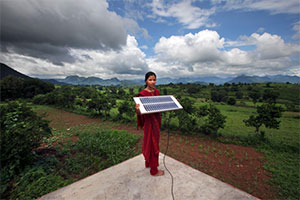 Bringing clean energy to rural India. Credit: Abbie Trayler-Smith / Panos Pictures / Department for International Development
Large reserves of oil, gas and minerals in developing countries generate opulent revenues. They could be used to stimulate economic growth and reduce poverty, but often result in environmental destruction and conflict, benefiting large companies and corrupt governments. Furthermore, competition over natural resources often manifests through geopolitical conflict. For example, before the US-Iraq war, Iraq’s domestic oil industry was nationalized. With US aggression came weakened Iraqi institutions and foreign intervention, thus eventually leading to the privatization of Iraqi oil, leaving the industry now largely dominated by Western companies. As another example, China’s rising investments within the lithium sector in South America are increasing the US-China rivalry across the Western Hemisphere. Notably, Bolivia has the largest reserves of lithium in the world, and the nation’s state-owned lithium extraction firm recently signed a contract with China’s CBC Consortium, while rejecting the entry of Western firms into the nation. In Bolivia’s case, rising Chinese investment in the nation’s lithium sector also raises concerns about environmental sustainability and the sociopolitical rights of Indigenous communities. More broadly, Sub-Saharan Africa holds nearly 30% of global reserves of critical minerals required for low-carbon technologies. Despite this, the region attracts less than 10% of global exploration investment, depicting a critical barrier to both the clean energy transitions and Sub-Saharan Africa’s economic development. Furthermore, resource wealth continues to fuel conflict like Sudan’s civil war, which has led to 9.1 million internally displaced people and is intensely connected to competition over gold, water, and agricultural land. IPS covers news about major oil, gas, and mining projects, their effects on the environment and local communities, and the ideas and actions of the interest groups involved.

The Week with IPS

NEXT STOP - SDGs
Tracking global progress towards a sustainable world
Tracking global progress towards a sustainable world
