Languages
Saturday, November 14, 2026



News and Views from the Global South
Natural Resources

Ancient Kings Fight Climate Change
Life for a widow with young children in Sri Lanka’s poor agrarian areas can be harsh. Families in remote areas like Anuradhapura in the North Central Province barely eke out a living through paddy cultivation or through vegetable and other crops planted in cleared jungle shrub - Chena cultivation as it is called.
Govt, Energy Industry Accused of Suppressing Fracking Dangers
New signs have emerged in recent days which indicate that extreme measures are being taken in order to suppress evidence of the pernicious effects of the energy extraction method known as hydraulic fracturing, or “fracking".
Tapping Rural Culture for Development Potential
“I was a hunter. I killed many animals,” said Rosalino Ortiz, a representative of Mashiramo, a campesino organisation that monitors biodiversity in Colombia’s Massif range in the southern department of Huila.
Supporting Rural Community Self-Management in Southern Peru
Some 40 multicoloured tents were set up to showcase the fruits of community-based rural development projects in the main square of this village in southern Peru during a visit by IFAD president Kanayo Nwanze.Global Value Chains from a Development Perspective
The current discourse on Global Value Chains by key proponents and also the World Trade Organisation (WTO) secretariat is that developing countries should liberalise - in goods and services - and conclude a trade facilitation agreement.
Alberta’s Oil Sands Bring Jobs, Services and Despair
“First the bugs began to disappear,” says Eriel Deranger, spokesperson for Athabasca Chipewyan First Nation.
Geothermal Energy Stuck in a Hole in Switzerland
An accident in a flagship project threatens the future of geothermal energy in Switzerland. The mishap that was followed by earthquakes has come as a warning that geothermal deep drilling still has a long way to go.
Grassroots Groups Wary of Haiti’s “Attractive” Mining Law
As the government works on preparing “an attractive law that will entice investors”, Haitian popular organisations are mobilising and forming networks to resist mining in their country.
World’s Poorest Nations Slowly Mending
The number of "least developed countries" (LDCs), which rose from the original 24 back in 1971 to the current 49, is beginning to shrink - haltingly.
A Decade of Legal GM Soy in Brazil
Ten years ago, Brazil yielded to agribusiness pressure and legalised the cultivation of genetically modified (GM) soy. Today it is the world’s second leading producer of GM crops, surpassed only by the United States.Fukushima Fallout Hits Farmers
Life for Yoshihiro Watanabe and his wife Mutsuko, mushroom and rice farmers from Fukushima, has changed drastically since the disastrous meltdowns in the Dai Ichi nuclear plant that was hit by a massive tsunami after a 9.0 strong earthquake struck on Mar. 11, 2011.
Colombian Town Says ‘No’ to Gold Mine
People in a farming town in central Colombia voted overwhelmingly against global corporation AngloGold Ashanti’s La Colosa gold mine.
Will Prayers Save Farmers in the Land of the Gods?
Over a month after flash floods in the Himalayan state of Uttarakhand in north India left 1,000 dead and 6,000 missing, the government has yet to release a full agricultural impact assessment, sparking fears about the extent of damage to the region’s farmland.
Biochar Could “Turn Back Clock” on Climate
Even as policymakers around the world wrestle with how to cut future emissions of global greenhouse gases, some scientists and environmentalists are increasingly turning their attention to the carbon dioxide that is already in the atmosphere, trying to discern ways that this level can be efficiently and safely brought down.
BOOKS: China’s March to “Wealth and Power”
The China pavilion is a red, inverted pyramid in Shanghai that was built for the city’s bustling 2010 World Expo. While the pavilion pays some homage to China’s ancient past, it mostly shows off China’s 21st century ambitions, with as much swagger as the 2008 Beijing Olympics.
U.S. Courts Uphold Conflict Minerals Disclosure
A U.S. federal judge has upheld a key regulatory provision aimed at ensuring that the profits from products mined in central Africa are not used to benefit armed groups, particularly in the Democratic Republic of Congo (DRC).
Poland’s Shale Gas Bubble ‘Bursting’
Since Jun. 3, inhabitants of the village Zurawlow in Grabowiec district in southeastern Poland have been occupying a field in their locality where the U.S. company Chevron plans to drill for shale gas. The farmers’ resistance is just the latest blow to shale gas proponents in the country.
Indonesia Comes under Fire for Fires
With a propensity to devour everything in their path and spiral quickly out of control, leaving behind swathes of scorched earth, forest fires are considered a hazard in most parts of the world. In Indonesia, however, fires are the preferred method for clearing large areas of land for massive plantations of commercial crops.
/CORRECTED REPEAT*/River Diversion Project Spells Disaster
Tsetseghkorol, a Mongolian herder, stares out nostalgically at the Orkhon River, the longest in the country.
BOOKS: Iran’s Coup, Then and Now
Ervand Abrahamian, a leading historian of modern Iran, has recently explored the 1953 Anglo/American-sponsored coup that overthrew Iranian Prime Minister Mohammad Mosaddeq.
In Search of a New Pan-Africanism
Bridging the gap between Pan-Africanism and the African Renaissance has been a top priority for the African Union (AU).« Previous Page — Next Page »


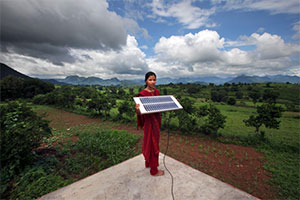 Bringing clean energy to rural India. Credit: Abbie Trayler-Smith / Panos Pictures / Department for International Development
Large reserves of oil, gas and minerals in developing countries generate opulent revenues. They could be used to stimulate economic growth and reduce poverty, but often result in environmental destruction and conflict, benefiting large companies and corrupt governments. Furthermore, competition over natural resources often manifests through geopolitical conflict. For example, before the US-Iraq war, Iraq’s domestic oil industry was nationalized. With US aggression came weakened Iraqi institutions and foreign intervention, thus eventually leading to the privatization of Iraqi oil, leaving the industry now largely dominated by Western companies. As another example, China’s rising investments within the lithium sector in South America are increasing the US-China rivalry across the Western Hemisphere. Notably, Bolivia has the largest reserves of lithium in the world, and the nation’s state-owned lithium extraction firm recently signed a contract with China’s CBC Consortium, while rejecting the entry of Western firms into the nation. In Bolivia’s case, rising Chinese investment in the nation’s lithium sector also raises concerns about environmental sustainability and the sociopolitical rights of Indigenous communities. More broadly, Sub-Saharan Africa holds nearly 30% of global reserves of critical minerals required for low-carbon technologies. Despite this, the region attracts less than 10% of global exploration investment, depicting a critical barrier to both the clean energy transitions and Sub-Saharan Africa’s economic development. Furthermore, resource wealth continues to fuel conflict like Sudan’s civil war, which has led to 9.1 million internally displaced people and is intensely connected to competition over gold, water, and agricultural land. IPS covers news about major oil, gas, and mining projects, their effects on the environment and local communities, and the ideas and actions of the interest groups involved.

The Week with IPS

NEXT STOP - SDGs
Tracking global progress towards a sustainable world
Tracking global progress towards a sustainable world
