
Saturday, November 28, 2026



News and Views from the Global South
Human Rights
Calls Mount for U.S. Intervention in Mali
The ambassador of Niger to the United States, Maman Sidikou, on Thursday called on the U.S. to step up military collaboration with African countries to support a potential intervention in Mali.
RIO+20: Canada, Last Holdout, Drops Opposition to Water as Human Right
Canada, in a dramatic political turnaround, has signaled its willingness to recognise water and sanitation as a basic human right.New Muzzle for Malaysian Media?
Despite a wave of reforms washing over the country, the Malaysian government-controlled media remains muzzled, mostly because ruling elites fear a free press will erode their iron grip on society.
After War, Economic Crisis Hits South Sudan
The United Nations has warned that despite the austerity measures put in place by South Sudan to deal with its economic woes, humanitarian agencies will have to increase relief efforts in order to keep the country’s poor alive as the financial situation worsens.
Singapore Still Hostile to Immigrants
The crash of a million-dollar Ferrari driven at high speed by a wealthy Chinese expatriate in the early hours of a weekend morning earlier this month has reignited the stormy immigration debate here, highlighting many Singaporeans’ resentment towards foreigners living and working in this small island nation.Egyptians Protest Choice Between Right and Right
Like the delayed after-effects of an earthquake below the ocean before the subsequent tsunami hits adjacent coastlines, Egyptian anger finally exploded this week after several days of stunned silence following the controversial results of Egypt’s first-round of presidential elections.
Q&A: Afghanistan Between Peace and Stagnation
Although Afghanistan's government and economy remains fragile and the security situation unstable, the 28 members of NATO plan to withdraw International Security Assistance Force (ISAF) troops by 2014, as they believe it is time to hand over responsibility to the Central Asian nation.Egyptians Protest Choice Between Right and Right
Like the delayed after-effects of an earthquake below the ocean before the subsequent tsunami hits adjacent coastlines, Egyptian anger finally exploded this week after several days of stunned silence following the controversial results of Egypt’s first-round of presidential elections.Battle Rages to Stretch the Legal Concept of Family in Nicaragua
A bill under discussion in the Nicaraguan parliament has unleashed a nationwide debate on the concept of family.MLK Centre: Building Social Networks in Cuba for 25 Years
There was little familiarity with community networks in Cuba until Apr. 25, 1987, when the Dr. Martin Luther King Jr. Memorial Centre (CMMLK) was founded. Today, this ecumenical Christian organisation links up local initiatives with others in the Americas.
Brazilian Indigenous Community Seeks Survival Through Carbon Credits
Less than 45 years ago, the Paiter-Suruí, an indigenous people living deep inside the Amazon rainforest in Brazil, had never been in contact with the outside world. Today they hope to ensure their survival through the complex mechanisms of the carbon market.COLOMBIA Langlois Case Raises Questions About Status of Journalists in War
French reporter Romeo Langlois is returning home today with an injured arm, after surviving a firefight and spending a month in the hands of the FARC guerrillas in Colombia’s southern Amazon jungle region.Indonesian Immigrants Suffer in Silence
Foreign workers, mostly from Indonesia, now make up just over 10 percent of Malaysia’s workforce of 14 million people, both in the formal and informal sectors, according to the latest government statistics.
Climate Change and Family Planning – Twin Issues for LDCs
The reproductive rights agenda, from improving women’s access to education to systematic family planning to reducing birth rates and combating poverty, has become a cornerstone of most industrialised nations’ development policies toward the least developed countries (LDCs), comprised primarily of sub-Saharan African states.Independent Media Losing Foothold in Morocco
The Moroccan government’s announcement that it would issue new public media guidelines at the end of May has reignited a stormy debate around independent media in the kingdom.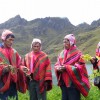
Elders in Peruvian Andes Help Interpret Climate Changes
A unique response to the challenge of global warming is happening in rural areas of Peru, where a network of indigenous elders is working out how to adjust weather forecasts in the light of climate change, while taking measures to safeguard their crops.Native Canadians See Way of Life Under Assault
Canada's West Coast First Nations are feeling overwhelmed by crises affecting their land rights, economic well-being and health, prompting warnings in one territorial dispute with a local energy company that the country risks a degeneration of Aboriginal-federal government relations to a level unseen in two decades.
Runaway Gold Prices Spark Major Headaches for Guyana
Fabian George drank and generally used water from jungle rivers near his mountainside home for decades until world market prices for gold began climbing in recent years.
Rural Women in Peru Key to Adaptation of Seeds to Climate Change
For ages, rural women in the Peruvian highlands have been selecting and storing seeds, ensuring their preservation. But the authorities have failed to tap into this storehouse of knowledge and experience, despite the contributions it could make to the design of effective policies for adaptation to climate change, which poses a growing threat to the women’s livelihoods.Annan: ‘Bold Steps’ Needed for Syria Peace
Kofi Annan, the U.N.-Arab League envoy to Syria, has called on the country's government to take bold steps to prove its commitment to restoring peace during a visit to Damascus.
South Africa’s ‘Traditional Courts Bill’ Impairs Rights of 12 Million Rural Women
The Traditional Courts Bill currently under discussion in South Africa’s parliament and due to be enacted by the end of 2012 could undermine the basic rights of some of the country’s most vulnerable inhabitants: the 12 million women living in remote rural communities across the country.« Previous Page — Next Page »


One world, one humanity, now one court to defend its rights. Another step towards universal human rights, but not remotely a step far enough. The United Nations adopted the Universal Declaration of Human Rights more than half a century ago, but that has done little to stop violations the world over, just as the Geneva Convention has not protected prisoners of war enough. Democracy itself and the freedom it presupposes has not been protective enough. This is the century to move from politicisation of human rights towards humanising political ways. IPS keeps an eye on that difficult path.

The Week with IPS

Tracking global progress towards a sustainable world
