Languages
Saturday, November 28, 2026



News and Views from the Global South
Human Rights
TAJIKISTAN: President Taking a Press Beating in Dushanbe
Following a diplomatic faux pas that enraged Russia, the knives seem to be out for Tajikistan's long-time president, Imomali Rahmon.
Q&A: “Brazil’s Foreign Aid Must Include Respect for Human Rights”
Amnesty International in Brazil will focus on the violence that plagues the favelas or shantytowns of this southern Brazilian city and the impact of construction work in preparation for the FIFA World Cup in 2014 and the Olympic Games in 2016, to check that human rights are being respected.
COLOMBIA: Worse than Fiction
A teenage love story is the fictional plot device in a new Colombian film, Silence in Paradise, about the all-too-real phenomenon of the "false positives" – the euphemism used to describe army killings of young civilians passed off as guerrilla casualties.EGYPT: ‘Army On Its Way Out’
Egyptians in Cairo and Alexandria went to the polls on Monday in the first parliamentary elections since the January 25 protest movement drove former president Hosni Mubarak from a 30-year grip on power.
Clinton Champions Gender Agenda at Busan
Women toil in the fields for most of their lives producing food and strengthening the largely agricultural economy of African countries, but when their fathers, husbands or older sons die, they are no longer welcome on land they may have tended for years.
AFGHANISTAN: False Intelligence, True Tragedies
A night raid in Hakimabad in the heart of eastern Nangarhar province shows the face of U.S.-led presence in Afghanistan, and what it means to local people.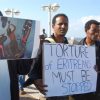
ISRAEL: Eritreans Flee From Dictatorship to Detention
Standing across the street from the American embassy in Tel Aviv, more than 200 Eritrean asylum seekers chanted "Yes to justice! Yes to humanity!", and demanded international intervention to stop torture camps in the Egyptian Sinai. Protests by African asylum seekers in Israel are growing, in the face of increasingly tough policies by the Israelis./CORRECTED REPEAT*/Will Texas Execute Man, Despite Untested Evidence?
To date, 138 people have been exonerated from death row in the United States. That figure represents 11 percent of the 1,277 executions carried out since the reinstatement of the death penalty in the country in 1976.
Forest-Dependent Communities Lobby for End of REDD+
Organisations working with indigenous peoples living in forests say the United Nations programme on Reducing Emissions from Deforestation and Forest Degradation in Developing Countries (REDD+) is just another way for big corporates to reap huge profits.
Lessons from the Andes on Budgeting to Close the Gender Gap
Three countries in South America's Andean region, Bolivia, Ecuador and Peru, have a great deal to teach and share with those meeting in Busan, South Korean this week to discuss, among other things, how to make sure that development aid incorporates a gender focus in order to be effective.
‘Nothing at Busan for African Women, Children’
Although there has been considerable progress towards reducing maternal and infant mortality, millions of women and children in Africa are still in need of better health services, food and sanitation.BALKANS: Fearing the ‘White al-Qaeda’
Mevludin Jasarevic (23) is in police custody in Sarajevo, scarcely revealing how he came to the capital of Bosnia-Herzegovina and went on a shooting spree in front of the United States embassy last month.
Sweden Runs Into South Sudanese Oilgate
Civil society leaders in South Sudan are closely watching a legal battle unfolding in Sweden, as prosecutors investigate an oil company accused of involvement in massive human rights abuses here.Washington Frets Over Pakistan Response to Soldiers’ Deaths
As the Pentagon scrambled Monday to satisfy Pakistani demands for a full accounting of Saturday's lethal air attack on two border posts, official Washington expressed hope that Islamabad's retaliation will be limited in both time and scope.
Q&A: “Gender Budgets Help You Think About People”
Gender responsive budgeting (GRB), a U.N. Women tool to curb inequality, "helps you think about people...and to use resources in a more effective manner," says Lorena Barba.
Global Fund for Education Gathers Momentum
If the international community can successfully raise billions of dollars to fight deadly diseases, why not a similar fund to promote education, asks Gordon Brown, former British prime minister.DR Congo Polls Disrupted by Violence
Five people have been killed in two separate clashes on election day in the southeast of the Democratic Republic of Congo (DRC), the country's interior minister has said.
West African farmers see climate changing
 Women in West Africa have over the years relied on fishing and farming as their traditional source of income. But as Sam Olukoya reports from Lagos, changing weather patterns caused by climate change have put their livelihood under threat.
Egyptians Cast Ballots in Post-Mubarak Polls
Egyptians have started casting their ballots in the first parliamentary elections since former president Hosni Mubarak was toppled in a popular uprising earlier this year.
SRI LANKA: Road Signs Indicate Better Times
The rough road is almost indistinguishable from the mud huts and dilapidated surroundings of this village - still pockmarked by the artillery duels of Sri Lanka’s fierce civil war that ended more than two years ago.
South-South Ties Reshape Aid Paradigm
When the G-8 countries, comprising the world’s largest industrialised nations, decided that improving Internet access to developing countries should be a priority, scores of leaders from developing world opposed the move.« Previous Page — Next Page »


One world, one humanity, now one court to defend its rights. Another step towards universal human rights, but not remotely a step far enough. The United Nations adopted the Universal Declaration of Human Rights more than half a century ago, but that has done little to stop violations the world over, just as the Geneva Convention has not protected prisoners of war enough. Democracy itself and the freedom it presupposes has not been protective enough. This is the century to move from politicisation of human rights towards humanising political ways. IPS keeps an eye on that difficult path.

The Week with IPS

NEXT STOP - SDGs
Tracking global progress towards a sustainable world
