Languages
Wednesday, October 7, 2026



News and Views from the Global South
Southern Africa
MALAWI: Activists Look Askance at New Mine
"We are serious about the integrity of the environment," says Neville Huxham, the country director for Paladin Energy Africa. "We're taking the uranium out of the ground, we're exporting it to be used for productive purposes, so we should be getting a medal for cleaning up the environment."
RIGHTS: Sweet 16 Marriages Cause Controversy in Malawi
Malawi's president, Bingu wa Mutharika, has come under severe pressure from civil society groups who are demanding he scrap a newly-passed bill allowing 16-year-olds to marry with the consent of their parents.
RIGHTS-NAMIBIA: Updating Child Protection
A mammoth draft bill on child care and protection is nearing completion in Namibia. A gaggle of experts has made recommendations; a muster of officials will decide what goes in and what stays out. And all worry what the politicians will say.
TRADE: Namibia Caught in Stand-Off Between South Africa and EU
Access to the European markets is not a goal Namibia wants to accomplish at all costs. Neither is the Southern African Customs Union (SACU) holy. What counts in the country’s realpolitik approach is a close relationship with its neighbours, especially regional economic powerhouse South Africa but also oil-rich Angola.
ZIMBABWE: Small-Scale Farmers Gearing Up to Take Cotton Buyers on
Zimbabweans like to believe that there is strength in numbers, which is the idea behind a local non-governmental organisation’s attempt to organise small-scale rural cotton farmers in cotton producer associations.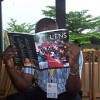
MALAWI: High-Risk Sex Among Those Who “Do Not Exist”
A study on men having sex with men (MSM) in Malawi shows that, as elsewhere in the developing world, this vulnerable group is at greater risk of contracting HIV and AIDS than the general population. Moreover, their risk status is exacerbated as governments fail to target them for health services or information to stem HIV transmission.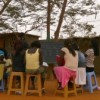
ANGOLA: Teenage School Programme Gives Drop Outs Second Chance at Education
Free primary education for all is an Angolan government policy, but unfortunately this has not translated into a reality that sees all children receiving education.RIGHTS-PAKISTAN: Displaced Women Finally Speak Out Against Taliban
"Burqa, burqa was all we heard [from the Taliban militants] in Swat, but when we ran, we were hardly covered and the whole world looked at us," said a woman from this conflict area, who now lives in a camp for the internally displaced people (IDPs).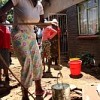
ZIMBABWE: No Water, Just a Bill
City council turns off the water. National minister in charge says turn it back on. Domestic and commercial users alike dispute their unpaid bills. The shadow of a cholera epidemic looms over it all. Must be Harare.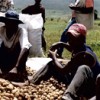
U.S.-AFRICA: Clinton Backs Agricultural Development
U.S. Secretary of State Hillary Clinton is using her trip to Africa to promote agricultural development as an approach to food aid which she has described as a "signature element" of the new Obama administration’s foreign policy.
RIGHTS-SOUTH AFRICA: Women Want Land to Call Their Own
In 1956, twenty thousand women marched to parliament to protest discriminatory pass laws. The march, commemorated as Women’s Day in South Africa on Aug. 9 each year, has become iconic of women’s quest for equality.
DRC: Respect and Protect Civilians
A government offensive against rebels in the eastern Democratic Republic of Congo that began in January has dramatically increased sexual violence in the provinces of North and South Kivu.HEALTH-AFRICA: Family Planning: Expand Role For Private Sector
Dwindling donor support in the face of rising contraceptive demand, combined with diminishing government budgets could make already widespread shortfalls in the provision of contraceptives worse. African reproductive health experts are suggesting that the private sector could be the key to filling the gap.
SWAZILAND: Govt in Court Over Property Rights
In a battle for gender equality, well-known Swazi women’s rights activist Doo Aphane has taken government to court. Aphane is contesting legislation that prohibits her from registering property in her maiden name jointly with her husband.
HEALTH-SOUTH AFRICA: Wheeling and Healing
Every weekday morning, a stylish procession leaves the offices of MaAfrika Tikkun NGO in Delft, Cape Town; bumps and jolts through the gravel entry gates; then hits the tar and scatters into every corner of the township...ZAMBIA: NGO Bill Still Inspires No Confidence
As the Zambian parliament resumes, civil society organisations (CSOs) have come out strongly to oppose the Non-Governmental Organisation (NGO) Bill, which seeks to regulate their operations.HEALTH-AFRICA: TB Vaccine In The Pipeline
For the first time in eighty years, a new Tuberculosis (TB) vaccine has entered the efficacy stage of a clinical trial. While the developers are optimistic about the outcome, lung health and TB experts are warning against being overly excited.
TANZANIA: Solutions to Dar's Water Problems in the Pipeline
In the nine months since she moved to the Dar es Salaam neighbourhood of Kinondoni, Anna Christopher has only seen water running from her taps once.WATER-TANZANIA: Who Pays the Piper?
When John Rubara* and his family moved into their new house in Dar es Salaam's Tabata Kimanga, a fast-growing middle-income neighbourhood in Temeke district, the water company disconnected their supply because the previous owner was in arrears.
HEALTH-AFRICA: Early ART: A Stitch in Time…
A global call to put people living with HIV on antiretroviral therapy (ART) at an earlier stage of their illness is intensifying, but most developing countries, especially in Africa, are struggling to meet the current recommendations.
ZIMBABWE: Water Rationing Looms in Bulawayo
Bulawayo city council is to tighten a water rationing programme relaxed last year because residents are rapidly pushing up the city's daily consumption by using municipal water supplies for non-domestic activities.« Previous Page — Next Page »





The Week with IPS

NEXT STOP - SDGs
Tracking global progress towards a sustainable world
Tracking global progress towards a sustainable world
