Languages
Sunday, November 8, 2026



News and Views from the Global South
Active Citizens

Opinion: From New York to Addis Ababa, Financing for Development on Life Support – Part One
Lack of ambition and consensus in the New York negotiations begs the question of whether governments in Addis Ababa will salvage or further dilute the outcome of the Third International Conference on Financing for Development from July 13-16.
“Why Hire a Lawyer When You Can Buy a Judge?”
A woman is stopped at a checkpoint; she gives birth, and dies. Another is sold in a slave market. A boy is killed by a tank. A young man drowns at sea, trying to reach a haven safe from oppression and poverty.Civil Society has Vital Role to Play in Post-2015 Development Agenda
“The action of the private sector can make or break the post-2015 development agenda,” Karmenu Vella, European Commissioner for Environment, Maritime Affairs and Fisheries, said in his opening remarks at a side event hosted in the context of a high-level political forum at the U.N. on Tuesday.
Will the New BRICS Bank Break with Traditional Development Models, or Replicate Them?
Just days ahead of a summit of the BRICS group of emerging economies (Brazil, Russia, India, China and South Africa) in which the five countries are expected to formally launch their New Development Bank (NDB), 40 NGOs and civil society groups have penned an open letter to their respective governments urging transparency and accountability in the proposed banking process.
Opinion: SDGs, FfD and Every Single Dollar in the World
Ethiopia will host an important meeting on Financing for Development (FfD) Conference next week. One of the most-asked questions is: How much will it cost us to achieve the Sustainable Development Goals (SDGs)?
Opinion: The End of the Greek Tragedy?
The decisive result of the Greek referendum held Jul. 5, in which voters overwhelmingly rejected (61.3 to 38.7 percent) the terms of an international bailout, has opened a new chapter not only for the future of Greece, but also in terms of the essence of the European Union itself.
Despite Scepticism, U.N. Hails Its Anti-Poverty Programme
The United Nations, which launched one of its most ambitious anti-poverty development programmes back in 2000, has hailed it as a riveting success story – despite shortcomings.
Opinion: Religion and the SDGs – The ‘New Normal’ and Calls for Action
In 2007, an op-ed in the International Herald Tribune argued that you “gotta have faith in the U.N”.
Equality, a Hard Game to Win for Women Footballers in Argentina
During a women’s football match in a poor neighbourhood in Buenos Aires, team manager Mónica Santino has to stop the game and ask a group of boys and young men not to invade the pitch where they’re playing. This frequent occurrence is just one symbol of a struggle being played out, centimeter by centimeter, on Argentina’s pitches.
Caribbean Fights to Protect High-Value, Declining Species
Threats from climate change, declining reefs, overfishing and possible loss of several commercial species are driving the rollout of new policy measures to keep Caribbean fisheries sustainable.
Sustainable Use of Biodiversity Could Fill Gap When Belo Monte Dam Is Finished
Some argue that the sustainable use of biodiversity is the best alternative for local development in the area surrounding the enormous Belo Monte hydroelectric dam, now that the construction project is entering its final phase on the Xingú River in Brazil’s Amazon jungle.
Financial Transaction Tax Could Boost New Development Goals
Ever since the Monterrey Consensus on Financing for Development in March 2002 called for new and innovative strategies to complement traditional Official Development Assistance (ODA), various financial instruments have been discussed.
Opinion: If You’re Against Coal Mining, Walk In and Stop It
“If you’re against coal mining, why don’t you just walk into a coal mine and stop the excavators?”
Poor Bear the Brunt of Corruption in India’s Food Distribution System
Chottey Lal, 43, a daily wage labourer at a construction site in NOIDA, a township in the northern Indian state of Uttar Pradesh, is a beleaguered man. After a gruelling 12-hour daily shift at the dusty location, he and his wife Subha make barely enough to feed a family of seven.
Black Women in the Americas Launch Decade of Struggle
They say they are tired of waiting for justice after centuries of neglect and contempt due to the color of their skin. Black women leaders from 22 countries of the Americas have decided to create a political platform that set a 10-year target for empowering women of African descent and overcoming discrimination.
U.S. Urged to Ramp up Aid for Agent Orange Clean-Up Efforts in Vietnam
A key senator and a D.C.-based think tank are calling for Washington to step up its aid in cleaning up toxic herbicides sprayed by the United States in Vietnam during the war that ended 40 years ago.
Rome March Celebrates Pope’s Call for Urgent Climate Action
People of faith, civil society groups, and communities affected by climate change marched together in Rome Sunday Jun. 28 to express gratitude to Pope Francis for the release of his Laudato Si encyclical on the environment, and call for bolder climate action by world leaders.
Ghosts Of War Give Way to Development in Sri Lanka
It is an oasis from the scorching heat outside. The three-storey, centrally air-conditioned Cargills Square, a major mall in Sri Lanka’s northern Jaffna town, is the latest hangout spot in the former warzone, where everyone from teenagers to families to off-duty military officers converge.
Fracking Expands Under the Radar on Mexican Lands
“People don’t know what ‘fracking’ is and there is little concern about the issue because it’s not visible yet,” said Gabino Vicente, a delegate of one of the municipalities in southern Mexico where exploration for unconventional gas is forging ahead.Billions Pledged for Nepal Reconstruction – But Still No Debt Relief
A major donor conference in Nepal’s capital, Kathmandu, came to a close on Jun. 25 with foreign governments and aid agencies pledging three billion dollars in post-reconstruction funds to the struggling South Asian nation.
Helping People with Disabilities Become Agents of Change
Participation, political and economic empowerment, inclusion, accessible technology and infrastructure as well as indicators for meaningful implementation are among the key issues persons with disabilities want to see reflected in the Sustainable Development Goals (SDGs).« Previous Page — Next Page »





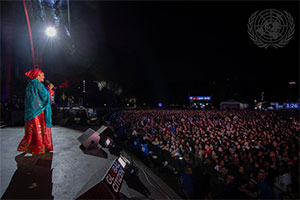 Global Citizen Festival in New York. Credit: UN Photo/Eskinder Debebe
Active citizens are committed to social change because they know that it is achievable. However, major political challenges face active citizens across the world. For example, in authoritarian regimes in Latin America where the hegemonic party has been in power for decades on end, protestors and human rights activists face enormous repression and struggle to materialize their advocacy into concrete results. The same can be said for Africans, where a shift towards elected government in recent decades has yet to translate into an effective voice in decision-making. Now, the Strengthening Citizen Demand for Good Governance, which uses evidence-based approaches – funded by DFID's Governance and Transparency Fund – seeks to raise their voices.
In 2025, the CIVICUS Monitor’s People Power Under Attack report revealed that civic freedoms are severely limited in 122 of 198 countries and territories, and only 7.2% of the global population now lives in countries where civic space is open. Through partnership with the Overseas Development Institute (ODI) and CIVICUS, IPS reporters across the continent will seek to define the extent and limits of state capability, government accountability and the responsiveness of leaders to the needs of citizens.

The Week with IPS

NEXT STOP - SDGs
Tracking global progress towards a sustainable world
Tracking global progress towards a sustainable world
