Languages
Sunday, November 8, 2026



News and Views from the Global South
Active Citizens

U.N. Security Council Takes “Historic” Stand on Killings of Journalists
When war breaks out, most non-combatants run the other way. But a handful of courageous reporters see it as their duty to tell the world what's happening on the ground. And many pay a high price.
Opinion: Internet Should be Common Heritage of Humankind – Part II
The Internet – and the applications that it has spawned – is the single most important technological innovation that has brought together and interlinked humankind in a real, tangible and interactive way.
Laissez Faire Water Laws Threaten Family Farming in Chile
Family farmers in Chile are pushing for the reinstatement of water as a public good, to at least partially solve the shortages caused by the privatisation of water rights by the military dictatorship in 1981.
Pineapple Industry Leaves Costa Rican Communities High and Dry
Twelve years after finding the first traces of pesticides used by the pineapple industry, in the rural water supply, around 7,000 people from four communities in Costa Rica’s Caribbean region are still unable to consume their tap water.
Q&A: Papua New Guinea Reckons With Unmet Development Goals
As Papua New Guinea celebrates 40 years of independence, 2015 marks a defining year for the largest Pacific Island nation, set to record 15 percent GDP growth this year.
Failure of Review Conference Brings World Close to Nuclear Cataclysm, Warn Activists
After nearly four weeks of negotiations, the Nuclear Non-Proliferation Treaty (NPT) Review Conference ended in a predictable outcome: a text overwhelmingly reflecting the views and interests of the nuclear-armed states and some of their nuclear-dependent allies.
School Gardens Combat Hunger in Argentina
In Argentina, where millions of families have unmet dietary needs despite the country’s vast expanse of fertile land, the Huerta Niño project promotes organic gardens in rural primary schools, to teach children healthy eating habits and show them that they can grow their own food to fight hunger.
Bougainville: Former War-Torn Territory Still Wary of Mining
From Arawa, once the capital city of Bougainville, an autonomous region in eastern Papua New Guinea in the southwest Pacific Ocean, a long, winding road leads high up into the Crown Prince Ranges in the centre of the island through impenetrable rainforest.
Opinion: Voice of Civil Society Muffled in Post-2015 Negotiations for Better Future
In September, the United Nations will agree on new Sustainable Development Goals (SDGs) which will set development priorities for the next 15 years. The draft goals that have been developed are ambitious – they seek to end poverty and ensure no one is left behind.
Opinion: New World Information Order, Internet and the Global South – Part I
More than four decades ago, the Non-Aligned Movement (NAM) launched the concept of a New International Information Order (NIIO).
Climate Change: Some Companies Reject ‘Business as Usual’
When it comes to climate change, business as usual is simply “not an option”.
Pakistan’s Streets Kids Drop the Begging Bowl, Opt for Pencils Instead
Khalil Ahmed's life story sounds like it could have come straight out of the plot of a Bollywood flick, but it didn’t. And that makes it all the more inspiring.
Opinion: Bangladesh’s Persecuted Indigenous People
The August 2014 killing of Timir Baran Chakma, an indigenous Jumma activist, allegedly in Bangladeshi military custody, was protested by his supporters. His death, and the failure of justice, like the plight of his people across the Chittagong Hills region, received little international notice.
Development Threatens Antigua’s Protected Guiana Island
In June 2014, Gaston Browne led his Antigua and Barbuda Labour Party to a resounding victory at the polls with a pledge to transform the country into an economic powerhouse in the Caribbean.
Opinion: Edinburgh University Bows to Fossil Fuel Industry
The University of Edinburgh has taken the decision to not divest from fossil fuels, bowing to the short-term economic interests of departments funded by the fossil fuel industry, with little to no acknowledgement of the long-term repercussions of these investments.
Murders of Gays Raise the Question of Hate Crimes in Cuba
During the events surrounding the eighth annual celebration of the Day Against Homophobia in Cuba, it emerged that a young transsexual had recently been killed in the city of Pinar del Río near the western tip of this Caribbean island nation.
“Swachh Bharat” (Clean India) Requires a Mindset Change
“Swachh Bharat”, or Clean India, is a slogan that most Indians today associate with the country’s Prime Minister Narendra Modi and his first nation-wide campaign launched soon after taking office in 2014.
Indonesia Still a Long Way from Closing the Wealth Gap
Every afternoon, Wahyu sets up his wooden food cart by the side of a busy road in Central Jakarta to sell sweet buns, known as ‘bakpao’, to people passing by. In a good month, the street vendor can make around 800,000 rupiah, which amounts to roughly 62 dollars.
Campaign to End Sexual Violence Targets Civilian Peacekeepers First
“We can really argue as much as we want but if we put ourselves in the skin of victims, we just have to do something to stop this.”
NGOs Urge Post-2015 Declaration Include Water, Sanitation as Basic Human Rights
Virtually every major international conference concludes with a “programme of action” (PoA) – described in U.N. jargon as “an outcome document” – preceded by a political declaration where 193 member states religiously pledge to honour their commitments.
Popular Nigerian Author Calls on Americans to ‘Reject Silence’
Nigerian author Chimamanda Ngozi Adichie, co-curator of a spectacular World Voices week with over 100 African writers, closed the May 4-10 event with an admonition.« Previous Page — Next Page »





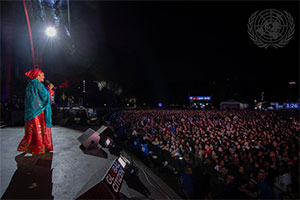 Global Citizen Festival in New York. Credit: UN Photo/Eskinder Debebe
Active citizens are committed to social change because they know that it is achievable. However, major political challenges face active citizens across the world. For example, in authoritarian regimes in Latin America where the hegemonic party has been in power for decades on end, protestors and human rights activists face enormous repression and struggle to materialize their advocacy into concrete results. The same can be said for Africans, where a shift towards elected government in recent decades has yet to translate into an effective voice in decision-making. Now, the Strengthening Citizen Demand for Good Governance, which uses evidence-based approaches – funded by DFID's Governance and Transparency Fund – seeks to raise their voices.
In 2025, the CIVICUS Monitor’s People Power Under Attack report revealed that civic freedoms are severely limited in 122 of 198 countries and territories, and only 7.2% of the global population now lives in countries where civic space is open. Through partnership with the Overseas Development Institute (ODI) and CIVICUS, IPS reporters across the continent will seek to define the extent and limits of state capability, government accountability and the responsiveness of leaders to the needs of citizens.

The Week with IPS

NEXT STOP - SDGs
Tracking global progress towards a sustainable world
Tracking global progress towards a sustainable world
