Languages
Wednesday, November 11, 2026



News and Views from the Global South
Active Citizens

Egypt Marks a Spring for Islamists
Egyptians are deeply divided and the majority are dissatisfied with the performance of Islamist President Mohamed Morsi, but also have little confidence in the main opposition figures or their future, a new poll has found.
Cancelling Fare Hike Fails to Quell Brazil Protests
Children of a generation that fought for basic rights like having enough to eat, learning to read and being treated in safer hospitals, the over 300,000 students protesting on the streets of Brazil want more from a democratic and economic system that no longer represents them and is beginning to show its limitations.
Arab Americans Aim at Preserving New York’s Little Syria
A brick red, six-story tenement house, St. George Melkite Church and a community house in desperate need of repair are nearly all that remain of a once thriving Arab-American community in downtown New York City.
U.S., EU Urged to Press Harder for Reform in Bahrain
Human rights groups here are calling for the United States and the European Union (EU) to exert more pressure on Bahrain, home to the U.S. Navy's Fifth Fleet, to seriously engage its opposition and end its repression of its majority Shi'a population.
Cambodia’s Opposition Fights Back
The violence that defined Cambodia during the years of the Khmer Rouge (1975-1979) may have been relegated to the realm of history, but the actions of the ruling party ahead of the Jul. 28 election smack of the dirty politics that once ruled this Southeast Asian country.Swiss Doorways to Refugees Narrow
Once more, Swiss voters have lashed out against asylum seekers, further tightening the country's already strict asylum law. The government has meanwhile announced a radical restructuring of the asylum procedure.
Resurgence of Indigenous Identity in the Crossfire in Brazil
The powerful tractors and other farm machinery that landowners recently used to block roads at a dozen points from north to south in Brazil illustrated the economic clout of big agriculture, which rose up against the demarcation of indigenous reserves.
Estonia Not on the Refugee Way
For asylum seekers, Estonia is the least attractive country in the European Union, so the numbers say. According to Eurostat only 75 people last year asked for protection in this country that borders Russia and Finland. Local human rights activists suspect that many of those in need for help are turned down at the border without getting a chance to ask for asylum.
Rural Mexican Communities Protest Wind Farms
"We can't sow our fields, which they have rented for next to nothing. What good do we get out of it?" Guadalupe Ramírez complained about wind farms operating in the southern Mexican state of Oaxaca.
Redoubling Efforts Against Racism in Cuba
Jokes, songs, crude gestures and epithets that degrade people of African descent are still common in Cuba, despite the fact that the constitution prohibits discrimination based on skin colour, and in spite of more recent political measures, activists say.
Corruption Eats Into India’s Food Distribution System
As India’s Parliament prepares to pass a bill to provide heavily subsidised food to 810 million people, there are misgivings over its implementation through a notoriously corrupt public distribution system (PDS).
Group Highlights Broken Families in Anti-Deportation Protest
As the debate on immigration reform continues in the Senate and fractured talks persist about the future of 11 million undocumented migrants, one New York-based group took to the streets to ask their senator a question.
Small Ponds Bring Bumper Harvests
“I would never have believed it possible to get a bumper rice harvest during the drought season,” 43-year-old Mohammad Shajahan Ali, a farmer hailing from the village of Magtapur in Bangladesh’s northern Chapainawabganj district, told IPS.
Iranians Vote for Hope and a Change of Course
Iran's Jun. 14 presidential election results, announced the day after voting was held, were nothing less than a political earthquake.
Award Spotlights Indian Women Helping Women
Jassiben, a self-employed potter from Nana Shahpur village in western India, loves summer despite the heat waves and frequent power cuts, because summer days always mean great business.
Legal Pressure Increases on Unpaid Internships in U.S.
A landmark court decision this week has challenged the controversial existence of unpaid internships, highlighting calls for greater clarity on the legal definition of an internship.
Outrage Over Safety Issues at Indian Nuke Plant
The Tirunelveli district in the southern Indian state of Tamil Nadu may seem idyllic, dotted with lush green fields, but upon closer inspection one sees signs of a battle that does not appear to be abating.
TerraViva Comes to FAO
Dear Reader: TerraViva, a special publication of the IPS news agency, the leader in coverage of development issues, civil society and the emerging South, is once again circulating, this time in the meeting rooms and hallways of the FAO building.
Former War Zone Craves Democracy
For the first time since Sri Lanka’s 30-year-long civil conflict drew to a bloody finish in May 2009, casting an eerie hush over the Northern Province that had grown accustomed to the sounds of war, there is a buzz in the air generated by the prospect of provincial elections that hold the promise of radical change.
The “Secret Treasure” of Food Waste
Twenty-nine-year-old Andrzej W. and his partner lived for almost a year off of food found in the trash bin of the upscale supermarket Piotr i Pawel in Muranow, a neighbourhood near the centre of the Polish capital Warsaw. And they ate in style.
India Goes Bananas Over GM Crops
India’s environmental and food security activists who have so far succeeded in stalling attempts to introduce genetically modified (GM) food crops into this largely farming country now find themselves up against a bill in parliament that could criminalise such opposition.« Previous Page — Next Page »





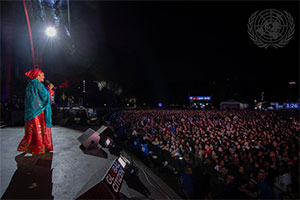 Global Citizen Festival in New York. Credit: UN Photo/Eskinder Debebe
Active citizens are committed to social change because they know that it is achievable. However, major political challenges face active citizens across the world. For example, in authoritarian regimes in Latin America where the hegemonic party has been in power for decades on end, protestors and human rights activists face enormous repression and struggle to materialize their advocacy into concrete results. The same can be said for Africans, where a shift towards elected government in recent decades has yet to translate into an effective voice in decision-making. Now, the Strengthening Citizen Demand for Good Governance, which uses evidence-based approaches – funded by DFID's Governance and Transparency Fund – seeks to raise their voices.
In 2025, the CIVICUS Monitor’s People Power Under Attack report revealed that civic freedoms are severely limited in 122 of 198 countries and territories, and only 7.2% of the global population now lives in countries where civic space is open. Through partnership with the Overseas Development Institute (ODI) and CIVICUS, IPS reporters across the continent will seek to define the extent and limits of state capability, government accountability and the responsiveness of leaders to the needs of citizens.

The Week with IPS

NEXT STOP - SDGs
Tracking global progress towards a sustainable world
Tracking global progress towards a sustainable world
