Languages
Saturday, November 14, 2026



News and Views from the Global South
Active Citizens

Security Council Vow on Women Lives Mostly on Paper
When the U.N. Security Council (UNSC) adopted a landmark resolution numbered 1325 back in 2000, it was supposed to integrate gender into its core mandate: the establishment and maintenance of international peace and security.
Nepal Unprepared for Imminent Earthquakes
Nepal now ranks 11th on a list of the world’s most earthquake-prone countries, yet it remains one of the least disaster-prepared nations globally.India Reaffirms Death Penalty
One day after voting against a United Nations General Assembly draft resolution seeking to abolish the death penalty, India executed Pakistani national Mohammad Ajmal Kasab for the November 2008 terror rampage in Mumbai that left 166 people dead.
Keeping African Roots Alive in Brazil
A Nigerian diviner dances and sings next to a Brazilian priest of the Candomblé religion, brought to this South American country by African slaves, that is now being rescued from oblivion in school texts on national history and culture.
Ethiopia Throttles Rights Organisations
The world received contradictory signals about Ethiopia’s human rights record when in the same week it was elected to the United Nations Human Rights Council, a major German charity closed its Ethiopian office in protest against a restrictive political environment.
Sustainable Fashion Born in Brazil’s Favelas
A Brazilian designer has taken fashion from the exclusivity of the catwalk to the reality of the favela, to demonstrate that styles, trends and fads are also born in these poor neighborhoods of cities like Rio de Janeiro.
An Agreement For Peace Means a Promise of Tourism
International travellers may soon get to enjoy the scenic spots and rich cultural heritage of Muslim Mindanao, the Philippines’ southernmost island group, without the threat of being caught in the crossfire of the region’s conflict.
Q&A: “Solidarity and Mutual Aid” Key to Operation Sandy
Dee Knight experienced Hurricane Sandy in several different capacities. As a reporter and an organiser, not only did he report on the aftermath of the hurricane, but he was also a part of "Occupy Sandy", a response to the hurricane based on solidarity and charity.
Colombians Hope for Peace, But Are Sceptical
Scepticism, fear of expressing an opinion and a dash of hope make up the cocktail of responses from Colombians asked about the possibility of the decades-old civil war finally coming to an end as a result of the peace talks between the government and the FARC guerrillas, which began Monday in Havana.Search for Missing Daughters in Mexico Drives Families into Ruin*
The families of thousands of girls and women who have disappeared in Mexico are spending everything they have in the search for their daughters – and for justice.
Fixing the ‘Silent’ Sanitation Crisis
Organisers of this year’s World Toilet Day, which falls on Nov. 19, are using the slogan ‘I give a shit – do you?’ to break the silence around the crucial issue of sanitation and remind the international community that 2.5 billion people around the world don’t have access to clean and private toilets.
Bangladesh Eyes Drug Export Market
Bangladesh has begun to shed its image as one of the world’s poorest nations and make a reputation for itself as a major exporter of cheap generic drugs to over 85 countries.
How Austerity Plans Failed the European Union
The austerity programmes being rolled out in virtually every member state of the European Union (EU) - particularly in Greece, Portugal, Spain and Italy - have failed to reach their stated objective of consolidating public finances in order to solve sovereign debt crises.Citizens’ Tribunal Brings Charges Against Mexican President
Conservative outgoing Mexican President Felipe Calderón is to face a ballot again - not to compete for public office but to receive the verdict of a citizens' trial that is accusing him of violating the constitution.
Aluminium Industry Has Its Defenders in Brazil
Aluminium, opposed by environmentalists mainly because of the amount of energy needed to produce it, is one of the targets of the heated campaign against hydroelectric dams in Brazil’s Amazon jungle region.
Soy and Sugar Cane Fuel Native Land Conflicts in Brazil
The threat of mass suicide by native Guaraní-Kaiowá people in southwest Brazil brought to light a new formula for worsening conflicts over indigenous territory: the expansion of the cultivation of soy beans and sugar cane, two top export crops.
Some U.S. Farmworkers Face “Inhuman Conditions”
A widely respected advocate for U.S. farmworker rights received a prestigious award on Capitol Hill here Wednesday, using the occasion to highlight pending state legislation that could significantly improve lives and working conditions that some have likened to modern-day slavery.
Family Planning Skips Millions in Pakistan
Thirty-year-old Shahida Saleem, who was not educated past the tenth grade, is a mother of two, living with her family in Karachi. Six months ago she suffered a miscarriage and her doctor, concerned about her anaemic condition, advised her to space out her next pregnancy by taking contraceptives.
Unsafe Abortions Threaten Thousands in Eastern Europe
Pressure from the Catholic Church, social stigma, a lack of information about sexuality and reproductive health and limited access to reproductive healthcare services are putting the lives of hundreds of thousands of women across Eastern Europe at risk.
Soup Kitchens Overwhelmed in Crisis-Ridden Spain
A huge pot of rice steams on the stove at the soup kitchen run by Emaús in the municipality of Torremolinos, on the outskirts of this southern Spanish city. This morning, like every other, Pepi, Adriana and Diego are cooking for over a hundred people who can no longer afford to feed themselves.
Racism Is Bad for Health
If a black woman and a white woman both need emergency obstetric care, a Brazilian doctor will assist the white woman because of the stereotype that black women are better at handling pain and are used to giving birth.« Previous Page — Next Page »


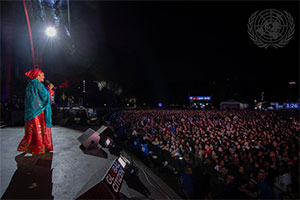 Global Citizen Festival in New York. Credit: UN Photo/Eskinder Debebe
Active citizens are committed to social change because they know that it is achievable. However, major political challenges face active citizens across the world. For example, in authoritarian regimes in Latin America where the hegemonic party has been in power for decades on end, protestors and human rights activists face enormous repression and struggle to materialize their advocacy into concrete results. The same can be said for Africans, where a shift towards elected government in recent decades has yet to translate into an effective voice in decision-making. Now, the Strengthening Citizen Demand for Good Governance, which uses evidence-based approaches – funded by DFID's Governance and Transparency Fund – seeks to raise their voices.
In 2025, the CIVICUS Monitor’s People Power Under Attack report revealed that civic freedoms are severely limited in 122 of 198 countries and territories, and only 7.2% of the global population now lives in countries where civic space is open. Through partnership with the Overseas Development Institute (ODI) and CIVICUS, IPS reporters across the continent will seek to define the extent and limits of state capability, government accountability and the responsiveness of leaders to the needs of citizens.

The Week with IPS

NEXT STOP - SDGs
Tracking global progress towards a sustainable world
Tracking global progress towards a sustainable world
