Languages
Saturday, October 17, 2026



News and Views from the Global South
Active Citizens

Making African Palm Oil Production Sustainable
“In San Lorenzo they cut down the jungle to plant African oil palms. The only reason they didn’t expand more was that indigenous people managed to curb the spread,” Ecuadorean activist Santiago Levy said during the World Conservation Congress.
When It Comes to Conservation, Size Matters
When the communities living in the Tatamá y Serranía de los Paraguas Natural National Park in the west of Colombia organised in 1996 to defend their land and preserve the ecosystem, they were fighting deforestation, soil degradation and poaching.
Without Indigenous People, Conservation Is a Halfway Measure
“You don't convert your own house in a tourist site,” said Oussou Lio Appolinaire, an activist from Benin, wearing a traditional outfit in vivid yellows and greens. He was referring to opening up to tourists places that are sacred to indigenous people.
Mexico, a Democracy Where People Disappear at the Hands of the State
“Go and tell my dad that they’re holding me here,” Maximiliano Gordillo Martínez told his travelling companion on May 7 at the migration station in Chablé, in the southern Mexican state of Tabasco. It was the last time he was ever seen, and his parents have had no news of him since.
Tracing War Missing Still a Dangerous Quest in Sri Lanka
As Sri Lanka readies to begin the grim task of searching for thousands of war missing, those doing the tracing on the ground say that they still face intimidation and threats while doing their work.
The UN Must be at the Forefront of the fight for Civic Rights
The United Nations’ Universal Declaration of Human Rights of 1948 provides the foundation for citizens’ rights to participate in shaping their communities.
133 Organisations Nominate Syria’s White Helmets for Nobel Peace Prize
Syria’s White Helmets - the volunteers who rescue civilians from collapsed buildings - could be the “most popular” nominee for the Nobel Peace Prize ever, according to human rights group, the Syria Campaign.
Peruvians Say “No!” to Violence Against Women
Peruvians took to the streets en masse to reject violence against women, in what was seen as a major new step in awareness-raising in the country that ranks third in the world in terms of domestic sexual violence.
The Counter Narrative to Terror and Violence is Already Among Us
The French philospher Voltaire once said that “if we believe in absurdities, we shall commit atrocities.” Indiscriminate killing of self and innocent others, ostensibly in the name of some religion, is among the most absurd of beliefs. And rather than ceasing, the spiral of violence appears to know no end. There appears to be no locus, and no focus, beyond random killing.
Native Plants Boost Local Diets in El Salvador
Juana Morales is cooking one of the most popular dishes in El Salvador: pupusas, corn tortillas with different fillings. But hers are unique: they are not made with the traditional corn tortillas, but use Maya nuts, a highly nutritional seed that has fallen out of use but whose consumption is being encouraged in rural communities.
Pan African Parliament Endorses Ban on FGM
After years of wrangling and debates among African leaders, the movement to end female genital mutilation (FGM) is gaining real momentum, with a new action plan signed this week by Pan African Parliament (PAP) representatives and the U.N. Population Fund (UNFPA) to end FGM as well as underage marriage.
“Non-lethal” Pellet Guns Maim Hundreds in Kashmiri Protests
Hospitals in Kashmir’s summer capital are packed to capacity these days, their wards overflowing with pellet gun victims injured during violent clashes with government forces.
Right to Education Still Elusive for Native People in Latin America
Education, the most powerful instrument in the struggle against exclusion and discrimination, is still elusive for indigenous people in Latin America who remain the most disadvantaged segment of the population despite their wide presence in the region.
The Next UN Secretary General Should Be a Woman – and Must Be a Feminist
The process for arguably the top political job on the planet is well underway. And the time is right for a woman and a feminist to take the helm.
UN Spotlight for Dark Shadow over Civil Society Rights
With more and more governments narrowing space for dissent and activism, the UN has emerged as a key platform to air concerns about acute rights violations and develop protections for civil society and other vulnerable groups.
Small Win for NGOs as UN Members Try to Exclude Critical Voices
An UN Committee responsible for giving non-government organisations (NGOs) UN accreditation has had one of its decisions overturned by other UN member states as it seems to be restricting NGOs which are perceived to be critical of governments.
No Medals for Sanitation at Rio Olympics
The biggest frustration at the Olympic Games, to be inaugurated in the Brazilian city of Rio de Janeiro on August 5, is the failure to meet environmental sanitation targets and promises in the city’s beaches, rivers, lakes and lagoons.
El Salvador Faces Dilemma over the Prosecution of War Criminals
The ruling of the highest court to repeal the amnesty law places El Salvador in the dilemma of deciding whether the country should prosecute those who committed serious violations to human rights during the civil war.
What can Development Banks do to Protect Human Rights?
In a petition signed by 150 NGOs, the Coalition for Human Rights in Development have called for development banks to make sure that human rights are respected by their beneficiaries.
Teachers and Students: Tip of Iceberg of Mexico’s Human Rights Crisis
Mexico is experiencing a monumental human rights crisis. There is abundant evidence of widespread human rights violations in the country, including torture, extrajudicial executions, enforced disappearances and violence against journalists and human rights defenders.
Civil Society Organizations Worried About Declining Involvement
Less than a year after the adoption of the global Sustainable Development Goals (SDGs), non-government organizations (NGOs) are concerned about declining possibilities for participation, both at the UN and in national politics.« Previous Page — Next Page »





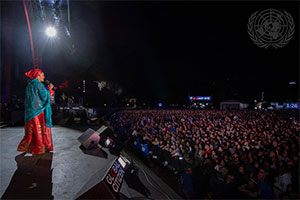 Global Citizen Festival in New York. Credit: UN Photo/Eskinder Debebe
Active citizens are committed to social change because they know that it is achievable. However, major political challenges face active citizens across the world. For example, in authoritarian regimes in Latin America where the hegemonic party has been in power for decades on end, protestors and human rights activists face enormous repression and struggle to materialize their advocacy into concrete results. The same can be said for Africans, where a shift towards elected government in recent decades has yet to translate into an effective voice in decision-making. Now, the Strengthening Citizen Demand for Good Governance, which uses evidence-based approaches – funded by DFID's Governance and Transparency Fund – seeks to raise their voices.
In 2025, the CIVICUS Monitor’s People Power Under Attack report revealed that civic freedoms are severely limited in 122 of 198 countries and territories, and only 7.2% of the global population now lives in countries where civic space is open. Through partnership with the Overseas Development Institute (ODI) and CIVICUS, IPS reporters across the continent will seek to define the extent and limits of state capability, government accountability and the responsiveness of leaders to the needs of citizens.

The Week with IPS

NEXT STOP - SDGs
Tracking global progress towards a sustainable world
Tracking global progress towards a sustainable world
