Languages
Tuesday, October 20, 2026



News and Views from the Global South
Conferences

The Global South Will Make Its Contribution to Fighting Climate Change
Seen for years as passive actors in the fight against global warming, more than 100 countries of the Global South have submitted their national contributions to reducing greenhouse gas emissions and decarbonising their economies.
CORRECTION/Who Will Pay the Price for Australia’s Climate Change Policies?
Rowan Foley has spent many years as a ranger and park manager, caring for Uluru–Kata Tjuta National Park Aboriginal lands in the spiritual heart of Australia’s Red Centre in the Northern Territory. He has been observing the effects of soaring temperatures and extreme weather events on his people, residing in some of the hottest regions of the country.
Latin American Scientists Call for More Human Climate Science
With the effects of global warming becoming more and more visible and the complicated socio-economic decisions indispensable to address this planetary crisis, science needs a new breed of experts: social scientists who specialise in climate change.
Despite Treaty, Conventional Arms Fuel Ongoing Conflicts
Despite last year’s Arms Trade Treaty (ATT), the proliferation of conventional weapons, both legally and illegally, continues to help fuel military conflicts in several countries in the Middle East and Africa, including Syria, Iraq, Sudan, South Sudan, Somalia, Libya and Yemen.
Water, Climate, Energy Intertwined with Fight Against Poverty in Central America
Central America’s toolbox to pull 23 million people – almost half of the population – out of poverty must include three indispensable tools: universal access to water, a sustainable power supply, and adaptation to climate change.
Latin America Should Lead in Protecting the Planet’s Oceans
Latin America should assume a position of global leadership by adopting effective measures to protect the oceans, which are threatened by illegal fishing, the impacts of climate change, and pollution caused by acidification and plastic waste.IMF Steps Up Lending to Achieve Sustainable Development
As the Third International Conference on Financing for Development opens in the Ethiopian capital, Addis Ababa, Monday, all eyes are on the United Nation’s post-2015 development agenda, billed as the most ambitious and far-reaching poverty eradication plan in the organisation’s history.Social Safety Net Not Wide Enough to Protect World’s Poor
Fifty-five percent of the world’s poor still have limited protection from hunger and economic, social or political crises despite expansion of social safety programmes in developing countries in recent years.
Black Women in the Americas Launch Decade of Struggle
They say they are tired of waiting for justice after centuries of neglect and contempt due to the color of their skin. Black women leaders from 22 countries of the Americas have decided to create a political platform that set a 10-year target for empowering women of African descent and overcoming discrimination.
German Development Cooperation Piggybacks Onto Africa’s E-Boom
In a major paradigm shift, the German government is now placing its bets on digitalisation for its development cooperation policy with Africa, under what it calls a Strategic Partnership for a ’Digital Africa’.Billions Pledged for Nepal Reconstruction – But Still No Debt Relief
A major donor conference in Nepal’s capital, Kathmandu, came to a close on Jun. 25 with foreign governments and aid agencies pledging three billion dollars in post-reconstruction funds to the struggling South Asian nation.
Donor Conference to Tackle Nepal Reconstruction
The 7.8 magnitude earthquake that shook Nepal in April, and the numerous aftershocks that followed, left the country with losses amounting to a third of its economy.
Q&A: Papua New Guinea Reckons With Unmet Development Goals
As Papua New Guinea celebrates 40 years of independence, 2015 marks a defining year for the largest Pacific Island nation, set to record 15 percent GDP growth this year.
Latin America’s Social Policies Have Given Women a Boost
Although they do not specifically target women, social policies like family allowances and pensions have improved the lives of women in Latin America, the region that has made the biggest strides so far this century in terms of gender equality, although there is still a long way to go.
Q&A: “People Need to Be at the Centre of Development”
In a populous archipelago nation like Indonesia, where 250 million live spread across some 17,500 islands, speaking over 300 languages, the question of development is a tricky one.
Q&A: Comprehensive Ban on Nuclear Testing, a ‘Stepping Stone’ to a Nuke-Free World
With the four-week-long review conference of the Nuclear Non-Proliferation Treaty (NPT) underway at the United Nations, hopes and frustrations are running equally high, as a binding political agreement on the biggest threat to humanity hangs in the balance.
Latin America Slow to Pledge Emissions Cuts
Latin America is making heavy weather of setting targets for greenhouse gas emissions reduction, which all countries must present ahead of the United Nations Framework Convention on Climate Change (UNFCCC) conference later this year.
Rural Women in Latin America Define Their Own Kind of Feminism
Rural organisations in Latin America are working on defining their own concept of feminism, one that takes into account alternative economic models as well as their own concerns and viewpoints, which are not always in line with those of women in urban areas.

Latin America Heralds New Era with United States
Latin America presented its own recipes for development in the new era of relations with the United States in the Seventh Summit of the Americas, where Cuba took part for the first time and the U.S. said it would close the chapter of “medd[ling] with impunity” in its neighbours to the south.
Economic Slowdown Threatens Progress Towards Equality in Latin America
Predictions of a sharp slowdown in Latin America’s economic growth this year make it even more necessary for the region’s leaders to make commitments to boost prosperity with equality during the Seventh Summit of the Americas, currently taking place in the Panamanian capital.Opinion: Challenging the Power of the One Percent
When you are faced with the task of moving an object but find it is too heavy to lift, what is your immediate and most natural response? You ask someone to help you lift it. And it makes all the difference.« Previous Page — Next Page »





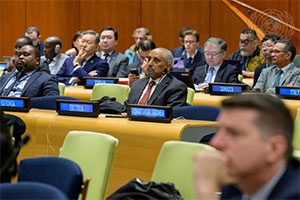 General Assembly Meets to Hear Briefing on UN80 Initiative. Credit: UN Photo/Manuel Elías
Global development conferences are continuing to produce critical frameworks for South-South cooperation and multilateral reform. In January of 2024, the 3rd Global South Nexus (GSN) International Conference was held in Odisha, India, with its theme being “Creating Responsible Professionals for Advancing SDGs: Inputs from Global North and South.” The 2025 UN SDG Report provided a midpoint assessment of the 2030 Agenda, with only 35% of targets on track and 18% having reversed. The 2025 UN Climate Change Conference (COP30) in Belém, Brazil, agreed to mobilize $1.3 trillion annually for climate action by 2035, operationalize the loss and damage fund, triple adaptation finance, and launched the Belém Mission to 1.5°C. In 2025, the Partnership for Economic Policy (PEP) convened its annual Policy Conference in Nairobi, Kenya, addressing the issue of “Financing and Inclusivity in Green Energy Transition in the Global South.” As the Global South advocates increasingly for a South-South framework alongside North-South cooperation, international conferences on sustainability aim to bridge economic and social divides between developed and developing countries in achieving the UN SDGs. Furthermore, to mark the UN’s 80th anniversary, the UN80 Initiative was launched to reshape how the UN system works so that every mandate, dollar, and decision creates greater impact for the global system.

The Week with IPS

NEXT STOP - SDGs
Tracking global progress towards a sustainable world
Tracking global progress towards a sustainable world
