Languages
Thursday, November 19, 2026



News and Views from the Global South
Civil Society

From Religious Conflict to an Interfaith Community
Holy men and their holy books have etched a trail of tears and blood in the annals of human history. From the depths of peaceful temples, mobs have been dispatched with flaming torches; from steeples and minarets messages of hatred have floated down upon pious heads bent in prayer. For too long religion has incited violence and fueled conflict.Survivors of Sexual Violence Deserve More Than Just Talk
“States must make concrete commitments to enable and protect women human rights defenders, so that they can safely and securely carry out their work in support of victims of sexual and gender-based violence,” Amnesty International told the Global Summit on Ending Sexual Violence in Conflict that wound up Friday in London.
Search for Nigerian Girls May be Impeded by Government’s Longstanding Lack of Coherent Strategy
The search for the Nigerian schoolgirls abducted by Islamist extremist group, Boko Haram, could be hampered by a series of policy and information flip-flops by the government, the latest one of them being a public disagreement on policy between the president and the military chief.
Costa Rica Holds Out Hope for LGBT Rights in Central America
Grey-haired gay activist Marco Castillo and his partner Rodrigo Campos are about to enjoy equal health care rights. For the first time in Costa Rica, and in Central America as a whole, homosexual couples will enjoy the same access to public health services as heterosexuals.
Ghost of the LTTE Flickers in Malaysia
The recent arrest and deportation from Malaysia of three Sri Lankan Tamils on U.N. refugee status, under suspicion of trying to revive the disbanded Liberation Tigers of Tamil Eelam (LTTE), has raised questions about regional security and minority politics.
Future of Peace Talks in Colombian Voters’ Hands
Colombians will basically decide Sunday whether to continue the five decade counterinsurgency war or persevere in the attempt to negotiate a political solution to the conflict, in order to allow the children being born this year to experience what their parents have never known: a country at peace.
Chile’s Patagonia Celebrates Decision Against Wilderness Dams
The Chilean government rejected Tuesday the controversial HidroAysén project for the construction of five hydroelectric dams on rivers in the south of the country. The decision came after years of struggle by environmental groups and local communities, who warned the world of the destruction the dams would wreak on the Patagonian wilderness.
Op-Ed: First Decolonisation, Now ‘Depatriarchilisation’
At the end of this week leaders of the Group of 77 and China will meet in Bolivia to commemorate the 50th anniversary of the group.
Train on the Move to Unite Basques, Scots and Catalans
"Around 150,000 showed up to claim that we, Basques, want to decide the future of this country,” Urtzi Urrutikoetxea, journalist, writer and member of the Basque people’s organisation Gure Esku Dago (GED), told IPS after on the 123-kilometre long human chain “for the right to decide” organised Sunday.Quest for Self-Determination Continues in New Caledonia
Since the French overseas territory of New Caledonia in the South Pacific was reinstated on the United Nations Decolonisation List in 1986, the indigenous Kanak people have struggled not only against socio-economic disadvantages, but also for the right to determine their political future after more than a century of colonialism.
When Nature Gets a Price Tag
How much does a forest cost? What’s the true economic value of an ocean? Can you pay for an alpine forest or a glacial meadow? And – more importantly – will such calculus save the planet, or subordinate a rapidly collapsing natural world to market forces?
Nature Is Talking And Africa’s Legislators Are Listening
Africa's climate change legislative frameworks, though a step in the right direction, have come under fire for not being ambitious enough to meet the challenge of a changing climate.
Q&A: Developing World Leads in Advancement of Climate Change Laws
Developing countries in Africa, Asia and Latin America are increasingly leading the way in providing a legal framework for climate security and are being hailed for their continued advancement in formulating climate change laws and policies.Brazil, Football and Protests
It is unlikely that Brazilians will listen to the audacious call made by Michel Platini – a great player in his time and now the politicking president of the Union of European Football Associations (UEFA) – on Apr. 26: “Brazil, make an effort for a month, calm down!”
Indian Legislators Wake Up to Climate Change
Ramanjareyulu, a 55-year-old farmer from the southern India state of Andhra Pradesh, has been struggling to find his feet ever since inadequate rainfall dealt a blow to his harvest of groundnut and red gram (a pulse crop that grows primarily in India).
Anti-Poverty Activists Welcome G7’S Renewed ‘Commitment’
Activists working to alleviate poverty worldwide gave a guarded welcome to the renewed commitment to development that G7 leaders made during their meeting in Brussels this week.
Mexico’s Biodiversity Under Siege
The Las Cruces hydroelectric project in the northwestern state of Nayarit is one of the threats to biodiversity in Mexico, according to activists.
A Common Vision – The Abolition of Militarism
On this Friday, June 6, people from all corners of the world gather here in Sarajevo, Bosnia, to explore a plethora of ideas on the road forward to a world in peace.
Triple Summit in Singapore Puts Urban Planning on the Map
With over 20,000 international participants, a triple summit wrapping up today in Singapore is generating an abundance of ideas on sustainable cities.Palestinian Unity Causing Political Ripples in Washington
The announcement this week of a new Palestinian unity government was greeted with cautious optimism by most of the world, outside of Israel. In the United States, however, it set off political rumblings that threaten to swell into a storm.
Kenya’s Climate Change Legislation Takes Shape To Save Struggling Farmers
Daniel Njau, a small-scale farmer from Nyeri County, central Kenya, is torn. He just may have to give up his six-hectare tea plantation in favour of farming climate-resilient food crops.« Previous Page — Next Page »


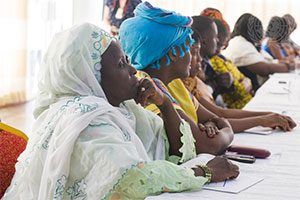 Representatives of Civil Society, Sierra Leone. Credit: UN Photo/Eskinder Debebe
Civil society faces mounting threats worldwide, even as it remains essential for democratic accountability, especially in countries struggling with economic instability and social inequality. However, at the same time, nations with weak democratic governance structures also systemically suppress the power of civil society. Human rights activists across the Global South frequently challenge issues such as political persecution and gender oppression, but in return face state-sanctioned punishment for their advocacy. Imprisonment and exile are common mechanisms of punishment that seek to erode the strength of civil society. The 2026 World Press Freedom Index has reached its lowest level in 25 years, with more than half of the world’s countries now falling into the "difficult" or “very serious” category for press freedom. IPS seeks to highlight the work of civil society across the Global South as well as the challenges that they face.
Updated by Yilan Batista and Shuli Wong August 2026

The Week with IPS

NEXT STOP - SDGs
Tracking global progress towards a sustainable world
Tracking global progress towards a sustainable world
