Languages
Thursday, November 19, 2026



News and Views from the Global South
Civil Society

U.S. Corporate Conflict Minerals Reports “Historic” But Incomplete
For the first time, nearly 1,300 U.S. companies have filed reports on whether the products they manufacture or sell are made with minerals that have bankrolled conflict in the Great Lakes region of central Africa.
Low-Wage Workers Butt Heads with 21st Century Capital
“Supersize my salary now!” The refrain rose over a busy street outside a McDonald’s in downtown Seattle.
Internet Censorship Floods Serbia
Waters have receded in Serbia after the worst flooding the country has seen in 120 years, and something new has surfaced, apart from devastated fields and property – censorship of the internet.
More Than Generals and Troglodytes in Egypt
Unconsciously or not, most mainstream media and foreign correspondents here have been echoing Muslim Brotherhood voices by depicting Egypt's new president, Abdel Fattah Al Sisi, as the general who led the July 2013 “military coup” against the “legitimately elected” Islamist leader Mohamed Morsi.
Legislation Alone Will Not Address Africa’s Climate Challenges
Despite a raft of legislation dealing with the environment, African countries are still falling short when it comes to enforcing the legal instruments that respond to challenges posed by climate change, researchers say.
Mexico – Both Victim and Victimiser in Cyberespionage
A lack of controls, regulation and transparency marks the monitoring and surveillance of electronic communication in Mexico, one year after the revelations of cyberespionage shook the world.
Syrians Flock to Vote in Lebanon… But Not in The West
Roughly three kilometres north of Beirut's Syrian embassy in Baabda, Syrians crammed in one of an endless stream of buses, exited and continued on foot. The masses opted to walk the remaining few kilometres rather than sit in a traffic jam generated by the tens of thousands flocking to vote.
Separatist Violence Just One of Ukraine’s Problems
As Ukraine’s president elect Petro Poroshenko prepares to begin his presidency, Ukrainians are hoping he will not forget that separatist violence is just one of a long list of problems he needs to help solve in the country.

Turkey’s Accession To European Union – A Long and Bumpy Road
Since 2004, the Independent Commission on Turkey (ICT) has watched closely developments within Turkey and between Turkey and the European Union (EU). On April 7 the ITC launched its third report, Turkey in Europe: The Imperative for Change.
Low Turnout and Disenchanted Youth Blot Sisi’s Victory in Egyptian Elections
With a result already known before the race started, many did not even bother heading to the polling stations and the streets in Cairo were unusually empty during the election process that ended Wednesday, just like the ballot boxes.

Rural Communities Push El Salvador Towards Ban on Mining
Mining is not viable in this country, say Salvador Sánchez Cerén - who will be sworn in as the new president of El Salvador on Jun. 1 - and his team of environmental advisers.
Malawi’s President Joyce Banda Gains Support for ‘Fraudulent Election’ Recount
When Malawi's President Joyce Banda said that last week's elections were fraudulent and riddled with rampant irregularities, social media went viral calling her a loser.
Women Journalists Seize Initiative in Gaza
“We let the men participate in the workshop discussions, but the training sessions are only for women journalists,” says Mona Khadir, who coordinates the activities of the Filastiniyat Women Journalists’ Club in Gaza.
Ugandan Lawyer Revolutionises Access to Justice with Just an iPhone and Facebook
When Gerald Abila received an iPhone as a gift almost two years ago, the Ugandan law student didn’t just use it to text his friends. He used it to create what would eventually become the first entity of its kind in East Africa — a tech savvy, multi-award winning, organisation that uses Facebook, Twitter, SMSes, and radio and television partnerships to provide free legal advice and consultations.
Where Will The New Europe Go?
“An era can be said to end when its basic illusions are exhausted” is a phrase from Arthur Miller which applies well to the European elections that have just ended. What those elections showed was that disenchantment with Europe as an ideal has grown to a dangerous point.
Burundi Headed for Election Turmoil as Ruling Party Allegedly Arms Youth Wing
Burundi could be heading for political violence ahead of the 2015 elections amid allegations that the ruling National Council for the Defence of Democracy-Forces for Defence of Democracy (CNDD-FDD) has been arming its youth wing.
Wary of Climate Change, Indonesia Looks to Lawmakers for Solutions
Comprised of over 17,000 islands that are highly susceptible to rising seas, Indonesia is taking stock of its position as the world’s third leading emitter of greenhouse gases after the United States and China.
Protests Threaten to Paralyse Brazil Ahead of World Cup
As the FIFA World Cup approaches, the streets of Brazil are heating up with strikes and demonstrations, and there are worries that the social unrest could escalate into a wave of protests similar to the ones that shook the country in June 2013.
EU Elections Overheat The Burning Catalonian Debate
The debate on Catalonian efforts to become a sovereign state independent from Spain has become the centre of the otherwise tedious European Parliament elections campaign this month.
U.S. Pledges to Reduce Child Stunting by Two Million Globally
The U.S. government has pledged to reduce the number of chronically malnourished children around the world by at least two million over the next half decade, receiving an initial positive response from the development community.
Peaceful Transitions From The Nuclear To The Solar Age
Japanese Buddhist and president of Soka Gakkai International (SGI) Daisaku Ikeda’s Peace Proposal 2014 elevated my focus from the daily news to my longer term concerns for more peaceful, equitable and sustainable human societies to assure our common future. These broader concerns are now shared by millions of humans who have transcended purely personal, local and nationalistic goals and become prototypical global citizens.« Previous Page — Next Page »


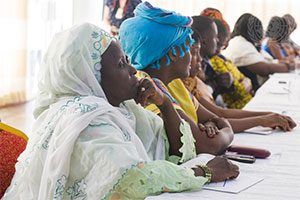 Representatives of Civil Society, Sierra Leone. Credit: UN Photo/Eskinder Debebe
Civil society faces mounting threats worldwide, even as it remains essential for democratic accountability, especially in countries struggling with economic instability and social inequality. However, at the same time, nations with weak democratic governance structures also systemically suppress the power of civil society. Human rights activists across the Global South frequently challenge issues such as political persecution and gender oppression, but in return face state-sanctioned punishment for their advocacy. Imprisonment and exile are common mechanisms of punishment that seek to erode the strength of civil society. The 2026 World Press Freedom Index has reached its lowest level in 25 years, with more than half of the world’s countries now falling into the "difficult" or “very serious” category for press freedom. IPS seeks to highlight the work of civil society across the Global South as well as the challenges that they face.
Updated by Yilan Batista and Shuli Wong August 2026

The Week with IPS

NEXT STOP - SDGs
Tracking global progress towards a sustainable world
Tracking global progress towards a sustainable world
