Languages
Monday, October 19, 2026



News and Views from the Global South
Aid

U.S. Boosts Sudan Aid as Humanitarian Crisis Deepens
In a memorandum released Tuesday, President Barack Obama ordered the State Department to allocate additional humanitarian assistance funds for Sudan as famine looms for thousands of civilians caught between intensified levels of armed conflict along the borders of Sudan and South Sudan.
Chad Famine – Mothers Breaking Apart Anthills in Search of Food
"Only God knows what will happen to me and my children - for two months there's been nothing to eat. We're living like beggars," Henriette Sanglar, a mother of four in the Moursal quarter of the Chadian capital, N'Djamena, told IPS.
The Forgotten Emergency in Sudan’s Blue Nile State
Hamid Yussef Bashir said he walked for 17 days with his wife and five children to get to a refugee camp in South Sudan. Here in Jamam, they joined about 37,000 other people who fled from the war across the border in Sudan’s Blue Nile state.
No Settlement in Sight as Syria Violence Intensifies
As Western governments reexamine their options for ending the ongoing violence in Syria, Kofi Annan, U.N.-Arab League special envoy to Syria, briefed diplomats Friday at the U.N. Security Council, who remain divided over whether a negotiated ceasefire or direct intervention will be necessary, or even feasible.
Shelters Don’t Shelter Haiti’s Needy
Almost half of the emergency shelters distributed by the British organisation Tearfund in the mountains above Léogâne remain uninhabited six months after they were built.
Humanitarian Disaster Unfolding in South Sudan
Less than a year since South Sudan's independence, thousands of people in the region continue to face the stark realities of secession.
Q&A: Group Founded by Rape Survivors Lifts Up Haitian Women
In Haitian refugee camps, women are still crammed under plastic or cloth tarps that provide no security and quickly become overheated by the sun. Sexual abuse, harassment, assault and rape run rampant, even as political responses to these dangers have stalled. But KOFAVIV, a women's organisation founded by and for rape survivors, offers a glimmer of hope.
Washington Struggles to Find a Path Forward on Syria
As the Syrian army has stepped up its attacks against opposition strongholds in Homs and elsewhere, the U.S. and its allies have achieved little consensus in choosing a course of action to oust President Bashar al-Assad.
Syria’s Chemical Weapons Trigger New Threats in War Zone
As the besieged government of President Bashar al-Assad continues to violently suppress the warring political opposition in Syria, the United Nations has expressed "concern" over reports "on the possible existence of chemical weapons" in the embattled Middle Eastern country.
Temporary Toilets Threaten Permanent Damage in Haiti – Part 2
Complete with gallery and garden, the 534 wood and plasterboard houses are arranged in neat rows on a gravel plot of former sugarcane land northwest of the capital.
Money for Cleaning Toilets in Haiti Down the Drain? – Part 1
The drawdown of hundreds of non-governmental organisations which have been in Haiti since the disastrous 2010 earthquake was inevitable. But with their departure, so too goes their purse and the millions earmarked for cleaning latrines.Japanese Women Empowered By Tohoku Quake
Devastating as the Tohoku earthquake was it gave the local women of the remote region an opportunity to come into their own and take on leadership roles in an essentially patriarchal country.Green Credit Scarce in Latin America
In Latin America, where bank loans for environmentally sustainable activities are rare, the United Nations Environment Programme (UNEP) is seeking to foment green credit.
Simple Steps to Improving Aid Effectiveness
As donors struggle to meet their aid commitments, and the number of people around the world in need of direct humanitarian and development assistance skyrockets, many experts and activists are asking the tough question: are donors being effective?Little Money to Promote Gender Equality in Eastern Europe
Despite pushes from international bodies such as the United Nations (UN) or the European Union (EU) to promote gender equality in Central and Eastern Europe, access to funding for such initiatives remains largely conditional upon national governments’ willingness to embrace this agenda.North Korea’s Pivot
After three years of frozen relations between North Korea and the United States, the two longstanding adversaries are on the verge of a thaw.
Brazil, Emerging South-South Donor
The Brazilian government is stepping up South-South aid, to strengthen the South American giant’s status as a donor country and its international clout. It now provides assistance to 65 countries, and its financial aid has grown threefold in the last seven years.
Chile’s Earthquake Reconstruction Hindered by Delays and Profiteering
Two years after the earthquake and tsunami in south-central Chile, the worst natural disaster to hit the country in half a century, thousands of families who saw their homes destroyed are still waiting for a solution.
Drought in Sahel Affects Urban Cameroonians
Sala Aminata, a housewife from the Logone and Shari Division in Cameroon’s Far North Region, looks at her six kids with apprehension as she tries to figure out how to feed them with her meagre salary.
Syria Stalls Senior U.N. Official’s Visit to War Zone
The United Nations, which remains politically deadlocked over the drawn-out crisis in Syria, has hit another roadblock, this time over humanitarian assistance to the thousands of men, women and children caught up in the 11-month-old conflict.
Correcting the Record of Haiti’s Earthquake
The world reacted swiftly to Haiti's catastrophic 7.0 earthquake in 2010. The United States shipped in 20,000 troops, some to perform lifesaving medical procedures, others to protect aid workers from earthquake victims deemed dangerous. Movie stars, criminals and other prospective parents rushed to adopt motherless Haitian babies.« Previous Page — Next Page »





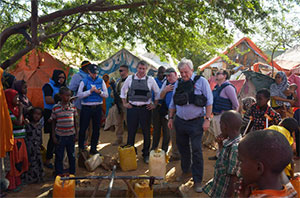 UN Emergency Relief Coordinator Visits Somalia. Credit: UN Photo/Tobin Jones
In recent years, conflicts have broken out across the world with no sign of slowing down or stopping. In times like this, millions of people globally are in dire need of humanitarian aid. Famine, warfare, natural disasters, and economic decline plague a host of nations, including Palestine, Sudan, Chad, Lebanon, and Haiti, to name a few. Humanitarian aid provides millions of people with critical services including healthcare, food, clean drinking water, psychosocial support, housing, and access to education. UN agencies such as the UNDP, UNICEF, the World Food Programme (WFP), UNHCR, UNRWA, and UNEP work with the UN Office for the Coordination of Humanitarian Aid (OCHA) and local organizations to come up with the best possible strategies to support affected communities. At the same time, humanitarian aid and those working on the frontlines are consistently threatened by both actors directly involved in conflict as well as those who are meant to contribute to the international humanitarian regime at large. The near-collapse of United States international aid structures in 2025, including the termination of 83% of USAID’s 6,300 global initiatives, has left millions of people without access to vital humanitarian assistance. 98 million people in 2025, only 65% of people targeted for humanitarian assistance, received the help they needed. In contrast, 123 million people received some form of humanitarian assistance in 2024, and OCHA’s 2026 Global Humanitarian Overview estimates that 239 million people are in need of assistance in 2026. IPS is well-positioned to discuss current initiatives to provide aid and relief through in-depth reporting and opinion content.

The Week with IPS

NEXT STOP - SDGs
Tracking global progress towards a sustainable world
Tracking global progress towards a sustainable world
