Languages
Monday, October 19, 2026



News and Views from the Global South
Aid

Correcting the Record of Haiti’s Earthquake
The world reacted swiftly to Haiti's catastrophic 7.0 earthquake in 2010. The United States shipped in 20,000 troops, some to perform lifesaving medical procedures, others to protect aid workers from earthquake victims deemed dangerous. Movie stars, criminals and other prospective parents rushed to adopt motherless Haitian babies.
Q&A: Climate Funding Needs Gender Equity
Gender considerations remain largely disregarded in existing climate funds, even though women are some of the hardest hit by the impacts of climate change on livelihoods and agriculture.U.S.: Obama’s 2013 Budget Slashes Aid for Working Families
The federal budget for fiscal year 2013 proposed by President Barack Obama severely cuts aid for working families by targeting at least two programmes, the Community Services Block Grant (CSBG) and Project-Based Rental Assistance (PBRA), that aid the nation's most vulnerable working families.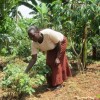
Rural Women Are Leading the Way – Will the World Follow? – Part 2
The United Nations’ 56th session of the Commission on the Status of Women (CSW) begins today in New York, with the empowerment of rural women high on a list of priorities for this year.Drought in Sahel Affects Urban Cameroonians
Sala Aminata, a housewife from Logone and Shari Division in Cameroon’s Far North Region, looks at her six kids with apprehension as she tries to figure out how to feed them with her meagre salary.NGOs Urge “Solution from Within” For Somalia
While the international community discusses Somalia's future in London and Brussels, European and Somali non-governmental organisations are calling for a radical shift from a military to a humanitarian approach as the only solution to the country's war-torn condition.
Q&A: How to Reverse the “Feminisation of Poverty”
The phrase "financing for gender equality" may sound dry, but it lies at the heart of some of the most intractable problems faced by women around the world today – and whether the political will exists to allocate real resources to solving them or simply pay lip service.GUATEMALA: Zero Hunger Plan Must Focus on Production, Experts Say
“We don’t want a repeat of welfare-oriented programmes, because they are unsustainable,” said Rony Palacios of the National Network for the Defence of Food Sovereignty in Guatemala, criticising President Otto Pérez Molina’s Zero Hunger plan.
Op-Ed: How Gender Values Point the Way for a More Effective U.N.
A growing list of U.N. Security Council Resolutions acknowledges the importance of gender in processes for peace. Resolutions 1325, 1820, 1888, 1889 and 1960 note that women continue to be marginalised in peace negotiations and their potential is not fully utilised in humanitarian planning, peacekeeping operations, peace building, governance and reconstruction.
Q&A: ‘World Bank in Tiger Territory – No Greenwashing’
BANGKOK, Feb 20, 2012 (IPS) - When World Bank president Robert Zoellick steps down in June, the tiger will lose an ally who worked to prevent the decimation of Asia’s iconic animal by a voracious demand for its bones and parts in newly affluent China.Mozambique Prepares for Dangerous Cyclone Giovanna
Over 100,000 people in Mozambique are still recovering from losing their homes and crops, and from being cut off from schools and shops after a tropical storm and cyclone hit the southern African country in January. But the worst may not be over as another dangerous cyclone is expected to make landfall Friday evening as emergency stocks run low.“A Catastrophic Year” as Hunger Crisis Looms over Sahel
Seven out of the eight governments in the Sahel – the arid zone between the Sahara desert in North Africa and Sudan’s Savannas in the south – have taken the unprecedented step of declaring emergencies as 12 million people in the region are threatened by hunger.MAURITANIA: Ravaged by Drought – the Number of Malnourished Children Rises
Mariem Mint Ahmedou sits cross-legged on a worn-out carpet in a basic tent built with mud bricks and layers of sewn-together fabric. Her eight-month-old twins, Hussein and Hassan, lie weakly against her body. Both of them have been malnourished since birth, because Beydar, undernourished herself, cannot produce enough breast milk to feed them.Renewed Push in U.S. to Arm Syrian Rebels
What with rumours from Israel of war on Iran, a major showdown with the Egyptian military over the indictments of government- funded U.S. activists in Cairo, and continuing political paralysis in Iraq, you would think President Barack Obama has enough Middle East crises to deal with.ZIMBABAWE: Not Prepared for Floods Amid Conflicting Weather Forecasts
Sibongile Dube knows the devastation heavy rain can leave in its wake. A villager in the lowveld area of Mberengwa in Zimbabwe’s Midlands province, Dube’s home is one of many that were washed away by flash floods last year.DEVELOPMENT-NIGER: Three Million Children Threatened by Hunger
Women have been left in charge of many of the households in the village of Zamkoye-Koïra, in western Niger, as food shortages have driven male family members to leave in search of work elsewhere. A national survey of vulnerable households shows that 5.4 million people face food insecurity across Niger.UNICEF Funding Falls Short Leaving Millions of Children at Risk
If the United Nations Children’s Fund (UNICEF) had 1.28 billion dollars it could help 97 million people around the world.SOUTH SUDAN: Still Counting the Dead in Inter-Ethnic Conflict
In the ward of a partially destroyed clinic, Mangiro (who did not give his last name) sat on a bed next to his wounded nine-year-old daughter, Ngathin. The little girl is fortunate, she survived the recent inter-ethnic clashes in Pibor county that killed her mother and sisters.
SOUTH SUDAN: Refugees Reluctant to Move to Safety as War Looms
In the sprawling settlement of Yida, just south of the Sudan border, more than 20,000 people have gathered after fleeing battles in the country's Southern Kordofan state. But they now find themselves caught up in a new conflict, as recent clashes along the frontier have some warning of the possibility of war.
Political Will – and Money – Needed for Disaster Management
Managing the impact of increased disasters due to climate change will only be possible if such efforts are led by local communities, say non-governmental organisations working in climate change.
SOMALIA: Aid Dwindles, Disease Spreads
Doctors in Mogadishu are warning that famine victims in internally displaced camps have become vulnerable to contagious diseases like cholera and measles, as conditions here are ripe for an outbreak. This comes as internally displaced persons complain that relief aid to some camps has dwindled or stopped.« Previous Page — Next Page »





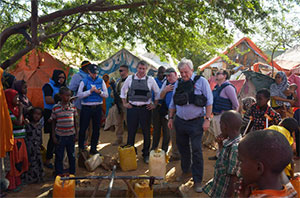 UN Emergency Relief Coordinator Visits Somalia. Credit: UN Photo/Tobin Jones
In recent years, conflicts have broken out across the world with no sign of slowing down or stopping. In times like this, millions of people globally are in dire need of humanitarian aid. Famine, warfare, natural disasters, and economic decline plague a host of nations, including Palestine, Sudan, Chad, Lebanon, and Haiti, to name a few. Humanitarian aid provides millions of people with critical services including healthcare, food, clean drinking water, psychosocial support, housing, and access to education. UN agencies such as the UNDP, UNICEF, the World Food Programme (WFP), UNHCR, UNRWA, and UNEP work with the UN Office for the Coordination of Humanitarian Aid (OCHA) and local organizations to come up with the best possible strategies to support affected communities. At the same time, humanitarian aid and those working on the frontlines are consistently threatened by both actors directly involved in conflict as well as those who are meant to contribute to the international humanitarian regime at large. The near-collapse of United States international aid structures in 2025, including the termination of 83% of USAID’s 6,300 global initiatives, has left millions of people without access to vital humanitarian assistance. 98 million people in 2025, only 65% of people targeted for humanitarian assistance, received the help they needed. In contrast, 123 million people received some form of humanitarian assistance in 2024, and OCHA’s 2026 Global Humanitarian Overview estimates that 239 million people are in need of assistance in 2026. IPS is well-positioned to discuss current initiatives to provide aid and relief through in-depth reporting and opinion content.

The Week with IPS

NEXT STOP - SDGs
Tracking global progress towards a sustainable world
Tracking global progress towards a sustainable world
