Languages
Tuesday, October 20, 2026



News and Views from the Global South
Aid
THAILAND: Bangkok Braces for Month of Floods
As the Thai Airways flight descends into Suvarnabhumi International Airport, passengers pull out cameras to snap pictures of flood waters rising inexorably and predicted to inundate the capital city by the end of the week.
AFRICA: Gov’ts Fail to Invest in Hungriest, Poorest Regions
For millennia, people have coped with drought in the Horn of Africa, comprised mainly of drylands. Yet today, more than 13 million people there are starving because of political instability, poor government policies and failure to invest in the world's poorest people, say experts here in Changwon.
SUDAN: Bombing the Homeless
Hawa Jundi sat on the ground outside a makeshift shelter where she and her family now live. A violent storm was moving in and lightning streaked toward the earth as the wind began blowing hard against the tarpaulin tied to a frame of sticks.World Bank Reveals Crippling Donor Dependency in West Bank, Gaza
The World Bank drew attention to the ongoing devastation wrought by one of the world's longest standing conflicts with the publication Monday of a report documenting high levels of donor dependency in the Israeli-occupied West Bank and Gaza Strip.Biofuels, Speculators Driving Food Price Surges
A new report on global hunger pinpoints factors at the heart of spikes in food prices it says are exacerbating the unfolding food crisis in the Horn of Africa.
SOMALIA: Rape – The Hidden Side of the Famine Crisis
When Aisha Diis* and her five children fled their home in Somalia seeking aid from the famine devastating the region, she could not have known the dangers of the journey, or even fathom that she would be raped along the way.Somalia’s Al-Shabaab Vows More Attacks
Al-Shabaab has vowed to carry out more attacks in Mogadishu following a vehicle bomb blast that killed scores of people in the Somali capital.Give Women the Seeds and They Can Feed the World
If women farmers were given more tools and resources, the number of hungry people in the world could be slashed by 100 to 150 million.US: Expanding Network of Drone Bases To Hit Somalia, Yemen
As Somalia undergoes its worst famine in six decades and Yemen slides into civil war, the administration of President Barack Obama is expanding its network of bases to carry out drone strikes against suspected terrorists in both countries, according to reports published in two major U.S. newspapers Thursday.Palestinians Face Large Cuts in U.S. Aid
With a vote on the Palestinians' status at the United Nations scheduled for next week, the Barack Obama administration has made its opposition to any upgrade of Palestinian status in the world body quite clear.
SOMALIA: Armed Militia Grab the Famine Business
Armed groups are withholding aid and preventing Somali famine refugees from leaving camps to ensure the continued supply of food by aid agencies that they are presently selling on the open market.
SOMALIA: Food Aid Stolen From Famine Victims
Masses of food meant for famine victims in Somalia are being stolen, an investigation has revealed.Watchdogs Blast Ethnic Cleansing in South Kordofan
On Jun. 19, Angelo al-Sir, a subsistence farmer from a small village east of Kadugli, capital of the oil-rich South Kordofan state in Northern Sudan, saw his pregnant wife, two of his 10 children, his nephew and another relative killed in an airstrike in broad daylight.
HAITI: Patchy Healthcare Adds to Miseries of Women and Girls
"I just gave birth on the ground...I had no drugs for pain during delivery," one Haitian mother tells Human Rights Watch (HRW) in a report released Tuesday that says a year and a half after the country's devastating earthquake, women and girls are still facing gaps in access to available healthcare services necessary to stop preventable maternal and infant deaths.
Haiti’s Earthquake Victims: ‘Abandoned Like Stray Dogs’
Eighty thousand tiny houses dot the countryside near this coastal city, located just west of the epicentre of the Jan. 12, 2010 earthquake that killed some 200,000 and displaced over one million.OP-ED: Expanding Deserts, Falling Water Tables and Toxins Driving People from Homes
People do not normally leave their homes, their families, and their communities unless they have no other option. Yet as environmental stresses mount, we can expect to see a growing number of environmental refugees. Rising seas and increasingly devastating storms grab headlines, but expanding deserts, falling water tables, and toxic waste and radiation are also forcing people from their homes.LIBYA: No ‘Mission Accomplished’ Claimed in Washington Yet
While the apparent end of Muammar Gaddafi’s 42-year reign over Libya was greeted with considerable satisfaction here Monday, no one was prepared to declare "mission accomplished", particularly given the looming questions around what happens next.Evidence Mounts of War Crimes Unfolding in Sudan
Witnesses reported that attacks continue on civilian populations in Sudan, even as the United Nations calls for a thorough investigation into violations of international law carried out in South Kordofan state in June.
SOMALIA: Massive School Dropouts As Famine Continues
Jamaal Abdi, an eight-year-old boy at the Badbaado camp on the outskirts of Mogadishu, would like to have an education. He has his own dreams for the future.
SOMALIA: City in Need of More Aid
The shelling and gunshots, once a common sound in Mogadishu, no longer ring out in the city's streets. The surprise withdrawal on Aug. 6 of the Islamist extremist group Al Shabaab from their stronghold in Mogadishu has meant that people now move about the city, for the first time in two years, without fear of constant attack.
Q&A: Climate-Driven Migrants Raise Thorny Legal Issues
As the effects of accelerating climate change ripple outward, pushing millions from their land and homes, experts warn that international human rights and refugee law needs to catch up to the reality on the ground if migrants are to be given adequate protection and support.« Previous Page — Next Page »





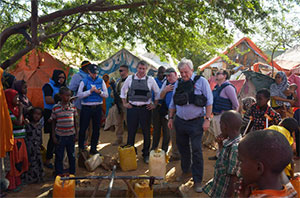 UN Emergency Relief Coordinator Visits Somalia. Credit: UN Photo/Tobin Jones
In recent years, conflicts have broken out across the world with no sign of slowing down or stopping. In times like this, millions of people globally are in dire need of humanitarian aid. Famine, warfare, natural disasters, and economic decline plague a host of nations, including Palestine, Sudan, Chad, Lebanon, and Haiti, to name a few. Humanitarian aid provides millions of people with critical services including healthcare, food, clean drinking water, psychosocial support, housing, and access to education. UN agencies such as the UNDP, UNICEF, the World Food Programme (WFP), UNHCR, UNRWA, and UNEP work with the UN Office for the Coordination of Humanitarian Aid (OCHA) and local organizations to come up with the best possible strategies to support affected communities. At the same time, humanitarian aid and those working on the frontlines are consistently threatened by both actors directly involved in conflict as well as those who are meant to contribute to the international humanitarian regime at large. The near-collapse of United States international aid structures in 2025, including the termination of 83% of USAID’s 6,300 global initiatives, has left millions of people without access to vital humanitarian assistance. 98 million people in 2025, only 65% of people targeted for humanitarian assistance, received the help they needed. In contrast, 123 million people received some form of humanitarian assistance in 2024, and OCHA’s 2026 Global Humanitarian Overview estimates that 239 million people are in need of assistance in 2026. IPS is well-positioned to discuss current initiatives to provide aid and relief through in-depth reporting and opinion content.

The Week with IPS

NEXT STOP - SDGs
Tracking global progress towards a sustainable world
Tracking global progress towards a sustainable world
