Languages
Thursday, November 5, 2026



News and Views from the Global South
Education
Aboriginal Businesses Stimulate Positive Change in Australia
Roy Roger Gibson, an indigenous Kuku Yalanji elder, would watch thousands of tourists and vehicles trampling his pristine land while working on the sugarcane fields in Far North Queensland. His people were suffering and their culture was being eroded. The native wildlife was disappearing. He dreamt of turning this around.
Fighting Extremism with Schools, Not Guns
As a wave of outrage, crossing Pakistan’s national borders, continues a month after the Dec. 16 attack on a school in the northern Khyber Pakhtunkhwa province, some citizens are turning away from collective expressions of anger, and beginning the hard work of building grassroots alternatives to terrorism and militancy.
From Bullets to Ballots: The Face of Sri Lanka’s Former War Zone
In four months’ time, Sri Lanka will mark the sixth anniversary of the end of its bloody civil conflict. Ever since government armed forces declared victory over the Liberation Tigers of Tamil Eelam (LTTE) on May 19, 2009, the country has savored peace after a generation of war.
Caribbean Youth Ready to Lead on Climate Issues
At 24 years old, Stefan Knights has never been on the side of those who are sceptical about the reality and severity of climate change.
Pacific Islands Call for New Thinking to Implement Post-2015 Development Goals
As the Millennium Development Goals (MDGs), a set of poverty-alleviation targets set by the United Nations, come to a close this year, countries around the world are taking stock of their successes and failures in tackling key developmental issues.
Escape Route Towards Social Inclusion for War-Disabled Gazan Youth
The Israeli attacks that the Gaza Strip has suffered in recent years have left in their wake a large number of young people who have come up against a further barrier to their creative energies – physical disability caused by military aggression.
Humanity’s Future: Below Replacement Fertility?
Is below replacement level fertility the future for humanity? The answer to this seemingly simple question regarding human reproduction is not only of considerable demographic concern, but also has enormous social, economic and environmental consequences for the planet.
Boko Haram Insurgents Threaten Cameroon’s Educational Goals
“I’d quit my job before going to work in a place like that.” That is how a primary school teacher responded when IPS asked him why he had not accepted a job in Cameroon’s Far North region.
Women ‘Sewing’ a Bright Future in Northern Pakistan
At 46, Naseema Nashad is starting her life over, not out of choice but out of necessity. The Afghan woman was just 25 years old when Taliban militants stormed Kabul and her family was forced to flee to neighbouring Pakistan to escape what they knew would be a brutal regime.
OPINION: Global Citizenship, A Result of Emerging Global Consciousness
Globalisation is an integral feature of modernity. It already has significantly advanced to transform local experiences into global ones, to unify the disparate villages of the world into a global community, and to integrate national economies into an international economy.
Illiteracy Wears a Woman’s Face in El Salvador
At the age of 74, Carmen López has proven that it’s never too late to learn. She is one of the 412 people in this small town in central El Salvador who recently learned to read and write.Syrian Students on the Frontline of Conflict
While millions around the world are celebrating the dawn of a new year and the promise of change, hundreds of thousands of Syrian children have little reason to hope that 2015 will bring better days.
India’s ‘Manual Scavengers’ Rise Up Against Caste Discrimination
Watching Bittal Devi deftly weave threads of different colours into a vibrant patchwork quilt, it’s hard to imagine that this 46-year-old’s hands have spent the better part of their life cleaning toilets.
Sri Lanka Still in Search of a Comprehensive Disaster Management Plan
About six months after a massive tsunami slammed the island nation of Sri Lanka on Dec. 26, 2004, large plumes of smoke could be frequently seen snaking skywards from the beach near the village of Sainathimaruthu, just east of Kalmunai town, about 300 km from the capital, Colombo.
OPINION: Understanding Education for Global Citizenship
Education for Sustainable Development (ESD) brings together concerns about the environment, economic development and social aspects. Since 1972, when the first U.N. Conference on the Human Environment was held in Stockholm, Sweden, there has been increasing awareness of the intricate link between conserving the environment and human development.
OPINION: We Have So Much to Learn From Cuba
Earlier this month, President Barack Obama announced the restoration of diplomatic relations with Cuba after more than five decades of a misguided policy which my uncle, John F. Kennedy, and my father, Robert F. Kennedy, had been responsible for enforcing after the U.S. embargo against the country was first implemented in October 1960 by the Eisenhower administration.
For Zimbabweans, Universal Education May be an Unattainable Goal
Zimbabwe boasts of one of the highest rates of literacy across Africa but, but without free primary education, achieving universal primary education here may remain a pipe dream, educationists say.
School Dropout Rate Soars for Afghan Refugees
“Our children quitting school is the greatest pain we have suffered during our troublesome lives here,” says Multan Shah, a vegetable-seller in a shantytown of Peshawar, the capital of Khyber Pakhtunkhwa, one of Pakistan's four provinces.
OPINION: Give Peace a Chance – Run with Youth
Rambang “Raymond” Tot Deng was 18 and attending his final year of school when fighting erupted in South Sudan’s capital Juba, one year ago. In the ensuing violence, as Raymond’s schoolbooks burned, thousands of South Sudanese were killed, including two of his cousins.
Nigeria Struggles to Care for its Adolescents Living With HIV
 HIV among teenagers is devastating families in Nigeria and elsewhere in Africa, where AIDS has become the No. 1 killer of adolescents.

CORRECTION/Filipino Children Make Gains on Paper, But Reality Lags Behind
Mae Baez sees some of the darkest sides of communications technology.« Previous Page — Next Page »





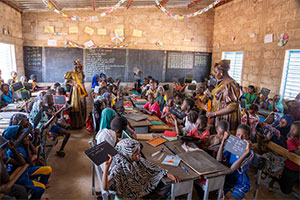 Two teachers work in a classroom in Forces Vives School in Dori, Burkina Faso. Credit: UNICEF/UNI978361
Safe and uninterrupted education is a fundamental right for all children. Education is paramount to global development, as it has been proven that investing in education – especially for girls and children – contributes significantly to economic growth and prosperity. Although more than 1 billion children go to school, many are subjected to conditions that are not conducive to a proper learning environment, including makeshift facilities, a lack of supplies, violence in classrooms, inadequate sanitation, untrained instructors, and widespread school closures. Since 2015, there have been immense gains in education with an increase of 109 million children in school. However, as of 2023, 272 million children are still out of school.
High poverty levels in developing countries also impede children’s access to a proper education. For example, from the early to mid 2000s, Sub-Saharan African nations witnessed a dramatic decline in trained teachers due to inadequate funding in the education sector. Furthermore, major cuts to United States international aid threaten an estimated 23 million additional children's access to education, as USAID‑funded school programmes across Africa and Asia face closure.
Various other factors contribute to the decline of education, notably hunger, which has increased as conflict and climate change interfere with global food production and dissemination. Meanwhile, certain social and cultural practices also impede children’s access to education, with gender inequality, discrimination, child labour, and child marriages preventing millions of children from attending school. Economic conditions such as the inaccessibility of higher education also affect disenfranchised communities across the world. In extreme situations, such as warfare where educational facilities are destroyed in their totality, notably in Gaza and Sudan, entire generations of children might grow up without access to education. Rebuilding educational infrastructure is a long and arduous process, especially when violence persists across generations, and this significantly stunts the development of societal prosperity and stability.
IPS is dedicated to telling the shocking truths about worldwide education through impassioned opinion pieces and comprehensive articles, highlighting global issues that impede worldwide education and the courses of action being taken by organizations such as UNICEF and Education Cannot Wait.

The Week with IPS

NEXT STOP - SDGs
Tracking global progress towards a sustainable world
Tracking global progress towards a sustainable world
