Languages
Thursday, November 5, 2026



News and Views from the Global South
Education

CORRECTION/Filipino Children Make Gains on Paper, But Reality Lags Behind
Mae Baez sees some of the darkest sides of communications technology.
Want Economic Growth? Lessen Inequality
For years, many policy makers, including economists, have clung to the belief that if states do nothing to boost income equality, market forces will cause wealth to trickle down to the poorest citizens and contribute to overall growth.
Mangrove Conservation Paves the Way to a Sustainable Future
 When the Asian tsunami washed over several Indian Ocean Rim countries on Boxing Day 2004, it left a trail of destruction in its wake, including a death toll that touched 230,000.

Latin America Faces the Novelty and Challenge of Ageing
The eternally young Latin America is also ageing, due to the rise in life expectancy and the drop in birth rates - a demographic revolution that poses new challenges in a region that has begun to move slowly away from its status as the most unequal part of the world.
OPINION: Women Must Be Partners and Drivers of Climate Change Decision-Making
As leaders from around the world gather in Lima, Peru this week to discuss global cooperation in addressing climate change, a woman in Guatemala will struggle to feed her family from a farm plot that produces less each season.
Chilean Activists Change the Rules of the Game
In 2011, students in Chile made headlines when they launched a nationwide strike lasting almost eight months.
U.N.’s 17 Sustainable Development Goals Remain Intact
Secretary-General Ban Ki-moon has refused to jettison any of the 17 Sustainable Development Goals (SDGs) proposed by an Open Working Group of member states: goals aimed at launching the U.N.'s new post-2015 development agenda through 2030.
HIV Prevention is Failing Young South African Women
When she found out that she had human immunodeficiency virus (HIV), Thabisile Mkhize (not her real name) was scared.
Citizens of the World, Unite!
As politics, economies, conflicts and cultures become increasingly intertwined, will individual identities also begin to transcend national boundaries?
OPINION: All Family Planning Should Be Voluntary, Safe and Fully Informed
The tragic deaths and injuries of women following sterilisation in the Indian state of Chhattisgarh have sparked global media coverage and public concern and outrage.
Mexico’s Undead Rise Up
“Alive they were taken, and alive we want them back!”
True Gender Equality for Both Women and Men
Numerous international and national efforts have focused on gender equality and the empowerment of women. The United Nations, for example, has convened four world conferences on women - Beijing in 1995, Nairobi in 1985, Copenhagen in 1980 and Mexico City in 1975 - and Member States have adopted various international agreements, such as the Beijing Declaration and Platform for Action and the Convention on the Elimination of All Forms of Discrimination against Women (CEDAW).
Building Disaster Resilience Amidst Rampant Poverty
Of the thousands of landslide-prone villages he has visited and worked with, R M S Bandara, a high-ranking official from Sri Lanka’s National Building Resources Organisation (NBRO), says only one has made him sit up and take note.
Women’s Safety Schemes Go Mobile in India
It was 9:45 pm when 23-year-old Manira Chaudhury, a final-year Master’s student in New Delhi, who was traveling home in a rickshaw, pressed a button on her smart phone that sent out emergency alerts to two of her closest friends.
How a Small Tribe Turned Tragedy into Opportunity
When the Asian tsunami washed over several Indian Ocean Rim countries on Boxing Day 2004, it left a trail of destruction in its wake, including a death toll that touched 230,000.
Braving Dust storms, Women Plant Seeds of Hope
In the world’s largest refugee complex – the sprawling Dadaab settlement in Kenya’s North Eastern Province – women listen attentively during a business management workshop held at a hospital in one of its newest camps, Ifo 2.Massachussetts Schools Welcome New Students Who Fled Danger
Pedro sought a safer life. He traveled to Somerville from Chalantenango, El Salvador on foot, by bus, car, and in the back of a tractor-trailer truck.
Children in Aleppo Forced Underground to Go to School
Winter has not yet hit this nearly besieged city, but children are already attending classes in winter coats and stocking hats.
Learning, Dating and Hooking Up: Sex Education Goes Online in Cambodia
The transition to puberty can be an awkward experience for youth to navigate. In Cambodia, sex education is moving increasingly into the virtual realm, with the Internet and mobile phones providing welcome spaces for young people to learn, seek help and stay safe.
Kyrgyzstan’s Teachers Quitting to Take Better Paying, Unskilled Jobs
Minovar Ruzieva, 38, was an English teacher in Osh until last summer. The mother of four now sells Chinese clothes at a local bazaar. Like many other teachers in Kyrgyzstan, she could not survive on her “scant salary,” so she took unskilled work to make ends meet.
OPINION: The Islamic State’s Ideology Is Grounded in Saudi Education
According to an article published Oct. 21 on Al-Monitor, the Islamic State (ISIS or IS) has issued new regulations for the school systems under its control in Iraq and Syria. The announced purpose of the so-called guidelines, which carried the imprimatur of the group’s “Amir al-Mu’minin,” presumably leader Abu Bakr al-Baghdadi, is to “eradicate ignorance and disseminate Sharia sciences.”« Previous Page — Next Page »





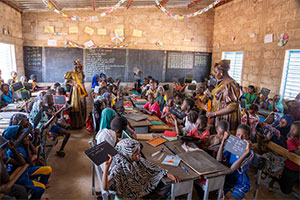 Two teachers work in a classroom in Forces Vives School in Dori, Burkina Faso. Credit: UNICEF/UNI978361
Safe and uninterrupted education is a fundamental right for all children. Education is paramount to global development, as it has been proven that investing in education – especially for girls and children – contributes significantly to economic growth and prosperity. Although more than 1 billion children go to school, many are subjected to conditions that are not conducive to a proper learning environment, including makeshift facilities, a lack of supplies, violence in classrooms, inadequate sanitation, untrained instructors, and widespread school closures. Since 2015, there have been immense gains in education with an increase of 109 million children in school. However, as of 2023, 272 million children are still out of school.
High poverty levels in developing countries also impede children’s access to a proper education. For example, from the early to mid 2000s, Sub-Saharan African nations witnessed a dramatic decline in trained teachers due to inadequate funding in the education sector. Furthermore, major cuts to United States international aid threaten an estimated 23 million additional children's access to education, as USAID‑funded school programmes across Africa and Asia face closure.
Various other factors contribute to the decline of education, notably hunger, which has increased as conflict and climate change interfere with global food production and dissemination. Meanwhile, certain social and cultural practices also impede children’s access to education, with gender inequality, discrimination, child labour, and child marriages preventing millions of children from attending school. Economic conditions such as the inaccessibility of higher education also affect disenfranchised communities across the world. In extreme situations, such as warfare where educational facilities are destroyed in their totality, notably in Gaza and Sudan, entire generations of children might grow up without access to education. Rebuilding educational infrastructure is a long and arduous process, especially when violence persists across generations, and this significantly stunts the development of societal prosperity and stability.
IPS is dedicated to telling the shocking truths about worldwide education through impassioned opinion pieces and comprehensive articles, highlighting global issues that impede worldwide education and the courses of action being taken by organizations such as UNICEF and Education Cannot Wait.

The Week with IPS

NEXT STOP - SDGs
Tracking global progress towards a sustainable world
Tracking global progress towards a sustainable world
