Languages
Thursday, November 5, 2026



News and Views from the Global South
Education

OPINION: Keeping All Girls in School is One Way to Curb Child Marriage in Tanzania
“You cannot continue with your education. You have to get married because this man has already paid dowry for you,” Matilda H’s father told her. Matilda, from Tanzania, was 14 and had just passed her primary school exams and had been admitted to secondary school. She pleaded with her father to allow her to continue her education, but he refused.
Bougainville Voices Say ‘No’ to Mining
The viability of reopening the controversial Panguna copper mine in the remote mountains of Central Bougainville, an autonomous region in the east of Papua New Guinea, has been the focus of discussions led by local political leaders and foreign mining interests over the past four years.Put People Not ‘Empire of Capital’ at Heart of Development
President Rafael Correa Delgado of Ecuador does not mince words when it comes to development. ”Neoliberal policies based on so-called competitiveness, efficiency and the labour flexibility framework have helped the empire of capital to prosper at the cost of human labour,” he told a crowded auditorium at the 15th Raul Prebitsch Lecture.
Asia: So Close and Yet So Far From Polio Eradication
The goal is an ambitious one – to deliver a polio-free world by 2018. Towards this end, the multi-sector Global Polio Eradication Initiative (GPEI) is bringing out the big guns, sparing no expense to ensure that “every last child” is immunised against the crippling disease.
Kashmir Flood Carries Away Humble Dreams
Rafiqa Kazim and her husband Kazim Ali had a simple dream – to live a modest life, educate their four children and repay the bank-loan that the couple took out to sustain their small business.
The Nagoya Protocol: A Treaty Waiting to Happen
For over 20 years, Mote Bahadur Pun of Nepal’s western Myagdi district has been growing ‘Paris polyphylla’ - a Himalayan herb used to cure pain, burns and fevers.
OPINION: Europe is Positioning Itself Outside the International Race
The new European Commission looks more like an experiment in balancing opposite forces than an institution that is run by some kind of governance. It will probably end up being paralysed by internal conflicts, which is the last thing it needs.
We Must Think of “Security” in New Ways
Recent events in the Arab world and elsewhere have underscored the point that traditional notions of security being dependent solely on military and related apparatus are outmoded.
Mexico’s Cocktail of Political and Narco-Violence and Poverty
The images filled the front pages of Mexico’s newspapers: 61 half-dressed state policemen kneeling, with their hands tied, in the main square of the town of Tepatepec in the central state of Hidalgo, while local residents threatened to burn them alive.
In Pakistan’s Tribal Areas, a Nobel Prize Is a ‘Ray of Hope’
For girls living in northern Pakistan’s sprawling tribal regions, the struggle for education began long before that fateful day when members of the Taliban shot a 15-year-old schoolgirl in the head, and will undoubtedly continue for many years to come.
Youth Employment Critical to Sustainable Development in Pacific Islands
The size of the youth population in the Pacific Islands is double the global average with 54 percent aged below 24 years, creating enormous challenges for slow-growing small island economies unable to create jobs fast enough.
Most Nations Reducing Worst Forms of Child Labour
Most of the world’s governments are taking measures to reduce the worst and most hazardous forms of child labour, according to a major report released here Tuesday by the U.S. Labour Department.
Humanity Failing the Earth’s Ecosystems
In pure numbers, the past few decades have been marked by destruction: over the last 40 years, Earth has lost 52 percent of its wild animals; nearly 17 percent of the world’s forests have been felled in the last half-century; freshwater ecosystems have witnessed a 75-percent decline in animal populations since 1970; and nearly 95 percent of coral reefs are today threatened by pollution, coastal development and overfishing.
Sustaining the Future Through Culture
International experts working in the creative sector are calling for governments to recognise the integral role that culture plays in development and to ensure that culture is a part of the post-2015 United Nations development goals, to be discussed next year.
Q&A: “The Battle Continues”
The Programme of Action adopted at the landmark 1994 International Conference on Population and Development (ICPD) included chapters that defined concrete actions covering some 44 dimensions of population and development, including the need to provide for women and girls during times of conflict, the urgency of investments in young people’s capabilities, and the importance of women’s political participation and representation.
‘Youth Exodus’ Reveals Lack of Opportunities
The small South Pacific island state of Samoa, located northeast of Fiji, attracts tourists with its beaches, natural beauty and relaxed pace of life, but similar to other small nations with constrained economies, it is experiencing an exodus of young people, who are unable to find jobs.
Living on a Ballpoint Pen in Kabul
Seventy-year-old Mohamad Arif still earns a living in the streets of Kabul. He prepares all kind of documents for those who cannot read or write – in other words, the majority of people in this country of 30.5 million people.
Despite New Pledges, Aid to Fight Ebola Lagging
Despite mounting pledges of assistance, the continuing spread of the deadly Ebola virus in West Africa is outpacing regional and international efforts to stop it, according to world leaders and global health experts.
Comprehensive Sex Education: A Pending Task in Latin America
In most Latin American countries schools now provide sex education, but with a focus that is generally restricted to the prevention of sexually transmitted diseases – an approach that has not brought about significant modifications in the behaviour of adolescents, especially among the poor.
The Changing Face of Caribbean Migration
Ruth Osman is attractive and well-groomed in tailored slacks and a patterned blouse, topped by a soft jacket worn open. Her demeanour and polished accent belie the stereotypical view that most Caribbean nationals have of Guyanese migrants.
Where Women Don’t Work
Saleema Bibi graduated from medical school 15 years ago – but to this day, the 40-year-old resident of Peshawar, capital of Pakistan’s northern Khyber Pakhtunkhwa (KP) province, has never been able to practice as a professional.« Previous Page — Next Page »





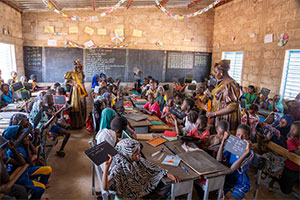 Two teachers work in a classroom in Forces Vives School in Dori, Burkina Faso. Credit: UNICEF/UNI978361
Safe and uninterrupted education is a fundamental right for all children. Education is paramount to global development, as it has been proven that investing in education – especially for girls and children – contributes significantly to economic growth and prosperity. Although more than 1 billion children go to school, many are subjected to conditions that are not conducive to a proper learning environment, including makeshift facilities, a lack of supplies, violence in classrooms, inadequate sanitation, untrained instructors, and widespread school closures. Since 2015, there have been immense gains in education with an increase of 109 million children in school. However, as of 2023, 272 million children are still out of school.
High poverty levels in developing countries also impede children’s access to a proper education. For example, from the early to mid 2000s, Sub-Saharan African nations witnessed a dramatic decline in trained teachers due to inadequate funding in the education sector. Furthermore, major cuts to United States international aid threaten an estimated 23 million additional children's access to education, as USAID‑funded school programmes across Africa and Asia face closure.
Various other factors contribute to the decline of education, notably hunger, which has increased as conflict and climate change interfere with global food production and dissemination. Meanwhile, certain social and cultural practices also impede children’s access to education, with gender inequality, discrimination, child labour, and child marriages preventing millions of children from attending school. Economic conditions such as the inaccessibility of higher education also affect disenfranchised communities across the world. In extreme situations, such as warfare where educational facilities are destroyed in their totality, notably in Gaza and Sudan, entire generations of children might grow up without access to education. Rebuilding educational infrastructure is a long and arduous process, especially when violence persists across generations, and this significantly stunts the development of societal prosperity and stability.
IPS is dedicated to telling the shocking truths about worldwide education through impassioned opinion pieces and comprehensive articles, highlighting global issues that impede worldwide education and the courses of action being taken by organizations such as UNICEF and Education Cannot Wait.

The Week with IPS

NEXT STOP - SDGs
Tracking global progress towards a sustainable world
Tracking global progress towards a sustainable world
