Languages
Monday, November 9, 2026



News and Views from the Global South
Humanitarian Emergencies

Kuwait Tops Humanitarian Aid to Syria at Pledging Conference
As Secretary-General Ban Ki-moon grimly predicted a worsening of the monumental humanitarian disaster in war-torn Syria, the international community Wednesday pledged over 2.4 billion dollars in new funds to help the displaced and devastated in the politically-troubled Arab nation.
2014: Solutions to Ten Conflicts
There are conflicts old and new crying for solution and reconciliation, not violence, with reasonable, realistic ways out.
Peacekeeping 20 Years after Rwanda
On Jan. 11, 1994, Romeo Dallaire, force commander of the United Nations Mission in Rwanda, sent a fax to U.N. Headquarters in New York, telling officials there a source close to the government had confided to him that Tutsis were being forced to register themselves in Kigali.
Djotodia’s Resignation Sparks Hopes for Peace in CAR
“I can’t wait to return back home,” Celeste Edjangue, a refugee from the Central African Republic (CAR) now in Cameroon’s East Region, told IPS.
U.N. Peacekeepers Overwhelmed in South Sudan
As the death toll rises from South Sudan’s spiraling political and ethnic conflict, the ability of the U.N. to enforce its peacekeeping mandate in the country is coming under increased scrutiny.
Natural Disasters Add to Myanmar’s Troubles
As Myanmar nurses a fragile democracy after long years of military rule, a new danger has reared its head. Climate change, say experts, has the potential to spur migration and exacerbate conflict in the country.
Major Parts of World Ignored by U.S. TV News in 2013
If people outside the United States are looking for answers why Americans often seem so clueless about the world outside their borders, they could start with what the three major U.S. television networks offered their viewers in the way of news during 2013.
U.N. to Seek Billions for Syria at Kuwait Conference
When Secretary-General Ban Ki-moon chairs a U.N. pledging conference next week for urgently needed aid to Syria, he is expected to warn the donor community that the humanitarian crisis in the politically-troubled Arab nation is threatening to reach biblical proportions.
Four Years Later, USAID Funds in Haiti Still Unaccounted For
As the fourth anniversary of the devastating earthquake in Haiti approaches on Jan. 12, development analysts are decrying an ongoing lack of transparency in U.S. foreign aid to the country, even as those assistance streams are drying up.
Europe’s Leaders Visit Athens to Celebrate Their Failure
The start of Greece’s six-month presidency of the EU was marked by a ceremony Wednesday in the Greek capital attended by the EU commissioners. But protests were banned and there was no in-depth talk about the raging controversy over the bloc’s handling of the Greek debt crisis and the renewed concerns about the vitality of the Eurozone.
Despite Legal Attacks, Conflict Minerals Ban Gets Stronger
Major manufacturing and business groups on Tuesday urged a court here to roll back a new U.S. regulation that would soon require major manufacturers to ensure that their global supply chains are free of minerals used to fund violence in the Great Lakes region of central Africa.
Christmas Storm Underlines Caribbean’s Vulnerability
Guyanese President Donald Ramotar says the death and destruction caused by intense rainfall in three Caribbean Community (CARICOM) countries over the Christmas holidays is a sign that the region has no time to lose in fortifying its resiliance to climate change.South Sudan Declares Emergency in Two States
South Sudanese President Salva Kiir has declared a state of emergency in two states, according to the government's official Twitter account.
A Complicated Calculus in South Sudan
Hours after forces ostensibly under Riek Machar’s command claimed victory in the strategic South Sudanese city of Bor, the former vice-president and once again rebel commander announced he would – after a week of postponement – send an envoy to upcoming peace dialogues in Addis Ababa with regional leaders and representatives of his one-time superior and comrade, President Salva Kiir.
Tallying Losses, St. Vincent Begins Repairs After Deadly Flood
Ralph Gonsalves fought to hold back tears as he shared how his cousin was killed the night before Christmas.
Christmas Deluge Brings Disaster to Eastern Caribbean
Colleen James arrived in St. Vincent and the Grenadines from Canada two days before Christmas hoping to enjoy the holiday season with her family. Now she’s getting ready to bury her two-year-old daughter and 18-year-old sister.
In the Philippines, a Vortex of Climate Change and Debt
Since Typhoon Yolanda made landfall in the Philippines on Nov. 8, the country has sent holders of its debt close to one billion dollars, surpassing, in less than two months, the 800 million dollars the U.N. has asked of international donors to help rebuild the ravaged central region of the archipelago.
How Israel Sank into the Quagmire of Apartheid
When one writes a book about Israel, one must expect that it will be analysed not for its quality but for its ideological bent.
Syrious Paralysis on Pennsylvania Avenue
Three months after averting a military strike against Syria with a last-minute deal to deprive it of its chemical weapons arsenal, U.S. policy toward the world's most violent conflict appears increasingly at sea.
Cameroonians Flee Atrocities in Central African Republic
“We couldn’t stand the violence anymore,” said 27-year-old Baba Hamadou shortly after alighting from a chartered flight at the Douala International Airport earlier this week.
Syria, CAR top U.N.’s Challenges for 2014
As the ongoing crises in some of the world's hot spots - including Syria, the Central African Republic, Mali, Libya, Palestine and Darfur, Sudan - continue unabated, Secretary-General Ban Ki-moon Monday singled out some of the biggest challenges facing the international community in 2014.« Previous Page — Next Page »





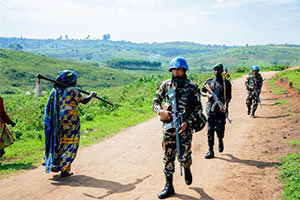 MONUSCO Peacekeepers and FARDC Soldiers Patrol Fataki Area. Credit: UN Photo/Jorkim Jotham Pituwa
Conflict, human rights violations, natural disasters, and famine have been at the forefront of concerns for humanitarian organizations. The escalation of humanitarian crises has led to over 239 million people in need of humanitarian assistance at the start of 2026, as estimated by OCHA’s Global Humanitarian Overview. The 2025 humanitarian appeal received only $12 billion, the lowest funding in over a decade, which has left 24 million fewer people reached in comparison to 2024. Conflict has remained the primary driver of crisis.
Humanitarian emergencies massively impact progress towards the Sustainable Development Goals (SDGs), adversely affecting economic development, inequality, education, planetary well-being, and poverty. Millions of people are faced with reduced access to essential services, including shelter, food, healthcare, and access to clean drinking water. UN Organizations such as UNHCR and the United Nations Children’s Fund (UNICEF) are committed to providing direct relief to affected communities when state governments cannot.
The United Nations 2024 Summit of the Future discussed measures that will be taken to reduce global inequality and promote peacekeeping efforts around the world. The recent UN Climate Change Conference (COP30) in Belém, Brazil, agreed to mobilize $1.3 trillion annually for climate action by 2035, operationalize the loss and damage fund, and triple adaptation finance. However, a fossil fuel transition commitment was not secured, despite climate change and the greenhouse effect being major contributors to humanitarian crises worldwide.
Countries across the world have also rallied to end humanitarian crises, as witnessed in conflicts such as Palestine and Ukraine. IPS is committed to providing relevant and in-depth reports of humanitarian emergencies around the world and their implications.

The Week with IPS

NEXT STOP - SDGs
Tracking global progress towards a sustainable world
Tracking global progress towards a sustainable world