Languages
Wednesday, November 11, 2026



News and Views from the Global South
Humanitarian Emergencies

Abrupt Shift from Drought to Flooding in Central Cuba
The sudden shift from drought to heavy rainfall that caused severe flooding in central Cuba drove home to the authorities the need to redesign preparedness and prevention plans for climate-related emergencies.Annan: ‘Bold Steps’ Needed for Syria Peace
Kofi Annan, the U.N.-Arab League envoy to Syria, has called on the country's government to take bold steps to prove its commitment to restoring peace during a visit to Damascus.
MALI: Food Aid Taking Too Long to Reach Needy
Her neat, bright yellow headscarf matches the rest of her outfit, but contrasts with her weary expression. Sokona Soumounou sits a little apart from the crowd queueing for assistance from the World Food Programme in the southern Mali town of Ségou.
HAITI: Partners in Deforestation and “Slumification”
More than 100 Haitian families now have new housing, thanks to the support of two non-governmental organisations working on reconstruction following the country's devastating 2010 earthquake.
Community Drills Part of Cuba’s Top-Notch Disaster Response System
A well-oiled prevention system that involves the entire country, from the highest spheres of government to the most isolated rural community, makes Cuba one of the best-prepared countries in the world when it comes to preventing deaths and mitigating risks in case of disasters.
Funding Dries Up Even as Rains Worsen Cholera Deaths
As predicted, the beginning of the rainy season in Haiti brought exponential increases in the numbers of people sickened and killed by cholera.
SOUTH SUDAN: Bracing for a Massive Influx of Returnees
In the wake of border tensions, the United Nations is airlifting 12,000 southerners from a Sudanese frontier town into South Sudan. But they are returning home in the midst of an economic crisis that has the U.N. warning it may appeal for more funding to scale up humanitarian operations.EU Feels Force of Israeli Demolitions
All 27 foreign ministers of the European Union have strongly spoken out against Israeli demolitions in Area C of the West Bank. Since the beginning of 2011 not less than 60 EU-funded projects have been demolished while 110 others are currently at risk. Several analysts claim the Israeli authorities are specifically targeting EU-funded projects.
Post-Quake Haiti Severely Dependent on Private Sector
More than two years after the January 2010 earthquake in Haiti, NGOs and private contractors are continuing to provide 80 percent of the country's social services.
Despite Economic Growth, Food Insecurity Lingers in Africa
Everlyne Wanjiku, a single mother of five, has earned a living selling vegetables in the sprawling Kibera slum in Nairobi, Kenya, for over three decades. And even though her earnings were meagre, she was able to provide all her children with a tertiary education.EU Backs Aid Through Budget Support
In an unprecedented move, all 27 EU development ministers championed budget support Monday as an effective way of reducing poverty in developing countries. At the same time they gave the green light to a new ground-breaking initiative to prevent new humanitarian crises in the Horn of Africa.
Deserting Refugees in the Sahara
As dusk settles over the isolated Saharan town Kufra, young guards order a few hundred migrants lined up at a detention centre to chant "Libya free, Chadians out", before they kneel down for evening prayers.
Recovering From the Spring, at a Price
The Arab Spring sent scores of sick and injured Libyans, fleeing their war- torn country, straight to Jordan, where the influx of patients is putting a lot of pressure on Jordanian hospitals and disrupting the lives of Libyan and Jordanian patients alike.Quake Empowers Japanese Women
Devastating as the Tohoku earthquake was it gave the local women of the remote region an opportunity to come into their own and take on leadership roles in an essentially patriarchal country.
Washington Struggles to Find a Path Forward on Syria
As the Syrian army has stepped up its attacks against opposition strongholds in Homs and elsewhere, the U.S. and its allies have achieved little consensus in choosing a course of action to oust President Bashar al-Assad.CULTURE-ARAB SPRING: A Revolution Through the Lens
The Arab world is talking about a revolution; not just out on the streets but in films, in newspapers, in songs – using any means necessary to document events, expose the horrors of war and explore the struggles and possibilities that lie ahead as the Arab Spring feels the wintry chill of post-revolutionary democratic challenges.North Korea’s Pivot
After three years of frozen relations between North Korea and the United States, the two longstanding adversaries are on the verge of a thaw.
Chile’s Earthquake Reconstruction Hindered by Delays and Profiteering
Two years after the earthquake and tsunami in south-central Chile, the worst natural disaster to hit the country in half a century, thousands of families who saw their homes destroyed are still waiting for a solution.Syria Stalls Senior U.N. Official’s Visit to War Zone
The United Nations, which remains politically deadlocked over the drawn-out crisis in Syria, has hit another roadblock, this time over humanitarian assistance to the thousands of men, women and children caught up in the 11-month-old conflict.Drought in Sahel Affects Urban Cameroonians
Sala Aminata, a housewife from Logone and Shari Division in Cameroon’s Far North Region, looks at her six kids with apprehension as she tries to figure out how to feed them with her meagre salary.NGOs Urge “Solution from Within” For Somalia
While the international community discusses Somalia's future in London and Brussels, European and Somali non-governmental organisations are calling for a radical shift from a military to a humanitarian approach as the only solution to the country's war-torn condition.« Previous Page — Next Page »





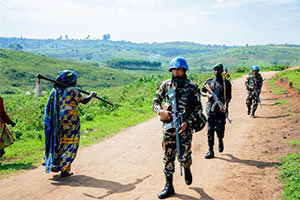 MONUSCO Peacekeepers and FARDC Soldiers Patrol Fataki Area. Credit: UN Photo/Jorkim Jotham Pituwa
Conflict, human rights violations, natural disasters, and famine have been at the forefront of concerns for humanitarian organizations. The escalation of humanitarian crises has led to over 239 million people in need of humanitarian assistance at the start of 2026, as estimated by OCHA’s Global Humanitarian Overview. The 2025 humanitarian appeal received only $12 billion, the lowest funding in over a decade, which has left 24 million fewer people reached in comparison to 2024. Conflict has remained the primary driver of crisis.
Humanitarian emergencies massively impact progress towards the Sustainable Development Goals (SDGs), adversely affecting economic development, inequality, education, planetary well-being, and poverty. Millions of people are faced with reduced access to essential services, including shelter, food, healthcare, and access to clean drinking water. UN Organizations such as UNHCR and the United Nations Children’s Fund (UNICEF) are committed to providing direct relief to affected communities when state governments cannot.
The United Nations 2024 Summit of the Future discussed measures that will be taken to reduce global inequality and promote peacekeeping efforts around the world. The recent UN Climate Change Conference (COP30) in Belém, Brazil, agreed to mobilize $1.3 trillion annually for climate action by 2035, operationalize the loss and damage fund, and triple adaptation finance. However, a fossil fuel transition commitment was not secured, despite climate change and the greenhouse effect being major contributors to humanitarian crises worldwide.
Countries across the world have also rallied to end humanitarian crises, as witnessed in conflicts such as Palestine and Ukraine. IPS is committed to providing relevant and in-depth reports of humanitarian emergencies around the world and their implications.

The Week with IPS

NEXT STOP - SDGs
Tracking global progress towards a sustainable world
Tracking global progress towards a sustainable world