Languages
Sunday, November 8, 2026



News and Views from the Global South
Population

Rio+20: Concrete Goals the Only Recipe for Success
Goals drive action, and that's why establishing a set of Sustainable Development Goals is so important to put the world on a sustainable pathway, experts said Saturday under the tropical fig and palm forest that covers much of the ground at the Pontifical Catholic University of Rio de Janeiro.
Obama Wins Cautious Praise for Ending Deportation of Minors
President Barack Obama's administration announced on Friday that the United States would no longer deport certain young immigrants.
Earth’s Future Not for Sale, Activists Say
Just ahead of the start of the United Nations Conference on Sustainable Development (Rio+20), many are worried about the influence that corporations will have on the summit's agenda.
Nepal’s Female Farmers Fear Climate Change
When Arati Chaudhary’s husband left for India to find work as a migrant labourer, the job of managing farm and family fell on her slender shoulders.
Blood Flows in Solidarity in Argentina
Voluntary blood donations have risen markedly in the year ending Thursday Jun. 14 in Argentina, which hosted the World Blood Donor Day event for 2011. South Korea takes over for the coming year.
Activists Aren’t Mourning Obama’s Absence at Rio Summit
When a reluctant George H.W. Bush, Sr., then U.S. president, changed his mind and decided at the eleventh hour to address the 1992 Earth Summit in Rio, he sounded defensive in his strong response to charges that the United States was one of the major powers responsible for the some of the world's worst environmental ills - from greenhouse gases to conspicuous consumption.
Q&A: Battle for Human Rights in Rio Is “Far From Over”
Human rights should be explicitly recognised as an indispensable ingredient of sustainable development at the Rio+20 summit in Brazil, says Navanethem Pillay, United Nations High Commissioner for Human Rights.
Q&A: Women Must Be at the Forefront of Rio+20, and Beyond
Unlocking women's energies and allowing them to become drivers of change could fuel the motor of sustainable development.Communal Violence Threatens Democratic Change in Myanmar
The outbreak over the past week of communal violence between Buddhists and Muslims in Rakhine State seriously threatens the ongoing reform process in Myanmar, according to experts here.
Defining Green Economy May Stymie Rio Summit
The thematic battle at the U.N. Conference on Sustainable Development (UNCSD) in Brazil next week will be primarily around the new concept of a "green economy" - and how best to define it.
Q&A: “We All Have to Start Being City Changers”
Building the cities of the future requires not only smarter planning but a profound shift toward greater equity and social justice, says Joan Clos, executive director of the U.N. Human Settlements Programme, or UN-HABITAT.
Health Warnings Loud and Clear on Cigarettes in Argentina
This month, Argentina will join the growing list of Latin American countries that compel tobacco companies to display health warnings about the dangers of smoking on cigarette packs, illustrated with graphic images.
Will Water Dry Up at Summit on Sustainable Development?
The headline in a New York newspaper last March captured the essence of a future potential threat to political stability the world over: "U.S. Report Sees Tensions Over Water."
Calls for an African Green Revolution, Only Smarter
To deal with looming food crises in the coming decades, Africa needs a Green Revolution on par with what took place in Asia during the 1960s and 1970s, according to experts in Washington.
Rural Zambia’s Drinking Supply Fraught with Danger and Disease
Bupe Bana-Victor has lived in the Mwense district of Luapula Province in northern Zambia all her life. And for her, water talk is synonymous with the Luapula River, which lies just 20 metres from her village and snakes through the entire region before it joins the Lualaba River – a tributary of the mighty Congo, Africa’s second-largest river.
RIO+20: A Stalemated U.N. in Do-or-Die Session on Action Plan
After weeklong negotiations, a meeting of the Preparatory Committee (PrepCom) to finalise a plan of action titled "The Future We Want" for next week's Rio+20 summit has failed to reach agreement - and deferred a decision to a final three-day session in Brazil.
24 Policies to End the Earth Emergency
Ecologically ignorant policies are largely responsible for the interlinked crises that are unraveling the planet's life support system.
Money Still “Buys” You Gold at the Olympics
The Olympic Games are widely viewed as a chance for countries to showcase their fastest, strongest, most skilled and disciplined athletes, a time when political, economic and cultural differences are set aside and individuals are judged on personal merit alone.
RIO+20: Earth Summit Negotiated the Size of the Zero
Amidst much political fanfare, the 1992 Earth Summit in Rio de Janeiro concluded with the adoption of the Rio Declaration on Environment and Development and the landmark Agenda 21 blueprint for a sustainable future in the 21st century.
Brazilian Street Stars Dance and Shine in Spain
Arrayed in colourful garments they have made themselves, six teenagers who used to be street kids in Fortaleza, in northeast Brazil, visited this southern Spanish city to recount their life experiences and awaken solidarity.
Family Planning and Subsistence Agriculture Key to Food Security
Papua New Guinea’s high fertility rate is exerting pressure on land and food production in a country where 80 percent of the population lives in rural communities. But the National Agricultural Research Institute (NARI) argues that traditions of subsistence agriculture provide a firm foundation to build food security for a growing population.« Previous Page — Next Page »





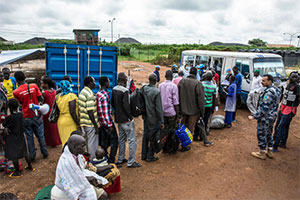 One Thousand Internally Displaced Persons (IDPs) Relocated from Tomping Camp in South Sudan. Credit: UN Photo/Isaac Billy
It took hundreds of thousands of years for the world’s human population to cross one billion in 1804. Approximately 200 years later, the population has multiplied sevenfold. In 2023, the global population crossed 8 billion, and is expected to reach 9 billion before 2050. With the planet more crowded than ever, it is essential to keep track of population trends, urbanization, migration, and reproduction across the world.
Life expectancy has seen significant strides in the past century, largely due to economic development and increased standards of living. On the contrary, trends in global fertility are shifting, with certain regions in Africa and Asia reporting higher rates, while parts of Europe and North America report stagnant or lower rates. This is in part due to differences in sexual and reproductive healthcare, as well as societal and economic conditions around the world. For example, child marriage is prevalent in certain societies, where childbearing is also considered a familial duty. Meanwhile, stagnating economies frequently experience lower marriage and childbearing rates.
The increase in migration and urban development around the world is also linked to global population trends. By 2050, it is expected that approximately 66 percent of all people will live in cities. Furthermore, global crises such as warfare and natural disasters also prompt transnational migration. Transnational migration is linked to a variety of socioeconomic issues in both host and receiving countries: migrants often leave developing countries with less access to educational and economic opportunities and arrive in developed countries where they are frequently the targets of ethnic, racial, and cultural discrimination, and economic exploitation. Recent crises in Europe and the United States demonstrate the importance of advocating for migrants worldwide. As migrants from the Global South are increasingly stripped of their legal and civic rights in unlawful deportations, or targeted in acts of identity-based violence, it is essential to keep track of population trends and protect the human rights of migrant populations. Climate-related disasters are now a major driver of displacement, with nearly half of all new internal displacements in 2025 being disaster-related.
IPS is devoted to covering issues surrounding population trends, migration, and reproduction through its compelling articles, which use both statistics and human stories to provide readers with robust and informative viewpoints.

The Week with IPS

NEXT STOP - SDGs
Tracking global progress towards a sustainable world
Tracking global progress towards a sustainable world
