Languages
Thursday, October 22, 2026



News and Views from the Global South
Trade & Investment

Mining Firms in Peru Mount Legal Offensive Against Inspection Tax
The leading mining companies in Peru have brought a rash of lawsuits to fight an increase in the tax they pay to cover the costs of inspections and oversight of their potentially environmentally damaging activities.
What’s More Important, the War on AIDS or Just War?
They say there is a war on and its target is the deadly human immunodeficiency virus (HIV).
What Do the World Bank and IMF Have to Do With the Ukraine Conflict?
Mostly unreported as the Ukraine conflict captures headlines, international financing has played a significant role in the current conflict in Ukraine.
Zimbabwe’s ‘Casualisation of Labour’ Leads to a New Form of Exploitation
Ethel Maziriri, 27, holds an Honours Degree in Social Work from the University of Zimbabwe, but instead of working in her chosen profession, she works as a cashier in one of the country’s leading clothing retail company. And it’s not by choice.
Zimbabwean Women Breathe New Life into Private Transport Sector
Mavis Gotora from Mabvuku high-density suburb, in Zimbabwe’s capital, Harare, walks up and down, as she persuades one passer-by after another to board the private taxi cab she drives.
Women Warriors Take Environmental Protection into Their Own Hands
Aleta Baun, an Indonesian environmental activist known in her community as Mama Aleta, has a penchant for wearing a colourful scarf on her head, but not for cosmetic reasons.
Will Obama’s “New Africa” Deliver on Its Promises?
As the three-day U.S- Africa Leaders Summit here drew to a close Wednesday, experts across the private, public and non-profit sectors continued to debate the opportunities and obstacles posed by the U.S’ expanding business partnership with Africa.
Tech Entrepreneur Encourages Rwanda’s Young Women to Venture into ICT
Akaliza Keza Gara is only 27, but she’s achieved much for women in Rwanda’s technology sector in just a short space of time.
OPINION: Toward an Inclusive TPP Trade Pact
The Trans-Pacific Partnership (TPP) negotiations have been hitting headlines recently, but not for all the right reasons.
Asia Looks to Innovation to Achieve Sustainability
Innovation in the fields of renewable energy, food production, water conservation, education and health will be crucial for the developing economies of Asia to meet the United Nations’ Sustainable Development Goals (SDGs).
Chile Taps Solar Thermal Energy with Latin America’s First Plant
With the first solar thermal power plant in Latin America, Chile hopes to begin to alleviate its energy crisis, which threatens to further drive up the high cost of electricity and to hinder the growth of investment, especially in the mining industry.
Cameroon Wants the World to Wake Up to the Smell of its Coffee
Issah Mounde Nsangou combs his 6.5-hectare Kouoptomo coffee plantation in Cameroon’s West Region, pulling up unwanted weeds and clipping off parasitic plants. For the 50-year-old farmer, the health of his coffee plants are of prime importance.
Africa Activists Urge Obama to Act on Extractive Industries Law
As the three-day U.S.-Africa Leaders Summit got underway here Monday, anti-corruption activists urged President Barack Obama to prod a key U.S. agency to issue long-awaited regulations requiring oil, gas, and mining companies to publish all payments they make in countries where they operate.
Did Argentina Default or Not? It’s More Than Semantics
Argentina’s supposed “default”, an unprecedented case in the history of world capitalism, sets a legal, political and financial precedent that indicates the need for concrete measures regarding the fine line between legal, ethical business activities and criminal usury.
Zimbabwe’s Food Entrepreneurs Cash in on a Failing Economy
Millicent Gananda, 34, and her two children enjoy their food at a roadside restaurant in downtown Harare, Zimbabwe’s capital, before they dash into the supermarket next door.Analysis: Ten Reasons for Saying ‘No’ to the North Over Trade
India’s decisive stand last week not to adopt the protocol of amendment of the trade facilitation agreement (TFA) unless credible rules were in place for the development issues of the South was met with "astonishment" and "dismay" by trade diplomats from the North, who described New Delhi’s as "hostage-taking" and "suicidal".
U.S. Summit Seeks to Play Catch-Up in Africa
Despite worsening crises in Ukraine, Gaza, and elsewhere in the Middle East, the administration of President Barack Obama hopes next week to focus at least some more positive attention on Africa.India Stands Firm on Protecting Food Security of South at WTO
The failure of the two major players in global trade negotiations to bridge their differences has put paid to the adoption of the protocol of amendment for implementation of the contested Trade Facilitation Agreement (TFA) for the time being.
Nicaragua Pins Hopes for Progress on Grand Canal
Víctor Sánchez doesn’t want gold or the comfortable future income he was promised. He just wants to live the life he has always lived on his farm along the Banks of the Las Lajas river – but the river is slated to become part of the route followed by the Nicaragua Interoceanic Grand Canal.Land Grabbing – A New Political Strategy for Arab Countries
Food price rises as far back as 2008 are believed to be the partial culprits behind the instability plaguing Arab countries and they have become increasingly aware of the importance of securing food needs through an international strategy of land grabs which are often detrimental to local populations.
Is Europe’s Breadbasket Up for Grabs?
Amidst an exodus of some 100,000 people from the conflict-torn eastern Ukraine, ongoing fighting in the urban strongholds of Donetsk and Luhansk between Ukrainian soldiers and separatist rebels, and talk of more sanctions against Russia, it is hard to focus on the more subtle changes taking place in this eastern European nation.« Previous Page — Next Page »





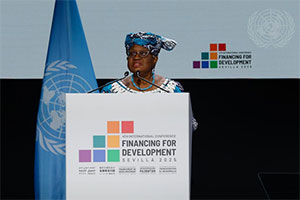 Opening of 4th International Conference on Financing for Development. Credit: UN Photo/Mariscal
International trade and investment are crucial elements of the world economy. While they can be powerful stimulators of development, they can also lead to global imbalances and dynamics of exploitation. In 2025, international trade entered a period of immense disruption, driven in part by a new wave of United States tariffs that reshaped global supply chains and investment flows. The increase in the US tariff rate, the highest since the 1930s, has forced bilateral renegotiations with global trading partners. Furthermore, the debt crisis in developing nations has accelerated while Official Development Assistance (ODA) has substantially dropped 7.3% in 2024.
In the 21st century, advancements in economic diversification in formerly colonized nations have propelled them into more central roles in the global economy. For example, both China and Mexico were able to develop their manufacturing sector and channel this development into booming export flows, thus advancing into the position of emerging economies. Foreign investment also plays an essential role in providing capital for developing countries, although they are oftentimes accompanied by social and environmental exploitation. For example, rising Chinese investments in natural resources in Latin America have often been met with tension as these investment projects fail to properly mitigate environmental risks and protect workers’ rights. In a more multifaceted vein, Sino-African relations have led to infrastructure development in Sub-Saharan Africa while also heightening the region’s economic dependency on China. IPS reports on global news in trade and investment, while shining a light on the nuanced nature of these endeavors.

The Week with IPS

NEXT STOP - SDGs
Tracking global progress towards a sustainable world
Tracking global progress towards a sustainable world
