Languages
Thursday, October 22, 2026



News and Views from the Global South
Trade & Investment

Oil Alliance Between China and Costa Rica Comes to Life Again
China’s plan to become Costa Rica’s main energy ally through the joint reconstruction of an oil refinery has been revived after the presidents of the two countries agreed to review the conditions of the project during a meeting in the Brazilian capital.
Gas and Sun Light the Way for Energy Industry in El Salvador
El Salvador is making steady progress towards diversifying its energy sources, with a plan to bolster the use of cleaner sources and achieve a substantial change in its energy mix by 2018.
Trade Facilitation Will Support African Industrialisation
In the 1960s, there were high hopes for the development of the newly-independent sub-Saharan African countries but these hopes were quickly dashed following a series of shocks which began in the mid-70s, with the first oil price spikes, followed by a severe decline in growth and increase in poverty in the 80s and early 90s.
Antigua Weighs High Cost of Fossil Fuels
Caught between its quest to grow the economy, create jobs and cut electricity costs, and the negative impacts associated with building an oil refinery, the Antigua and Barbuda government is looking to a mix of clean energy and fossil fuels to address its energy needs.
OPINION: The Affinity Between Iraqi Sunni Extremists and the Rulers of Saudi Arabia
Which story line sounds the more credible – that linking the rebel movement ISIS (the Islamic State in Iraq and Syria) to policies pursued by Iran or that linking the Sunni extremist force to Iran’s adversary Saudi Arabia?South Stymies North in Global Trade Talks
A group of developing countries brought a tectonic shift at the World Trade Organization on Friday by turning the tables against the industrialised countries, when they offered a positive trade agenda to expeditiously arrive at a permanent solution for food security and other development issues, before adopting the protocol of amendment of the contested Trade Facilitation Agreement.Positive Outlook For Agricultural Prices But Not For World’s Poorest
The official outlook for agriculture up to 2023 carries optimistic forecasts for agricultural productivity and commodity prices but it is unlikely that the benefits will be shared by the world’s poorest.
Oil Lubricates Equatorial Guinea’s Entry into Portuguese Language Community
Evidently, oil talked louder. By unanimous resolution, the Community of Portuguese Language Countries (CPLP) admitted Equatorial Guinea as a full member, in spite of the CPLP’s ban on dictatorial regimes and the death penalty.
Social Protection Needed to Reduce Africa’s Inequalities
For the last 13 years, Michael Ndah, 37, has worked for three road construction companies in Cameroon, but it is only in the last two years that his current employer has managed to register him with the National Social Insurance Fund (CNPS).
Human Development Report Finds South Asia’s Poor on a Knife’s Edge
Millions still live in poverty and even those who have gained the security of the middle-income bracket could relapse into poverty due to sudden changes to their economic fortunes in South Asia, the latest annual Human Development Report by the United Nations Development Programme (UNDP) revealed.
BRICS – The End of Western Dominance of the Global Financial and Economic Order
The sixth BRICS Summit which has just ended in Brazil marks the transition of a grouping based hitherto on shared concerns to one based on shared interests.
From Havana to Bali, Third World Gets the Trade Crumbs
The world of today is considerably different from the one at the end of the Second World War; there are no more any colonies, though there are still some 'dependent' territories.
U.S. Debating “Historic” Support for Off-Grid Electricity in Africa
Pressure is building here for lawmakers to pass a bill that would funnel billions of dollars of U.S. investment into strengthening Africa’s electricity production and distribution capabilities, and could offer broad new support for off-grid opportunities.Fragility of WTO’s Bali Package Exposed
The “fragility” of the World Trade Organization’s ‘Bali package’ was brought into the open at the weekend meeting in Sydney, Australia, of trade ministers from the world’s 20 major economies (G20).
As Winds of Change Blow, South America Builds Its House with BRICS
While this week's BRICS summit might have been off the radar of Western powers, the leaders of its five member countries launched a financial system to rival Bretton Woods institutions and held an unprecedented meeting with the governments of South America.

U.S. Accused of Forcing EU to Accept Tar Sands Oil
Newly publicised internal documents suggest that U.S. negotiators are working to permanently block a landmark regulatory proposal in the European Union aimed at addressing climate change, and instead to force European countries to import particularly dirty forms of oil.
International Reform Activists Dissatisfied by BRICS Bank
The creation of BRICS’ (Brazil, Russia, India, China and South Africa) own financial institutions was “a disappointment” for activists from the five countries, meeting in this northeastern Brazilian city after the group’s leaders concluded their sixth annual summit here.BRICS Forges Ahead With Two New Power Drivers – India and China
The Sixth BRICS Summit which ended Wednesday in Fortaleza, Brazil, attracted more attention than any other such gathering in the alliance’s short history, and not just from its own members – Brazil, Russia, India, China and South Africa.
BRICS Build New Architecture for Financial Democracy
The BRICS alliance (Brazil, Russia, India, China and South Africa) launched the New Development Bank (NDB) and Contingency Reserve Arrangement (CRA) during its sixth summit, institutionalising a new financial architecture for the emerging powers.Russia Hoping Cuba Can Help Spur Trade with Latin America
Amid deteriorating relations with the West, Russian President Vladimir Putin is looking to diversify a Russian economy that is tightly linked to European markets. Fittingly, an old Soviet-era satellite state seems eager to lend a helping hand.« Previous Page — Next Page »





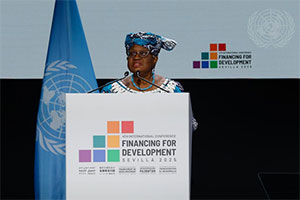 Opening of 4th International Conference on Financing for Development. Credit: UN Photo/Mariscal
International trade and investment are crucial elements of the world economy. While they can be powerful stimulators of development, they can also lead to global imbalances and dynamics of exploitation. In 2025, international trade entered a period of immense disruption, driven in part by a new wave of United States tariffs that reshaped global supply chains and investment flows. The increase in the US tariff rate, the highest since the 1930s, has forced bilateral renegotiations with global trading partners. Furthermore, the debt crisis in developing nations has accelerated while Official Development Assistance (ODA) has substantially dropped 7.3% in 2024.
In the 21st century, advancements in economic diversification in formerly colonized nations have propelled them into more central roles in the global economy. For example, both China and Mexico were able to develop their manufacturing sector and channel this development into booming export flows, thus advancing into the position of emerging economies. Foreign investment also plays an essential role in providing capital for developing countries, although they are oftentimes accompanied by social and environmental exploitation. For example, rising Chinese investments in natural resources in Latin America have often been met with tension as these investment projects fail to properly mitigate environmental risks and protect workers’ rights. In a more multifaceted vein, Sino-African relations have led to infrastructure development in Sub-Saharan Africa while also heightening the region’s economic dependency on China. IPS reports on global news in trade and investment, while shining a light on the nuanced nature of these endeavors.

The Week with IPS

NEXT STOP - SDGs
Tracking global progress towards a sustainable world
Tracking global progress towards a sustainable world
