Languages
Sunday, October 18, 2026



News and Views from the Global South
Trade & Investment

Big Business Opportunities Seduce BRICS Entrepreneurs
The growing vitality of the group of countries made up of Brazil, Russia, India, China and South Africa (BRICS), which is beginning to formalise its institutions even as it tries to bridge very disparate realities, seems to be partly cemented by increasing links between its companies.
OPINION: Why Asia-Europe Relations Matter in the 21st Century
Hopes are high that the 10th Asia-Europe Meeting – or ASEM summit – to be held in Milan on October 16-17 will confirm the credibility and relevance of Asia-Europe relations in the 21st century.
Europe and the United States, Allies in Crisis
A few decades ago, even before the end of the Cold War and before and after Ronald Reagan’s election to the White House, analyses regularly referred to U.S. decadence. At other times, it was Europe’s turn for pessimistic descriptions, especially when it could not overcome its ambivalence over deepening integration, and above all because of the failure of its constitutional project.
New BRICS Monetary Fund May Reproduce Inequalities
The first common institutions to be set up by Brazil, Russia, India, China and South Africa – the BRICS – are financial, and have arisen as a result of reforms to an international system that continues to largely ignore the growing influence of emerging countries.
Greek Privatisation of Key Sectors Meets Strong Opposition
Plans by the Greek government to sell companies that handle the key resources of energy and water face serious obstacles and its policy to offer investors exceptional privileges in an effort to boost interest in privatisation is coming under strong pressure.
Macau Gambling Away Its Future
Macau’s gaming boom just keeps on giving. Gambling revenues soared to a new high of 45 billion dollars last year, a whopping 18.6 percent rise over 2012 and the city’s sixth straight year of record earnings.
U.S. Overseas Coal Financing May Be Restarting
Landmark new policies that have sharply curtailed U.S. financing for international coal projects may be rolled back, the result of a sudden, polarised fight over a little-known government agency here.
Cuba-United States – Something Is Moving
In ‘Hard Choices’, her new book about her experiences as Secretary of State during U.S. President Barack Obama’s first term (2008-2012), Hillary Clinton writes something of prime importance about Cuba – she says that late in her term in office she urged Obama to reconsider the U.S. embargo against Cuba.
Salvadoran Peasant Farmers Clash With U.S. Over Seeds
Under a searing sun, surrounded by a sea of young maize plants, Gladys Cortez expresses her fears that her employment in the cooperative that produces seed for the Salvadoran government may be at risk, if United States companies achieve participation in seed procurement.Africa Under “Unprecedented” Pressure from Rich Countries Over Trade
African countries are coming under strong pressure from the United States and the European Union to reverse the decision adopted by their trade ministers to implement the World Trade Organization’s trade facilitation agreement on a “provisional” basis.
Indonesia’s Presidential Hopefuls Face Up to Deforestation
As the world’s third-largest democracy heads to the polls next week to elect a new president, environmental activists remain sceptical of the candidates’ commitment to tackle climate change.
Inequality Blocks Path to “Gold” in Latin America
Inequality, poor infrastructure and declining trade are some of the problems that Latin America needs to overcome if the region truly wishes to achieve a “golden age”, according to Peru’s President Ollanta Humala.
No Limits to Shale Gas Chemicals in Mexico
The new legal framework for Mexico’s oil industry has not placed controls on the use of harmful chemicals in the extraction of unconventional fossil fuels, and environmentalists and experts fear their consumption will increase in an industry that is opening up to private capital.
Violence Casts Shadow Over ‘Himalayan Viagra’ Harvest in Nepal
Intense competition during harvest season for a fungus dubbed ‘Himalayan Viagra’ – coveted for its legendary aphrodisiac qualities – has sparked violence in Nepal’s remote western mountains, causing concern among security officials here about the safety of more than 100,000 harvesters.
Community Resilience Tops U.N.’s Disaster Relief Agenda
The Bangkok Declaration on Disaster Risk Reduction in Asia and the Pacific adopted at the close of the 6th Asian Ministerial Conference On Disaster Risk Reduction (AMCDRR) here today emphasised community-based solutions, and reflects a growing global desire to focus more on grassroots actions in the face of catastrophic climate change.
EU Aims to Scuttle Treaty on Human Rights Abuses
When the United Nations began negotiating a Code of Conduct for Transnational Corporations (TNCs) back in the 1970s, the proposal never got off the ground because of vigourous opposition both from the powerful business community and its Western allies.
From Genocide to African Catwalks – How Rwandan Women are Building their Lives and the Fashion Industry
Before Rwanda’s 1994 genocide, Salaam Uwamariya’s husband, a professor, was the family breadwinner, providing for her and their eight children. Uwamariya sold vegetables at a nearby market to supplement their income.
Senegal Walks a Fine Line Between Development and Environmental Protection
While the cement factories in Senegal are at war, ostensibly over the environmental impact one company will have on this West African nation, experts have cautioned that as the government plans to radically develop and industrialise the country, striking a balance between environmental protection and development will be key.
Afghans Look Beyond Elections
With protests erupting Thursday over alleged voter fraud during Afghanistan’s first-ever democratic transfer of power, and presidential hopeful Abdullah Abdullah announcing his intention to boycott the electoral process, ordinary Afghans are beginning to despair that they will ever start to feel a sense of normalcy in their country, ravaged by years of civil war.
Argentina Once More on the Map, Invited by BRICS
As Argentina starts to mend fences with the international financial markets, the emerging powers that make up the BRICS bloc invited it to their next summit. This could be a step towards this country’s reinsertion in the global map, after its ostracism from the credit markets since the late 2001 debt default.
Women Herders Bring Change
When Sangan Bhai, a humble man in the Kutch region of India’s western state of Gujarat, was offered a position as an executive member of the local camel breeder’s association, he made a decision that surprised his community: instead of accepting the prestigious post he offered his wife’s name instead.« Previous Page — Next Page »





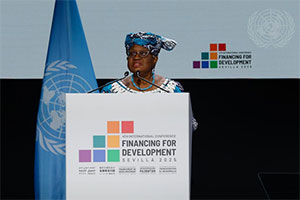 Opening of 4th International Conference on Financing for Development. Credit: UN Photo/Mariscal
International trade and investment are crucial elements of the world economy. While they can be powerful stimulators of development, they can also lead to global imbalances and dynamics of exploitation. In 2025, international trade entered a period of immense disruption, driven in part by a new wave of United States tariffs that reshaped global supply chains and investment flows. The increase in the US tariff rate, the highest since the 1930s, has forced bilateral renegotiations with global trading partners. Furthermore, the debt crisis in developing nations has accelerated while Official Development Assistance (ODA) has substantially dropped 7.3% in 2024.
In the 21st century, advancements in economic diversification in formerly colonized nations have propelled them into more central roles in the global economy. For example, both China and Mexico were able to develop their manufacturing sector and channel this development into booming export flows, thus advancing into the position of emerging economies. Foreign investment also plays an essential role in providing capital for developing countries, although they are oftentimes accompanied by social and environmental exploitation. For example, rising Chinese investments in natural resources in Latin America have often been met with tension as these investment projects fail to properly mitigate environmental risks and protect workers’ rights. In a more multifaceted vein, Sino-African relations have led to infrastructure development in Sub-Saharan Africa while also heightening the region’s economic dependency on China. IPS reports on global news in trade and investment, while shining a light on the nuanced nature of these endeavors.

The Week with IPS

NEXT STOP - SDGs
Tracking global progress towards a sustainable world
Tracking global progress towards a sustainable world
