Languages
Wednesday, October 14, 2026



News and Views from the Global South
Trade & Investment

Picture the World as a Desert
Try to imagine an expanse of barren land, stretching for miles, with no trace of greenery, not a single bough to cast a sliver of shade, or a trickle of water to moisten the parched earth. Now imagine that desert expanding by 12 million hectares a year. Why? Because it’s already happening.
Argentina Seeks to Ward Off “Paradoxical” Default
Argentina finds itself in a strange position since the U.S. Supreme Court rejected its appeal Monday to take a case in which a small group of creditors is suing this country for full repayment: it is on the brink of default even though it is one of the countries in the world that has done the most to dig itself out of debt.
U.S. Supreme Court “Validates” Vulture Fund Activities
The U.S. Supreme Court’s decision to reject an appeal by the Argentine government will embolden aggressive “holdout” creditors, anti-poverty groups say, and make it far more difficult to arrive at debt-relief agreements for poor countries.
Natural Gas – Both Crisis and Solution in Chile
In April 2004, Argentina began to steadily cut natural gas exports to neighbouring Chile, triggering a major energy crisis and revealing structural problems in this vital sector.
Obama’s Free Trade Strategy Falters in Asia
Amid simmering territorial conflicts across the Western Pacific, specifically between China and its neighbours in the South and East China Seas, coupled with China rising to the rank of top trading partner with Japan, South Korea, Australia and the Association of Southeast Asian Nations (ASEAN), the Obama administration has been hard-pressed to re-assert its strategic footprint in the region.
FIFA World Cup – Where the Spectacle Is the Champion
The seven-year-old got bored after running here and there for five minutes, amidst a group of a dozen classmates. He eventually stomped off the field because he hadn’t managed to kick the ball even once.
Q&A: “Some Individuals Are Now as Wealthy as Entire Countries”
As it turns 50, the United Nations Conference on Trade and Development (UNCTAD) finds itself engaged in an ongoing struggle to reduce economic and social inequalities in the world.
Deadline Looms for Due Diligence Reporting on U.S. Investments in Myanmar
U.S. companies newly operating in Myanmar have until the end of the month to file official reports detailing the actions they’ve taken to ensure that their investments comply with safeguards around land, human rights and other concerns.Despite Crisis, Europe Continues to Protect Its Banksters
More than six years after the global financial crisis broke out, European Union (EU) countries continue to protect banks and investments funds from tougher rules, despite abundant evidence of recurrent criminal or reckless activities in the sector, and new accumulation of enormous financial risks.
Mauritian Sugar Farmers Squeezed by Low Prices as Bagasse and Ethanol Become Popular By-products
While Mauritius has been forced to transform its sugar industry because of low prices for the commodity, the country’s small-scale sugarcane farmers who contribute to it say they are barely earning a living.Donors to Assist Developing Countries Negotiate Extractives Contracts
Major donor countries will unveil next week a new initiative aimed at strengthening the ability of developing countries’ governments to negotiate complex contracts, particularly around the extractives sector.
Wall Street Sets Its Sights on Renters
Six years after the financial crisis, Wall Street’s housing alchemy engine is revving up again - only this time it’s coming for your rental.
When Nature Gets a Price Tag
How much does a forest cost? What’s the true economic value of an ocean? Can you pay for an alpine forest or a glacial meadow? And – more importantly – will such calculus save the planet, or subordinate a rapidly collapsing natural world to market forces?Brazil, Football and Protests
It is unlikely that Brazilians will listen to the audacious call made by Michel Platini – a great player in his time and now the politicking president of the Union of European Football Associations (UEFA) – on Apr. 26: “Brazil, make an effort for a month, calm down!”
Ethiopia Shoots for the Stars and Galaxies as it Aims to Become Space Science Hub
High up in the eucalyptus-strewn Entoto Mountains, which overlook the Ethiopian capital, Addis Ababa, work is nearly complete on the country’s first observatory. Studying the stars and the galaxies will be vital for this Horn of Africa nation’s development and will hopefully also go a long way to developing brotherly love, say scientists who are part of the project.
Triple Summit in Singapore Puts Urban Planning on the Map
With over 20,000 international participants, a triple summit wrapping up today in Singapore is generating an abundance of ideas on sustainable cities.
Wheat Smugglers Bring High Prices, and Hunger
With its lush valleys and well-watered plains, Pakistan’s northwestern Khyber Pakhtunkhwa (KP) province produces plenty of food for the local population, including 10 million tons of wheat every year. So why are the people of this bountiful mountainous region going hungry?
Côte d’Ivoire Rides the Fast Track to Public Transport Development
Two years ago, it would have taken Catherine Adjoua almost an hour to travel from M’Badon, the isolated fishing area where she lives that has no asphalt roads, to reach her workplace some 13 kilometres away in Abidjan, Côte d’Ivoire’s economic capital.
U.S. Corporate Conflict Minerals Reports “Historic” But Incomplete
For the first time, nearly 1,300 U.S. companies have filed reports on whether the products they manufacture or sell are made with minerals that have bankrolled conflict in the Great Lakes region of central Africa.
China Casts A Long Shadow Over Latin America
In the past 15 years, China has gone from being a relatively insignificant economic partner in Latin America to the number-one trading partner of some of the largest economies in the region.
Showing the West that Russia is Not Alone
Aleksander Mizdrakin is convinced he knows who Russia’s future international partners are – and they’re not in Europe, nor is the United States among them.« Previous Page — Next Page »





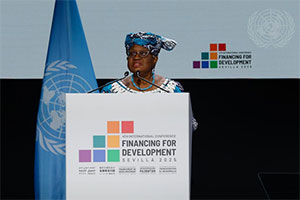 Opening of 4th International Conference on Financing for Development. Credit: UN Photo/Mariscal
International trade and investment are crucial elements of the world economy. While they can be powerful stimulators of development, they can also lead to global imbalances and dynamics of exploitation. In 2025, international trade entered a period of immense disruption, driven in part by a new wave of United States tariffs that reshaped global supply chains and investment flows. The increase in the US tariff rate, the highest since the 1930s, has forced bilateral renegotiations with global trading partners. Furthermore, the debt crisis in developing nations has accelerated while Official Development Assistance (ODA) has substantially dropped 7.3% in 2024.
In the 21st century, advancements in economic diversification in formerly colonized nations have propelled them into more central roles in the global economy. For example, both China and Mexico were able to develop their manufacturing sector and channel this development into booming export flows, thus advancing into the position of emerging economies. Foreign investment also plays an essential role in providing capital for developing countries, although they are oftentimes accompanied by social and environmental exploitation. For example, rising Chinese investments in natural resources in Latin America have often been met with tension as these investment projects fail to properly mitigate environmental risks and protect workers’ rights. In a more multifaceted vein, Sino-African relations have led to infrastructure development in Sub-Saharan Africa while also heightening the region’s economic dependency on China. IPS reports on global news in trade and investment, while shining a light on the nuanced nature of these endeavors.

The Week with IPS

NEXT STOP - SDGs
Tracking global progress towards a sustainable world
Tracking global progress towards a sustainable world
