Languages
Saturday, October 24, 2026



News and Views from the Global South
Trade & Investment

U.S. Hedge Funds Paint Argentina as Ally of Iranian ‘Devil’ – Part Two
Vulture capitalist Paul Singer has hundreds of millions of dollars at stake in his legal battle with Argentina over the country's 2001 debt default.
World’s Poorest Nations Slowly Mending
The number of "least developed countries" (LDCs), which rose from the original 24 back in 1971 to the current 49, is beginning to shrink - haltingly.Fukushima Fallout Hits Farmers
Life for Yoshihiro Watanabe and his wife Mutsuko, mushroom and rice farmers from Fukushima, has changed drastically since the disastrous meltdowns in the Dai Ichi nuclear plant that was hit by a massive tsunami after a 9.0 strong earthquake struck on Mar. 11, 2011.
Voting to Save Zimbabwe’s Economy
At a recent campaign rally in Zimbabwe’s Midlands Province, Prime Minister Morgan Tsvangirai pledged to establish rural-based companies to create employment. It was a promise that appealed to 34-year-old sociologist Agnes Ngwenya who graduated from the University of Zimbabwe 10 years ago, but has not yet found work.U.S. Hedge Funds Paint Argentina as Ally of Iranian ‘Devil’ – Part One
When Argentina defaulted on its national debt in 2001, U.S. hedge funds swooped in to buy the nation's bonds at pennies on the dollar, confident they would eventually prevail in the U.S. legal system and force the country to pay out in full.Is Chinese Investment in Kyrgyzstan Really Win-Win?
With Westerners now leery of investing in Kyrgyzstan, it is perhaps inevitable that officials in Bishkek turn to China as they try to attract capital for infrastructure development.
Will Prayers Save Farmers in the Land of the Gods?
Over a month after flash floods in the Himalayan state of Uttarakhand in north India left 1,000 dead and 6,000 missing, the government has yet to release a full agricultural impact assessment, sparking fears about the extent of damage to the region’s farmland.
Q&A: “Angela Merkel Is the Decider of Our Fate”
“Who do I call if I want to call Europe?” This famous question attributed to former U.S. secretary of state Henry Kissinger has an obvious answer today: Angela Merkel, the conservative German chancellor.
BOOKS: China’s March to “Wealth and Power”
The China pavilion is a red, inverted pyramid in Shanghai that was built for the city’s bustling 2010 World Expo. While the pavilion pays some homage to China’s ancient past, it mostly shows off China’s 21st century ambitions, with as much swagger as the 2008 Beijing Olympics.
Industry in Argentina Going Strong, But More Is Needed
Industry in Argentina has seen a sustained rise in production, exports and employment since 2003. But in order for this trend to become a structural change, greater import substitution is needed, analysts say.World Bank “Falling Behind” on Human Rights, Critics Warn
The World Bank is being urged to explicitly incorporate human rights into its development lending criteria, ahead of an important technical briefing on the subject to its board of directors on Tuesday.
Indonesia Comes under Fire for Fires
With a propensity to devour everything in their path and spiral quickly out of control, leaving behind swathes of scorched earth, forest fires are considered a hazard in most parts of the world. In Indonesia, however, fires are the preferred method for clearing large areas of land for massive plantations of commercial crops.
/CORRECTED REPEAT*/River Diversion Project Spells Disaster
Tsetseghkorol, a Mongolian herder, stares out nostalgically at the Orkhon River, the longest in the country.OECD Proposes Plan to Curb International Tax Avoidance
Finance ministers from the Group of 20 (G20) countries on Friday received a previously requested strategy under which the world’s largest economies could crack down on international tax avoidance, particularly on the part of multinational corporations.
When Israelis Boycott a Settlement
As the European Union delegitimises the settlement enterprise further by officially announcing that, effective Jul. 30, its 28 member states are required to differentiate between pre-1967 Israel and Israeli-occupied territories, Israelis supportive of a two-state solution vigorously lead their own boycott campaign against Ariel, a settlement town of 20,000.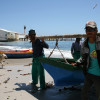
Southern African Trade Talks Stall, and the Clock Ticks
Southern Africa has to settle in for another round of negotiations after talks on Economic Partnership Agreements failed to produce results in June, bringing countries closer to losing access to the lucrative European Union market.Economists’ Fantasies, Planetary Nightmares
While debating a high frequency trader recently, I encountered the familiar rationalisations that high frequency trading (HFT) contributes to liquidity and price discovery in markets. Assertions about liquidity are hard to justify after the “flash crash” of May 6, 2010, where the “faux liquidity” of HFT disappeared when needed and the traditional market-making obligations of the old specialists were absent.
Japan’s Uneven Conservation Efforts
Efforts to protect the critically endangered Iriomote wildcat, a spotted, shy, feral creature native to the tiny Iriomote Island that forms part of the Okinawa Prefecture in southern Japan, are becoming a highly respected model of conservation here, where the government’s uneven track record in protecting imperiled species has frustrated wildlife activists for decades.
Critics Warn Pacific Pact Could Jack Up Drug Costs
As a new round of talks behind a major proposed free trade area, the Trans-Pacific Partnership (TPP), get underway this week, the United States is pushing several developing countries to accept provisions that critics say would make it more difficult for their citizens to access medicine.
New Labour Norms Could Hurt Bangladesh
The decisions of the United States and the European Union to demand implementation of controversial labour standards in Bangladesh following the Sawa industrial tragedy pose a serious threat to the rule-based global trading system, says Dr Supachai Panitchpakdi, Secretary-General for United Nations Conference on Trade and Development.
Small Businesses Tackle Poverty in Mauritius
Raja Venkat, a food vendor on the sidewalk of Immigration Square in the centre of Port Louis, the Mauritian capital, sits on his tricycle with a bag full of dhal puris - small, round, flat Indian bread stuffed with pulses - which he sells together with tomato sauce and bean curry.« Previous Page — Next Page »





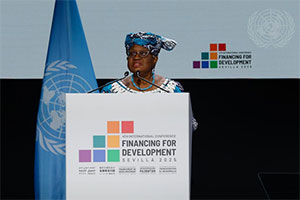 Opening of 4th International Conference on Financing for Development. Credit: UN Photo/Mariscal
International trade and investment are crucial elements of the world economy. While they can be powerful stimulators of development, they can also lead to global imbalances and dynamics of exploitation. In 2025, international trade entered a period of immense disruption, driven in part by a new wave of United States tariffs that reshaped global supply chains and investment flows. The increase in the US tariff rate, the highest since the 1930s, has forced bilateral renegotiations with global trading partners. Furthermore, the debt crisis in developing nations has accelerated while Official Development Assistance (ODA) has substantially dropped 7.3% in 2024.
In the 21st century, advancements in economic diversification in formerly colonized nations have propelled them into more central roles in the global economy. For example, both China and Mexico were able to develop their manufacturing sector and channel this development into booming export flows, thus advancing into the position of emerging economies. Foreign investment also plays an essential role in providing capital for developing countries, although they are oftentimes accompanied by social and environmental exploitation. For example, rising Chinese investments in natural resources in Latin America have often been met with tension as these investment projects fail to properly mitigate environmental risks and protect workers’ rights. In a more multifaceted vein, Sino-African relations have led to infrastructure development in Sub-Saharan Africa while also heightening the region’s economic dependency on China. IPS reports on global news in trade and investment, while shining a light on the nuanced nature of these endeavors.

The Week with IPS

NEXT STOP - SDGs
Tracking global progress towards a sustainable world
Tracking global progress towards a sustainable world
