Languages
Saturday, October 24, 2026



News and Views from the Global South
Trade & Investment

The World Trade Organisation after Eight Transformational Years
On Aug. 31, I will be stepping down after eight years as Director-General of the World Trade Organisation (WTO).
Caribbean Economies Battered by Storms
The Caribbean is in danger of becoming “a region of serial defaulters” with respect to international debt obligations, according to one expert, and this may partly be due to its economies suffering frequent shocks from natural disasters.
Ecological Cuban Recipes Boost Sustainable Agriculture
Vilda Figueroa and her husband, José Lama, live in Marianao on the outskirts of Havana, where they share hundreds of recipes based on Cuban-grown foods and sun-drying, along with other ecological food preservation methods.
Opponents of Fracking Seek to Thwart Shale Gas Finance
Non-governmental organisations are putting pressure on multilateral financial institutions not to finance production of shale gas by hydraulic fracturing or fracking because of the high environmental costs they say are associated with this method.
Crossing Borders with Trade
Experts are agreed that the key to unlocking the economic potential of the Southern African Development Community lies in easing cross-border flows of people, goods, capital and services.
The Role of the State in Developing Countries under Attack from New FTAs
Two new trade agreements involving the two economic giants, the United States and the European Union, are leading a charge against the role of the state in the economy of developing countries.
Building the Future Enterprise by Enterprise in Rural Peru
Women and young people are central players in dozens of small businesses and environmental protection plans that are changing the lives of poor rural families in the Andes highlands of southern Peru.
Tanzanian Traders Seek Rescue From Chinese
The Chinese characters boldly painted on a supermarket poster in Tanzania’s commercial capital Dar es Salaam say a lot about the growing influence of China on this east African nation.Linking Fair and SQUAR in Myanmar
What’s less than two months old, has hit the headlines globally, and has more than 79,000 ‘likes’ and over 16,000 people talking about it?
Where Banks Need Less Regulation
Leading bankers are concerned that the regulatory environment in some southern African states is preventing them from offering a full range of services to individuals and companies across the region.
Now Tunisia Begins to Shake
Tunisia was plunged into political strife when opposition leader Mohamed Brahmi was assassinated late last month, triggering widespread pro- and anti-government demonstrations across the country. In the days since his death the North African nation has faced a further series of terrorist attacks that have threatened to destabilise a country seen as a model for post-revolution democracy in the region.
Ivory Course Runs From Africa to Malaysia to China
A distance of nearly 9,000 kilometres separates Malaysia from Africa, but that hasn’t stopped the Southeast Asian nation from becoming a key staging post in the illegal trade of ivory from Africa to China.
Mining Industry Plans Massive Use of Seawater in Arid Northern Chile
The arid climate in northern Chile has forced mining companies to seek out new sources of water. The main source is seawater from the Pacific Ocean, whose use is expected to increase significantly in the coming decade despite the high costs of extraction and transport.
Zimbabwe’s Electoral Commission Shaken by Vote
As a second commissioner from the Zimbabwe Electoral Commission (ZEC) resigns, local opposition parties and analysts are questioning the organisation’s credibility and President Robert Mugabe’s victory.
Environmentalists Alarmed at Tourism Plans for Small Islands
The Venezuelan government’s plans to develop tourism infrastructure on virtually uninhabited highly biodiverse small islands in the southern Caribbean have triggered warnings from environmentalists.
Seeking More Indian Business, With Chinese Help
As he stood on the westernmost edge of Colombo’s new harbour expansion, it was hard for Priyath Bandu Wickrema - the man tasked with reinventing the port as a regional giant - to cap his enthusiasm.Global Value Chains from a Development Perspective
The current discourse on Global Value Chains by key proponents and also the World Trade Organisation (WTO) secretariat is that developing countries should liberalise - in goods and services - and conclude a trade facilitation agreement.China Trade Deal Raises Hackles in Taiwan
A broad coalition of Taiwanese labour, human rights and other civil society organisations are campaigning to block legislative ratification of the controversial Cross-Strait Services Trade Agreement signed Jun. 21 by representatives of Taiwan and China.
Grassroots Groups Wary of Haiti’s “Attractive” Mining Law
As the government works on preparing “an attractive law that will entice investors”, Haitian popular organisations are mobilising and forming networks to resist mining in their country.
Zimbabweans Looking for a Brighter Economic Future
Zimbabwean analysts say that it will be historical if President Robert Mugabe, who has ruled this country for 33 years, loses the country’s presidential election to his long-time rival Prime Minister Morgan Tsvangirai and relinquishes power.
Chinese Built Port Leaves Cameroonians Adrift
The Kribi Seaport on the coast of southern Cameroon is destined to become a mega harbour to serve all of Central Africa. But there is little chance that locals, particularly engineers and scientists, will benefit much from the 567 million dollar development.« Previous Page — Next Page »





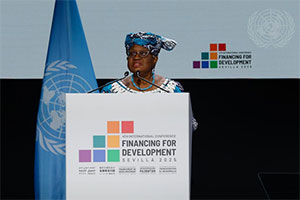 Opening of 4th International Conference on Financing for Development. Credit: UN Photo/Mariscal
International trade and investment are crucial elements of the world economy. While they can be powerful stimulators of development, they can also lead to global imbalances and dynamics of exploitation. In 2025, international trade entered a period of immense disruption, driven in part by a new wave of United States tariffs that reshaped global supply chains and investment flows. The increase in the US tariff rate, the highest since the 1930s, has forced bilateral renegotiations with global trading partners. Furthermore, the debt crisis in developing nations has accelerated while Official Development Assistance (ODA) has substantially dropped 7.3% in 2024.
In the 21st century, advancements in economic diversification in formerly colonized nations have propelled them into more central roles in the global economy. For example, both China and Mexico were able to develop their manufacturing sector and channel this development into booming export flows, thus advancing into the position of emerging economies. Foreign investment also plays an essential role in providing capital for developing countries, although they are oftentimes accompanied by social and environmental exploitation. For example, rising Chinese investments in natural resources in Latin America have often been met with tension as these investment projects fail to properly mitigate environmental risks and protect workers’ rights. In a more multifaceted vein, Sino-African relations have led to infrastructure development in Sub-Saharan Africa while also heightening the region’s economic dependency on China. IPS reports on global news in trade and investment, while shining a light on the nuanced nature of these endeavors.

The Week with IPS

NEXT STOP - SDGs
Tracking global progress towards a sustainable world
Tracking global progress towards a sustainable world
