Languages
Wednesday, October 21, 2026



News and Views from the Global South
Trade & Investment

Bitcoins Catching On in Latin America
The Bitcoin, a virtual currency that circulates outside regular financial systems, is catching on in Latin America.
Downsizing Finance: The Mother of All Bubbles
As our climate destabilises, floods inundate cities, wildfires burn forests, droughts kill our crops and manmade radioactive isotopes leach into our soil and water, many accountants and policy analysts are waking up. They are joined by NGOs, civic leaders, whistle-blowers and a few public-minded politicians.
Cameroonians ‘Dying’ for Fake Drugs
When Francois Biloa fell ill with malaria, his family did what they had always done in the past – they gave him anti-malaria drugs and antibiotics bought from the local market. Only when his condition worsened and he became bedridden and fell unconscious, did his family take him to a local clinic in Cameroon’s capital Yaoundé.
Newspapers Are Becoming the Toys of Billionaires
Few people today know that when the first news agencies were created in the 19th century, the French Havas and the British Reuters divided the world between themselves.
Mobile Phones Big Hit in Rural Zimbabwe
Prosper Muripo rents a small space in a general dealer’s shop at the Gotora shopping centre in Zimbabwe’s Mashonaland East province. He is one of the many people in rural Zimbabwe who earn a living selling recharge vouchers and charging mobile phone batteries on solar-powered chargers.
Pink Dollars Emerge as New Currency
Naomi Fontanos is seeing a change from when she went holidaying in 2002. Then she had run into ignorance about transgender people or worse at hotels, restaurants and other business establishments in Boracay, the popular tourist destination south of Manila.
Revised U.S. Stance on Marijuana Will Be Felt Beyond Borders
The U.S. Justice Department on Thursday issued surprise guidance directing its attorneys not to sue states that have moved to decriminalise the recreational use of marijuana, so long as those states implement strict regulatory regimes.Public Media Want Piece of Advertising Pie
Today’s new world of digital communications presents public media outlets with a complex challenge: to conquer loyal and active audiences, with programming that is beholden neither to governments, their main funders, nor to market imperatives.
Nationwide Protests Rage against Colombia’s Economic Policies
A strike declared nearly two weeks ago in Colombia by farmers and joined later by truck drivers, health workers, miners and students spread to include protests in the cities before mushrooming into a general strike Thursday, demanding changes in the government’s economic policies.
West Cold-Shoulders Rebuilding Southern Africa
The Southern African Development Community has had to revisit its plans to raise funding for its ambitious regional development plan in the wake of a cold-shoulder from western nations and multilateral finance institutions.
Argentina Seeks to Restructure Debt Held by Vulture Funds
As a sign of Argentina’s willingness to repay its bondholders, President Cristina Fernández introduced a bill for a new swap of the foreign debt held by “holdout” creditors who refused earlier restructurings after the country’s late 2001 default.
Zimbabwe Sails Close to Economic Rocks
For President Robert Mugabe to defeat the opposition in the Jul. 31 election by hook or by crook may have been a walk in the park, but beating the economic crisis will be another matter. The stock market fell 11 percent the day he was sworn in, the biggest fall in a day since 2009.U.S. Court Ruling Boosts Vulture Funds at Developing World’s Expense
A recent U.S. court ruling over a fight between Argentina and its creditors on Wall Street will increase global poverty by making it easier for "vulture funds" to seize the assets of indebted nations, according to anti-debt campaigners who are urging the U.S. government to overturn the decision.
Q&A: Everyone Loses in War Over Amazon Dams
In the war over major hydropower dams in the Amazon jungle, everyone loses - even the winners who manage to overcome the opposition and build them, but who suffer delays, costs that are difficult to recoup, and damage to their image.
U.S. Sells Attack Helicopters to Indonesia amid Rights Concerns
U.S. Secretary of Defence Chuck Hagel announced Monday that Washington is going forward with a controversial sale of eight attack helicopters to the Indonesian government, despite concerns that the gunships will be used for internal repression.
Uruguay Prepares for Iron Rush
A bill that would regulate large-scale mining operations is making its way through Uruguay’s two houses of parliament, despite a lack of political consensus and vocal opposition from environmental organisations and other sectors of civil society.
Civil Society Calls for Vote on Drilling in Ecuador’s Yasuní Park
The Ecuadorean government’s decision to allow oil drilling in the Yasuní National Park, one of the most biodiverse areas of the planet, has caused alarm among environmentalists and indigenous people, who are calling for a referendum on the issue.
Nicaragua’s New Canal Threatens Biggest Source of Water
The law passed in Nicaragua to grant a concession to a Chinese company to build a canal between the Pacific and Atlantic oceans repealed legislation that protects Lake Cocibolca and its tributaries.
Mining in Chile Going Back Underground
Declining mineral content, the need to preserve the environment, and technological advances are causing big mining companies to turn back to underground mining in what is a rising trend in Chile and around the world, experts say.
Civil Society Trial Finds Oil Corp Guilty in Colombia
An “ethical and political trial on pillaging of natural resources” in Colombia condemned three foreign corporations, including Canada’s Pacific Rubiales Energy, which has dozens of oil and natural gas operations around the country.
The World Trade Organisation after Eight Transformational Years
On Aug. 31, I will be stepping down after eight years as Director-General of the World Trade Organisation (WTO).« Previous Page — Next Page »





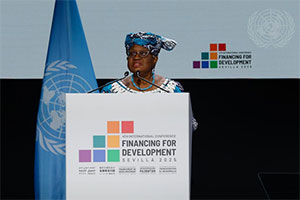 Opening of 4th International Conference on Financing for Development. Credit: UN Photo/Mariscal
International trade and investment are crucial elements of the world economy. While they can be powerful stimulators of development, they can also lead to global imbalances and dynamics of exploitation. In 2025, international trade entered a period of immense disruption, driven in part by a new wave of United States tariffs that reshaped global supply chains and investment flows. The increase in the US tariff rate, the highest since the 1930s, has forced bilateral renegotiations with global trading partners. Furthermore, the debt crisis in developing nations has accelerated while Official Development Assistance (ODA) has substantially dropped 7.3% in 2024.
In the 21st century, advancements in economic diversification in formerly colonized nations have propelled them into more central roles in the global economy. For example, both China and Mexico were able to develop their manufacturing sector and channel this development into booming export flows, thus advancing into the position of emerging economies. Foreign investment also plays an essential role in providing capital for developing countries, although they are oftentimes accompanied by social and environmental exploitation. For example, rising Chinese investments in natural resources in Latin America have often been met with tension as these investment projects fail to properly mitigate environmental risks and protect workers’ rights. In a more multifaceted vein, Sino-African relations have led to infrastructure development in Sub-Saharan Africa while also heightening the region’s economic dependency on China. IPS reports on global news in trade and investment, while shining a light on the nuanced nature of these endeavors.

The Week with IPS

NEXT STOP - SDGs
Tracking global progress towards a sustainable world
Tracking global progress towards a sustainable world
