Languages
Wednesday, October 21, 2026



News and Views from the Global South
Trade & Investment

Q&A: Mexico and the Rediscovery of South America
Cuauhtémoc Cárdenas, known as the ‘moral leader’ of the Mexican left, said that his country and Central America “focus very much on the North” and should make a shift towards South America and its integration processes, in order to achieve less-dependent, alternative development conditions.Giant Companies Pinpricked by ‘Direct Democracy’
A Swiss village has decided to reject tax money from the firm Glencore and to instead donate it to charities. Other towns may follow, sending a strong signal to the government to follow the U.S. and the EU and introduce transparency rules for the extractive industry.
Energy Hits New Rocks in Mongolia
Mongolia, 90 percent dependent on fuel imports from Russia and vulnerable to price hikes, is seeking to develop its oil shale deposits of at least 800 billion tons.
Pacific Pact – a Minefield for Health Care
The Trans Pacific Partnership Agreement (TPP), the negotiation of which is set to conclude this year, could drive research into new drugs and improve access to medicines. Except – it won’t.
Risk Management Can Ease Poverty, World Bank Says
Successful risk management can be a powerful tool for development, the World Bank said Monday in its annual World Development Report (WDR).
U.S.-Africa Trade Mostly Benefits Oil, Textiles
With a key U.S.-Africa trade agreement up for renewal in 2015, advocates on all sides of the issue say current policies are rife with shortcomings that leave many African businesses out in the cold.
WTO: Stingy with the Poor, Generous with the Rich
A fight taking place in the World Trade Organisation (WTO) negotiations towards the Bali Ministerial Conference shows how the rules on agriculture allow developed countries to continue to shell out huge subsidies while penalising farmers in developing countries.
Egypt Paying a Price for ‘Cheap’ Labour
Egyptian workers who mobilised during the 2011 uprising that toppled the regime of Hosni Mubarak have used the past two and a half years to organise into unions, press for labour reforms, and strike for better wages and working conditions.
Push for Transparency in U.S.-Mexico Drilling Agreement
As lawmakers here prepare to take up legislation that would green-light a U.S.-Mexico agreement on oil-and-gas drilling in the Gulf of Mexico, development and rights groups are urging them to reject a proposal that would exempt involved companies from new disclosure requirements.
Poverty Declines as Inequality Deepens
As world leaders from 193 countries evaluate the successes and failures of the Millennium Development Goals (MDGs) during high-level meetings and special events here, the United Nations claims that extreme poverty worldwide has been cut in half.
Tallying the Benefits of Climate Action
More than a half-dozen governments on Tuesday launched a yearlong collaborative investigation into the economic benefits of taking broad action to combat global climate action.
Robin Hood Activists Take Aim at Wall Street
Five years after the 2008 world financial crisis and two years after the Occupy movement it triggered, U.S. critics of the financial sector are coalescing around the idea of a Robin Hood Tax on financial transactions.
Credit Rating Reform Overlooks Developing World
The concerns of developing countries about credit rating agencies (CRAs) risk going unheard as regulatory bodies around the world tackle questions raised after the 2008 financial crisis.
The Emerging Economies and the G20 Summit at St. Petersburg
The eighth G20 Summit convened in St. Petersburg on Sept. 5-6, 2013 was dominated by the Syrian crisis, deflecting attention from the mandate of the gathering to serve as the premier forum for international economic coordination.Proposed Global Accord Called a Disaster for Public Services
Nearly 350 international civil society organisations are urging countries taking part in new negotiations towards an agreement on “trade in services” to abandon the effort, warning that the accord would negatively impact on universal access to and national regulation of public services.
“The Oil Is Ours” – But Its Secrets Are the NSA’s
Reported U.S. spying on Brazil’s Petrobras oil firm revived the controversy over opening up the company, a symbol of Brazilian sovereignty since the 1950s, to foreign investment.
Argentina’s Imports Climb Despite State Controls
To maintain its trade surplus, Argentina continues to control imports – a strategy that has bolstered its national industry but is questioned by importers, partners in the Mercosur trade bloc, and rich countries.
Scarcity Reveals an Inaccessible Excess
For decades Zakayo Ekeno has walked Turkana County’s arid land, herding his livestock, and his father’s before that. Yet nothing about the persistently drought-stricken land in northern Kenya could have given him an indication of the wealth beneath it.
Tourism Rescuing Tunisia
The Tunisian revolution, which ousted the dictator Ben Ali in early 2011, gave greater liberty to Tunisians but it also scared off many tourists. However, despite the current political crisis visitors have steadily returned, and the Tunisian authorities and tourism industry are determined to protect a sector which plays a vital role in the Tunisian economy.
Africa in Debt to Brazil: Forgiveness Isn’t Always Free
The Brazilian government projects the cancellation of nearly 900 million dollars in debt owed by a dozen African countries as a gesture of solidarity. But others simply see an aim to expand the economic and political influence of South America’s powerhouse.
Bitcoins Catching On in Latin America
The Bitcoin, a virtual currency that circulates outside regular financial systems, is catching on in Latin America.« Previous Page — Next Page »





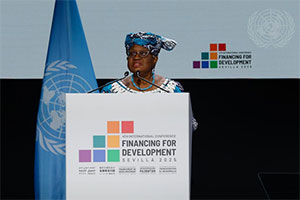 Opening of 4th International Conference on Financing for Development. Credit: UN Photo/Mariscal
International trade and investment are crucial elements of the world economy. While they can be powerful stimulators of development, they can also lead to global imbalances and dynamics of exploitation. In 2025, international trade entered a period of immense disruption, driven in part by a new wave of United States tariffs that reshaped global supply chains and investment flows. The increase in the US tariff rate, the highest since the 1930s, has forced bilateral renegotiations with global trading partners. Furthermore, the debt crisis in developing nations has accelerated while Official Development Assistance (ODA) has substantially dropped 7.3% in 2024.
In the 21st century, advancements in economic diversification in formerly colonized nations have propelled them into more central roles in the global economy. For example, both China and Mexico were able to develop their manufacturing sector and channel this development into booming export flows, thus advancing into the position of emerging economies. Foreign investment also plays an essential role in providing capital for developing countries, although they are oftentimes accompanied by social and environmental exploitation. For example, rising Chinese investments in natural resources in Latin America have often been met with tension as these investment projects fail to properly mitigate environmental risks and protect workers’ rights. In a more multifaceted vein, Sino-African relations have led to infrastructure development in Sub-Saharan Africa while also heightening the region’s economic dependency on China. IPS reports on global news in trade and investment, while shining a light on the nuanced nature of these endeavors.

The Week with IPS

NEXT STOP - SDGs
Tracking global progress towards a sustainable world
Tracking global progress towards a sustainable world
