
Tuesday, October 20, 2026



News and Views from the Global South
Combating Desertification and Drought

Zimbabwe Turns to Boreholes Amid Groundwater Level Concerns
Faced with cyclical droughts and low water levels in supply dams, Zimbabwe is turning to boreholes for relief, raising concerns about already precarious groundwater levels across the country.
Taliban: The Return of Misogynistic Gynophobes in Afghanistan
 Gynophobia is defined as an intense and irrational fear of women or hatred of women, it may be characterized as a form of specific phobias, which involves a fear that is centered on a specific trigger or situation, which in the case of gynophobia is women.

The Risks of Turning Planet Earth into a Giant Desert
The message is clear: three-quarters of the world’s population will be affected by drought by 2050. Does it sound too far in time? Well, your kids might be among the billions of humans living on a desertified planet.
No Climate Transition Without Securing Land Rights
The landmark land tenure decision by parties to the UN Convention to Combat Desertification (UNCCD) in 2019 offers a blueprint for upcoming climate negotiations in Sharm El Sheikh in November.
Bringing Seeds of Hope to Farmers
Amidst a backdrop of rising food insecurity worldwide and a global food supply chain crisis, many countries are attempting to increase the level of food self-production. One improved input for farming which is receiving renewed attention is improved seed. The two most populous countries in the world, China and India, have recently made ground-breaking moves to improve their competitive position by developing new seeds which will improve their food production and increase resilience to climate change. So far, in 2022, new regulations on using biotechnology (genetic modification and gene editing) have been put in place by both countries to ultimately allow smallholder farmers to benefit from these new seeds.
Landmark UN Report Issues Stark call for Sustainable Land Management to Save Human Health
With 50% of humanity affected by land degradation, the world must move to a ‘crisis footing’ to conserve, restore and use land resources sustainably, a major UN report has said.
Traditional, Time-Tested Methods and a Modern App Helps Beat Climate Change
Even as erratic weather and extremely high temperatures increase pest infestation and affect harvests, a combination of traditional methods, integrated pest management through intercropping and multilayering is helping farmers in Ahmednagar and Aurangabad districts of Maharashtra, India.
How a Massive Climate Project Can Help Win Peace for Ukraine – And Help African Job + Food Crises
How would the late Archbishop Desmond Tutu have reacted to the Russian Invasion of Ukraine? Differently than you might think. The invasion of Ukraine is a mass human tragedy. It is killing Ukrainians, exposing families to violent atrocities, and has driven a refugee crisis of over 4 million people and counting. The war in Ukraine has also reawakened our fear of global war - even nuclear war - and the importance we place on global peace.
Indian Agriculture Towards 2030
India began its journey as an independent nation in 1947 with fresh memory of the Bengal Famine of 1943 which claimed 1.5 to 3 million lives. Against this backdrop, the First Five Year Plan (1951-56) prioritized agriculture which, however, shifted to heavily industrialization in the second Plan.
Bangladeshi Lawyer Rizwana Hasan Awarded International Women of Courage Award
In an exclusive interview to IPS UN Bureau, journalist Sania Farooqui is in conversation with Bangladeshi lawyer, Rizwana Hasan who was recently awarded the 16th Annual International Women of Courage Awards by the U.S Department of State. Hasan works primarily to protect the environment and defend the dignity and rights of marginalized Bangladeshis. Through landmark legal cases over the past 20 years, Hasan has changed the dynamics of development in Bangladesh to include a people-centered focus on environmental justice.

The New World Wonder: a 100 Million Hectares Wall to Protect Africa
Once completed in 2030, it could well be considered the world’s eighth wonder, this time natural. It is the African-led Great Green Wall or the largest living structure on the planet – an 8.000 kilometres natural hit stretching across the entire width of the continent.
Call for Increased Global Efforts to Ease Africa’s Climate-Induced Water Crisis
When years ago warnings were sounded that future wars would be fought not over oil but water, the predictions were dismissed as alarmist.
Too Harmful: The March of Salt and Plastics on World Soils
There are more under-reported consequences of human activities unmatching the rhythm of Mother Nature. Such is the case, among many others, of the growing salinisation and ‘plastification’ of the world's soils.
Severe Water Stress, Absolute Scarcity for 2 to 4 Billion Humans by 2025
Now it comes to the scary water crises, as it is estimated that, globally, over two billion people live in countries that experience high water stress.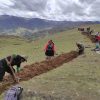
Rural Women in Peru Seed Water Today to Harvest It Tomorrow
"When I was a little girl we didn't suffer from water shortages like we do now. Today we are experiencing more droughts, our water sources are drying up and we cannot sit idly by," Kely Quispe, a small farmer from the community of Huasao, located half an hour from Cuzco, the capital of Peru's ancient Inca empire, told IPS.
Growing Amazon Deforestation a Grave Threat to Global Climate
For three weeks, the Brazilian government concealed the fact that deforestation in Brazil’s Amazon rainforest increased by nearly 22 percent last year, accentuating a trend that threatens to derail efforts to curb global warming.
COP26 – Adapting to the Climate Crisis
Look up any map showing today’s global humanitarian crises and you’ll find it awash in red alerts more than ever before. Climate emergencies are fast emerging in new areas that have never previously witnessed them, and they are accelerating humanity’s march towards the precipice in regions long battered by conflict, hunger and displacement.
Carbon Tax Over-Rated
Addressing global warming requires cutting carbon emissions by almost half by 2030! For the Intergovernmental Panel on Climate Change, emissions must fall by 45% below 2010 levels by 2030 to limit warming to 1.5°C, instead of the 2.7°C now expected.
Obtaining Water, a Daily Battle in Argentina’s El Impenetrable Region
Next to the brick or adobe houses of El Impenetrable, a wild area of forest and grasslands in northern Argentina, loom huge plastic barrels where rainwater collected from the corrugated iron roofs of the houses is stored. However, the barrels are empty, because it has hardly rained for two years, local residents complain.
China and the UN at 50- What We Can Achieve Together
China was one of the architects of the United Nations and was the first signatory of the UN Charter in San Francisco in 1945. But it was only in October 1971, with the Chinese delegation led by Mr. Qiao Guanhua, that China’s representation at the UN resumed. Since that time, the UN has had the great privilege of witnessing and supporting China in achieving one of the greatest periods of socio-economic progress in world history.
Pandemic Highlights Urgent Need to Improve Sanitation in Brazil
Basic sanitation, a sector that is undervalued because, according to politicians, it does not bring in votes, has gained relevance in Brazil due to the pandemic that has hit the poor especially hard and the drought that threatens millions of people.« Previous Page — Next Page »





Today, some two billion people depend on ecosystems in dryland areas, with 90 percent of them living in developing countries. But the pace of arable land degradation is accelerating – now estimated at 35 times the historical rate -- impacting biodiversity, availability of clean water and food security, as well as exposing vulnerable communities to the harsh impacts of climate change. As the only legally binding international agreement linking environment and development to sustainable land management, the United Nations Convention to Combat Desertification (UNCCD) works to improve the living conditions of people in the drylands. IPS looks at local solutions being implemented around the world, from restoring soil productivity and mitigating the effects of drought, to projects that empower communities to manage their dryland resources more effectively.

The Week with IPS

Tracking global progress towards a sustainable world
