
Friday, October 16, 2026



News and Views from the Global South
Environment

Traditional, Time-Tested Methods and a Modern App Helps Beat Climate Change
Even as erratic weather and extremely high temperatures increase pest infestation and affect harvests, a combination of traditional methods, integrated pest management through intercropping and multilayering is helping farmers in Ahmednagar and Aurangabad districts of Maharashtra, India.
The Mayan Train and the Fight for Mexico’s Ancient Jungle
Along the wide slash of white earth in southwestern Mexico there are no longer trees or animals. In their place, orange signs with white stripes warn visitors: "Heavy machinery in motion," "No unauthorized personnel allowed".
Worrying Insights from UN’s First-Ever Assessment of Water Security in Africa
When it comes to water security – a reliable, good supply of safe water – just 29 African countries have made some progress over the past three to five years. Twenty-five have made none.
How a Massive Climate Project Can Help Win Peace for Ukraine – And Help African Job + Food Crises
How would the late Archbishop Desmond Tutu have reacted to the Russian Invasion of Ukraine? Differently than you might think. The invasion of Ukraine is a mass human tragedy. It is killing Ukrainians, exposing families to violent atrocities, and has driven a refugee crisis of over 4 million people and counting. The war in Ukraine has also reawakened our fear of global war - even nuclear war - and the importance we place on global peace.
Warning: Climate Crisis Is Now the Single Biggest Health Threat Facing Humanity
While the world’s top scientists and experts continue their arduous work to finally submit to politicians at the 27th session of the Conference of the Parties (COP 27) in Sharm El-Sheikh, Egypt (7-18 November 2022), a new alert now emerges: the climate crisis has already become the single biggest health threat to humankind.
Proposed Animal Protection Legislation Ignores Rights of Local Communities to Practice their Approach to Conservation
On the battleground that has become African wildlife conservation, rural communities find themselves in the middle of a tug-of-war that is bound to the past on one side, and their future, on the other.
Perils of Hunger, Food Insecurity in Southern Africa- Challenges & Opportunities
Food systems are under severe stress around the world now. The thresholds of tolerance are already exceeding limits with millions facing acute food and water scarcity throughout all continents. Over a quarter of Africa’s population are facing hunger and food insecurity. Conflict, droughts, flooding, rising unemployment, inequality, economic crises, and the impacts of Covid-19 pandemic have been ravaging the Continent on an unprecedented scale.
Indian Agriculture Towards 2030
India began its journey as an independent nation in 1947 with fresh memory of the Bengal Famine of 1943 which claimed 1.5 to 3 million lives. Against this backdrop, the First Five Year Plan (1951-56) prioritized agriculture which, however, shifted to heavily industrialization in the second Plan.
Palm Oil for Biodiesel in the Amazon: Sustainable Fuel or Deforestation Risk?
Oil palm, known as dendezeiro in Brazil, can produce up to ten times more vegetable oil per hectare than other crops, but it is regularly condemned as harmful to the biodiversity of tropical forests in Asia, Africa and Latin America. Now, its cultivation looks set to advance in the Brazilian Amazon.
Turning Agro-industrial Waste into Energy in Argentina
Three giant concrete cylinders with inflated membrane roofs are a strange sight in the industrial park of Zárate, a world of factories 90 kilometers from Buenos Aires that heavy trucks drive in and out of all day long. They are the heart of a plant that is about to start producing energy from agro-industrial waste, for the first time in Argentina.
New Seed Bank to Support Agriculture of the Future
As he points to a white shelf that holds bean seeds, Austrian biologist Peter Wenzl explains that one of them, obtained in Ecuador, provided a gene for the discovery that major seed protein arcelin offers resistance to the bean weevil.
Do we Really Need a World Ranking to Measure Happiness?
The 10th edition of the World Happiness Report was recently published and once again the findings raised an array of mixed emotions with many questioning the real foundations underpinning the most discussed aspect of the Report, the World Happiness Ranking,
Unity of Purpose to Accelerate Africa’s Sustainable Development
The COVID-19 pandemic reversed several development gains on the continent, and Africa’s leaders are convinced stronger cooperation in boosting investment in green growth will help Africa meet the Sustainable Development Goals (SDG).
Desalination Plants, Solution and Environmental Challenge for Chile
The Pacific Ocean could quench the thirst caused by 10 years of drought in Chile, but the operation of desalination plants of various sizes has a long way to go to become sustainable and to serve society as a whole rather than just corporations.
Water & Sanitation, a Better Future for Girls & our Planet
At the World Water Forum this week (March 21-26), the international community will raise awareness of the 2 billion people worldwide who lack access to clean water and sanitation. Among them are millions of women and girls, who walk hundreds of miles each year to find water for their families and are blocked from education and economic empowerment also due to poor sanitation services.
South African Court Rules that Clean Air Is a Constitutional Right: What Needs to Change
A court in South Africa has confirmed the constitutional right of the country’s citizens to an environment that isn’t harmful to their health. This includes the right to clean air, as exposure to air pollution affects human health. Air pollution also affects land and water systems, and decreases agricultural yields.
Water & Sanitation Crisis Escalates as Yemenis Mark World Water Day
As Yemen enters its 8th year of an escalating conflict, 21.7 million of my fellow Yemenis are forced to rely on humanitarian assistance to survive. The conflict has left a trail of devastation in its wake – the country is in economic freefall, and families face intensified violence, hunger, and disease. As we also mark another World Water Day on March 22, within Women’s History Month, it is a time to reflect on the immense water and sanitation crisis that continues to take countless lives – and how it impacts women and girls so acutely. The destruction of the country’s health and water infrastructure has left Yemen acutely vulnerable to multiple epidemics including malaria, diphtheria, dengue, cholera, and COVID-19.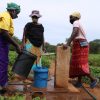
Groundwater at the Heart of the Water Security Equation
Groundwater is invisible and yet its impact is visible everywhere – this infinite resource provides almost half of all drinking water worldwide. About 40% of water for irrigated agriculture and about 1/3 of water required for industry is from groundwater resources. Despite these impressive facts, groundwater remains invisible and less prominent compared to surface water.
Pandemic Pushes SDGs Further out of Reach of Asia and the Pacific
2022 marks the second anniversary of the COVID-19 pandemic, and while an end to the pandemic is in sight, it is far from over and the consequences will be felt for decades to come. At the same time, the 2030 Agenda for Sustainable Development is becoming increasingly distant. The region must use the 17 Sustainable Development Goals as a roadmap to a fairer recovery.
Ethanol Not Enough to Heal Sugarcane’s Environmental Legacy in Colombia
As a visitor drives across the plains of the department of Valle del Cauca in southwestern Colombia, green carpets dominate the view: sugarcane fields that have been here since the area got its name.
What This Year’s “No 1 Central Policy Document” Tells Us about Beijing’s Food Security and Rural Revitalisation Ambitions
The recently published “No 1 central policy document” (“No 1 document”), China’s national blueprint for rural policy, further demonstrates Beijing’s commitment to safeguarding food security and advancing rural revitalisation. The document’s release comes against an increasingly complicated geopolitical environment which, along with factors, such as disruptions to the global food chain supplies and worsening climate change impacts, have forced Beijing to rethink how its national goals can be achieved.« Previous Page — Next Page »





Through our global network of local writers, we are continuing our award-winning coverage of global and local environmental challenges, with a focus on the people for whom the ecosphere matters in a direct way: rural dwellers who have little means to protect themselves against adverse conditions; communities that need to switch to sustainable development in order to survive; poor women and children, who are the most vulnerable in natural disasters. Sponsored by the United Nations Environment Program (UNEP), the United Nations Development Program (UNDP) and The World Bank (WB), IPS also maintains the award-winning Tierramérica, a specialised information service on environment and development.

The Week with IPS

Tracking global progress towards a sustainable world


