Languages
Thursday, October 1, 2026



News and Views from the Global South
Active Citizens
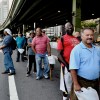
New York’s Homeless Pushed Deeper into the Shadows
Joe sits on newspapers spread on the sidewalk by the entrance to midtown's Grand Central Station. His head rests in his hands, only looking up when coins from passersby clink into his paper cup.
OPINION: International Relations, the U.N. and Inter Press Service
In 1979, I had a debate at the United Nations with the late Stan Swinton, then the very powerful and brilliant director of Associated Press (AP). At one point, I furnished the following figures (which had been slow to change), as an example of Western bias in the media:
Organic Farming Taking Off in Poland … Slowly
Polish farmer Slawek Dobrodziej has probably the world’s strangest triathlon training regime: he swims across the lake at the back of his house, then runs across his some 11 hectares of land to check the state of the crops, and at the end of the day bikes close to 40 kilometres to and back from a nearby town for some shopping.
No Hope for AIDS-Free Generation in Uganda as Controversial HIV Bill is Signed into Law
HIV/AIDS activists are adamant Uganda will not achieve an “AIDS-free generation” now a “backwards” HIV/AIDS Bill criminalising the “wilful and intentional” transmission of the disease has been signed into law.
U.S., Brazil Nearing Approval of Genetically Engineered Trees
The U.S. and Brazilian governments are moving into the final stages of weighing approval for the commercialisation of genetically engineered eucalyptus trees, moves that would mark the first such permits anywhere in the world.
Churches at the Frontline of Climate Action
Johannes Kapelle has been playing the organ in the Protestant church of Proschim since he was 14. The 78-year-old is actively involved in his community, produces his own solar power and has raised three children with his wife on their farm in Proschim, a small village of 360 inhabitants in Lusatia, Germany.
A Life Reserve for Sustainable Development in Chile’s Patagonia
The people of Patagonia in southern Chile are working to make the Aysén region a “life reserve”. Neighbouring Argentina, across the border, is a historic ally in this remote wilderness area which is struggling to achieve sustainable development and boost growth by making use of its natural assets.
Despite Current Debate, Police Militarisation Goes Beyond U.S. Borders
The shooting of an unarmed black teenager by a white police officer in the southern United States earlier this month has led to widespread public outrage around issues of race, class and police brutality.
Island States to Rally Donors at Samoa Meet
Amid accelerating climate change and other challenges, a major international conference in the South Pacific island nation of Samoa next month represents a key chance for Small Island Developing States (SIDS) in the Caribbean to turn the tide.
Militarism Should be Suppressed Like Hanging and Flogging
I once asked Dan Berrigan, the great American anti-war activist, for some advice to me in my life as a peace activist. He replied “Pray and Resist”.
Does Iceland Gain From Whaling?
Although fin whaling by Icelanders has encountered increasing opposition over the last year, Icelandic whaling boats headed off to sea again in mid-June for the first hunt of the summer and by August 14 had killed 80 fin whales.
Trauma Kits and Body Bags Now Fill Aleppo School
Volunteer civil defence units operating here in Syria’s largest city careen through crater-pocked routes of precariously hanging, pancaked concrete where barrel bombs have struck.
U.S. Urged to Put Development Aid over Border Security
When U.S lawmakers departed Washington for a month-long recess, they left behind a simmering debate over what to do about the tens of thousands of Central American children and adults that continue to cross the U.S. southern border.
Brazil’s “Dalai Lama of the Rainforest” Faces Death Threats
Davi Kopenawa, the leader of the Yanomami people in Brazil’s Amazon rainforest, who is internationally renowned for his struggle against encroachment on indigenous land by landowners and illegal miners, is now fighting a new battle - this time against death threats received by him and his family.
U.S. Waives Sanctions on Myanmar Timber
Civil society groups are split over a decision by the U.S. government to waive sanctions on Myanmar’s timber sector for one year.
Abuse of Older Women Overlooked and Underreported
A veteran women's rights activist, Patricia Brownell was still taken aback by the prevalence of abuse against older women she discovered during dozens of conversations she and her colleagues had with victims.IFC Warned of Systemic Safeguards Failures in Honduras
For the second time this year, an internal auditor has criticised the World Bank’s private sector investment agency over dealings in Honduras, and is warning that similar problems are likely being experienced elsewhere.
Azerbaijan: Human Rights Plummet to New Low
Azerbaijan in recent months has launched a clear assault against various civil society activists and non-governmental organisations. While rough treatment of critics is nothing new in this energy-rich South-Caucasus country, one question remains unanswered: Why pick up the pace now?
Guido, the Grandson in the DNA of All Argentinians
The recovery of “grandchild number 114” – one of the sons and daughters of those who were “disappeared” during the Argentine dictatorship – caused a commotion that many compared to the excitement of making it to the final match of the World Cup a month ago.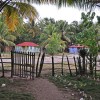
For Disenfranchised Haitian Islanders, Tourism Signals a Paradise Lost
Calm waters lap the shore beneath stately coconut palms. Mango trees display their bounty alongside mangrove forests. Goats graze peacefully on hillsides.
Will Obama’s “New Africa” Deliver on Its Promises?
As the three-day U.S- Africa Leaders Summit here drew to a close Wednesday, experts across the private, public and non-profit sectors continued to debate the opportunities and obstacles posed by the U.S’ expanding business partnership with Africa.« Previous Page — Next Page »


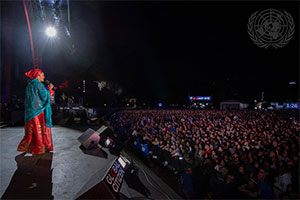 Global Citizen Festival in New York. Credit: UN Photo/Eskinder Debebe
Active citizens are committed to social change because they know that it is achievable. However, major political challenges face active citizens across the world. For example, in authoritarian regimes in Latin America where the hegemonic party has been in power for decades on end, protestors and human rights activists face enormous repression and struggle to materialize their advocacy into concrete results. The same can be said for Africans, where a shift towards elected government in recent decades has yet to translate into an effective voice in decision-making. Now, the Strengthening Citizen Demand for Good Governance, which uses evidence-based approaches – funded by DFID's Governance and Transparency Fund – seeks to raise their voices.
In 2025, the CIVICUS Monitor’s People Power Under Attack report revealed that civic freedoms are severely limited in 122 of 198 countries and territories, and only 7.2% of the global population now lives in countries where civic space is open. Through partnership with the Overseas Development Institute (ODI) and CIVICUS, IPS reporters across the continent will seek to define the extent and limits of state capability, government accountability and the responsiveness of leaders to the needs of citizens.

The Week with IPS

NEXT STOP - SDGs
Tracking global progress towards a sustainable world
Tracking global progress towards a sustainable world
