Languages
Sunday, October 18, 2026



News and Views from the Global South
Aid
Chatterjee, new Resident Coordinator, to lead 25 UN agencies in East Africa
Siddharth Chatterjee, the Representative of the UN Population Fund (UNFPA) in Kenya, has been appointed UN Resident Coordinator, where he will lead and coordinate 25 UN agencies in East Africa. At the same time, he will also serve as the Resident Representative of the UN Development Programme (UNDP).
Asia, Looking Beyond the Green Revolution
 More than 2.2 billion people in Asia rely on agriculture for their livelihoods, but the Asian Development Bank warns that stagnant and declining yields of major crops such as rice and wheat can be ultimately linked to declining investments in agriculture. Public investments in agriculture in India, for instance, have been roughly the same since 2004.

Nurturing African Agriculture
While agriculture could be the driving force to lift millions of Africans out of poverty and alleviate hunger, its full potential remains untapped. For example, only between five and seven percent of the continent’s cultivated land is irrigated, leaving farmers vulnerable to climate shocks like the devastating El Nino-driven drought in southern Africa. That's why international agencies like the U.N. Food and Agriculture Organization (FAO) are forging key partnerships to enhance agricultural production, sustainable natural resource management and increased market access. 
Smart Technologies Key to Youth Involvement in Agriculture
She is only 24 and already running her father’s farm with 110 milking cows. Cornelia Flatten sees herself as a farmer for the rest of her life.
Deadly Yellow Fever Spreading, Amid Global Vaccine Shortages
As deadly yellow fever spreads to seven provinces of the Democratic Republic of Congo (DRC), new measures have been introduced to ensure that as many people as possible are immunised, despite global shortages of the yellow fever vaccine.
The Time is Ripe to Act against Drought
Let us start with some good news. Sort of. The strongest El Niño in 35 years is coming to an end. [1]
Dhaka Could Be Underwater in a Decade
Like many other fast-growing megacities, the Bangladeshi capital of Dhaka faces severe water and sanitation problems, chiefly the annual flooding during monsoon season due to unplanned urbanisation, destruction of wetlands and poor city governance.
Arable Lands Lost at Unprecedented Rate: 33,000 Hectares… a Day!
Humankind is a witness every single day to a new, unprecedented challenge. One of them is the very fact that the world's arable lands are being lost at 30 to 35 times the historical rate. Each year, 12 million hectares are lost. That means 33,000 hectares a day!
Ethiopian Food Aid Jammed Up in Djibouti Port
Bags of wheat speed down multiple conveyor belts to be heaved onto trucks lined up during the middle of a blisteringly hot afternoon beside the busy docks of Djibouti Port.
Adaptation to Climate Change: Need for a Human Rights Approach
The memories of Cyclone Sidr and Aila are fresh in the mind of Razia Begum, a victim of climate change, of Dacope Upazila, Khulna. The standing field crops and houses of her community were destroyed, and they suffered the loss of cattle as well as people who perished in these natural disasters. She says mournfully that Saturkhali, Kamarkhola, Koilashganj and Baniashanta are the most vulnerable unions where access to necessary human rights is disrupted. Furthermore, salinity, flood, river erosion, heavy rain, cyclone, water logging and seasonal variations etc. are the most devastating impacts of climate change in those areas.
Let’s Improve Our Global Ranking on Impunity
After my remarks on impunity last week, a friend brought to my attention a disturbing study on Impunity (via InterAksyon), showing that among 59 countries, the Philippines led in the Global Impunity Index.
Youth Key to the Success of the SDGs in Kenya
Consider this: in 1956 Sweden and Kenya’s population was roughly at 7 million. Today Sweden has about 9.8 million, while there are about 44 million Kenyans. Fertility levels are declining gradually and Kenyans are living longer. It is estimated that there will be 85 million people in Kenya by 2050, with three quarters of these being below 35 years. While Kenya’s median age is 19, Sweden’s is 42.
Youth Employment: Turning Workplace Partnerships into Opportunity
Many of us can remember the difficulties of getting our first job – the searching, the frustration of rejection, the nervous wait for an interview or the first day of work. Today’s staggering unemployment rates in many countries make it an especially difficult time for young job-seekers.
War on Climate Terror (II): Fleeing Disasters, Escaping Drought, Migrating
"No one can deny the terrible similarities between those running from the threat of guns and those fleeing creeping desertification, water shortages, floods and hurricanes.”
The UN Steps up Efforts to End Child Marriage
Barely 17 years old and from the Gajapati district in Odisha, India, Susmita has never gone to school. She rears the few animals her family owns, and this is her primary duty besides attending to household chores.
War on Climate Terror (I): Deserts Bury Two Thirds of African Lands
Two-thirds of the African continent is already desert or dry-lands. But while this vast extension of the second largest continent on Earth after Asia is “vital” for agriculture and food production, nearly three-fourths of it is estimated to be degraded to varying degrees.
Team Refugees: Pivotal Moment in Olympic History
For the first time ever, a team of displaced athletes will have their chance to demonstrate their relentless determination and integrity in a bid to leave their own distinct mark on Olympic history.
African Farmers Can Feed the World, If Only…
Can African farmers feed the world?. Apparently the answer is “yes.” Bold as it may sound, this statement is based on specific facts: Africa is home to 60-65 per cent of the world’s uncultivated arable land and 10 per cent of renewable freshwater resources, and it has registered a 160 per cent increase in agricultural output over the past 30 years.
Developing Nations Seek Tax Body to Curb Illicit Financial Flows
Despite Western opposition, the 134-member Group of 77 is continuing to pursue a longstanding proposal for an inter-governmental UN-affiliated tax body aimed at combating corporate tax dodging and curbing illicit financial flows, including money laundering and off-shore banking.
The Devil in Development
The word “development” - eliciting as it does grandiloquent notions of progress - has become, at least in Bangladesh, something of a red herring. It is used as a catch-all phrase to justify just about anything — from eviction of slum-dwellers to make way for high-rise housing projects to forceful grabbing of ancestral lands to build eco-parks and tourism spots, from rampant deforestation of our woodlands to unapologetic pollution of our rivers, from undemocratic and top-down imposition of anti-people projects to suppression of dissent through violence both sponsored or otherwise. It matters little that such so-called development only exacerbates the extreme vulnerabilities of people already on the margins, destroys scarce natural resources and intensifies the ever-widening gap between the haves and the have-nots; that it does precisely the opposite of what “development”—real, pro-people development—ought to do. If one protests these actions as unjust, undemocratic or inequitable, one can be easily dismissed as being “anti-development”, and by extension, “unpatriotic”, making it ever more difficult to have any sort of constructive conversation about Bangladesh's development priorities (or the lack thereof).
Climate-Smart Agriculture for Drought-Stricken Madagascar
Mirantsoa Faniry Rakotomalala is different from most farmers in the Greater South of Madagascar, who are devastated after losing an estimated 80 percent of their crops during the recent May/June harvesting season to the ongoing drought here, said to be the most severe in 35 years.« Previous Page — Next Page »





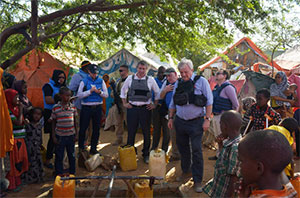 UN Emergency Relief Coordinator Visits Somalia. Credit: UN Photo/Tobin Jones
In recent years, conflicts have broken out across the world with no sign of slowing down or stopping. In times like this, millions of people globally are in dire need of humanitarian aid. Famine, warfare, natural disasters, and economic decline plague a host of nations, including Palestine, Sudan, Chad, Lebanon, and Haiti, to name a few. Humanitarian aid provides millions of people with critical services including healthcare, food, clean drinking water, psychosocial support, housing, and access to education. UN agencies such as the UNDP, UNICEF, the World Food Programme (WFP), UNHCR, UNRWA, and UNEP work with the UN Office for the Coordination of Humanitarian Aid (OCHA) and local organizations to come up with the best possible strategies to support affected communities. At the same time, humanitarian aid and those working on the frontlines are consistently threatened by both actors directly involved in conflict as well as those who are meant to contribute to the international humanitarian regime at large. The near-collapse of United States international aid structures in 2025, including the termination of 83% of USAID’s 6,300 global initiatives, has left millions of people without access to vital humanitarian assistance. 98 million people in 2025, only 65% of people targeted for humanitarian assistance, received the help they needed. In contrast, 123 million people received some form of humanitarian assistance in 2024, and OCHA’s 2026 Global Humanitarian Overview estimates that 239 million people are in need of assistance in 2026. IPS is well-positioned to discuss current initiatives to provide aid and relief through in-depth reporting and opinion content.

The Week with IPS

NEXT STOP - SDGs
Tracking global progress towards a sustainable world
Tracking global progress towards a sustainable world
