Languages
Wednesday, November 11, 2026



News and Views from the Global South
Aid
World Bank Urged to Rethink Reforms to Business-Friendliness Report
Civil society groups from several continents are stepping up a campaign urging the World Bank to strengthen a series of changes currently being made to a major annual report on countries’ business-friendliness.
How Midwives on Sierra Leone’s Almost Untouched Turtle Islands are Improving Women’s Health
Emmanuel is a male midwife. At the age of 26, he lives and works on one of eight islands off the southwest peninsular of Sierra Leone, an hour by speedboat from Mattru Jong, the capital of Bonthe District.
OPINION: Boosting Resilience in the Caribbean Countries
Having lived and worked for more than a decade in four Caribbean countries, I have witnessed firsthand how Small Island Developing States (SIDS) are extremely vulnerable to challenges ranging from debt and unemployment to climate change and sea level rise.
Building Public Trust is a Key Factor in Fighting West Africa’s Worst Ebola Outbreak
The nurse carefully packs the body into a plastic bag and then leaves the isolation tent, rinsing his feet in a bucket of water that contains bleach. Then he carefully takes off his safety glasses, gloves and mask and burns them in a jerry can.
These Children Just Want to Go Back to School
Between government efforts to wipe out insurgents from Pakistan’s northern, mountainous regions, and the Taliban’s own campaign to exercise power over the Federally Administered Tribal Areas (FATA), the real victims of this conflict are often invisible.
U.N. Conference Set to Bypass Climate Change Refugees
An international conference on small island developing states (SIDS), scheduled to take place in Samoa next week, will bypass a politically sensitive issue: a proposal to create a new category of "environmental refugees" fleeing tiny island nations threatened by rising seas.
Bangladeshi Girls Seek Equal Opportunity
Until five years ago, Shima Aktar, a student in Gajaghanta village in the Rangpur district of Bangladesh, about 370 km northwest of the capital Dhaka, was leading a normal life. But when her father decided that it was time for her to conform to purdah, a religious practice of female seclusion, things changed.
When Land Restoration Works Hand in Hand with Poverty Eradication
Tugging at the root of a thorny shrub known as ‘juliflora’, which now dots the village of Chirmiyala in the Medak District of southern India’s Telangana state, a 28-year-old farmer named Ailamma Arutta tells IPS, “This is a curse that destroyed my land.”
Innovation Offers Hope in Sri Lanka’s Poverty-Stricken North
In this dust bowl of a village deep inside Sri Lanka’s former conflict zone, locals will sometimes ask visitors to rub their palms on the ground and watch their skin immediately take on a dark bronze hue, proof of the fertility of the soil.
Zambia’s Cash Transfer Schemes Cushion Needy Against Climate Shocks
“Last season, I lost an entire hectare of groundnuts because of a prolonged drought. Groundnuts are my hope for income,” says Josephine Chaaba, 60, from Pemba district in southern Zambia.
In Saving a Forest, Kenyans Find a Better Quality of Life
When Mercy Ngaruiya first settled in Kasigau in south eastern Kenya a decade ago, she found a depleted forest that was the result of years of tree felling and bush clearing.
India: Home to One in Three Child Brides
Basanti Rani*, a 33-year-old farmers’ wife from the northern Indian state of Haryana, recently withdrew her 15-year-old daughter Paru from school in order to marry her off to a 40-year-old man.
TNT and Scrap Metal Eviscerate Syria’s Industrial Capital
Numerous mechanics, tyre and car body shops used to line the busy streets near the Old City of Syria’s previous industrial and commercial hub.
Can Land Rights and Education Save an Ancient Indian Tribe?
Scattered across 31 remote hilltop villages on a mountain range that towers 1,500 to 4,000 feet above sea level, in the Malkangiri district of India’s eastern Odisha state, the Upper Bonda people are considered one of this country’s most ancient tribes, having barely altered their lifestyle in over a thousand years.
Recurrent Cholera Outbreak in Far North Cameroon Highlights Development Gaps
Under a scorching sun, with temperatures soaring to over 40 degrees Celsius, Lara Adama’s family is forced to dig for water from a dried-out river bed in Dumai, in northern Cameroon.
Despite Current Debate, Police Militarisation Goes Beyond U.S. Borders
The shooting of an unarmed black teenager by a white police officer in the southern United States earlier this month has led to widespread public outrage around issues of race, class and police brutality.
Island States to Rally Donors at Samoa Meet
Amid accelerating climate change and other challenges, a major international conference in the South Pacific island nation of Samoa next month represents a key chance for Small Island Developing States (SIDS) in the Caribbean to turn the tide.
Helping Uganda’s HIV positive Women Avoid Unplanned Pregnancies
Barbara Kemigisa used to call herself an “HIV/AIDS campaigner”. These days she would rather be known as an “HIV/AIDS family planning campaigner”.
U.S. Urged to Put Development Aid over Border Security
When U.S lawmakers departed Washington for a month-long recess, they left behind a simmering debate over what to do about the tens of thousands of Central American children and adults that continue to cross the U.S. southern border.
South Sudan Heads towards Famine Amid ‘Descent into Lawlessness’
Another deadline has passed. But instead of bringing about peace, the leaders of South Sudan’s warring parties have allowed the country to continue its slide toward famine.
Adaptation Gaps Mean African Farmers Fork Out More Money for Reduced Harvests
In Cameroon's Northwest Region, Judith Muma walks 9km from her home to her 300-square-metre farm. The vegetables she grows here are flourishing thanks to the money she has borrowed from her njangi (thrift group) and a local credit union to finance a small artisanal irrigation scheme.« Previous Page — Next Page »





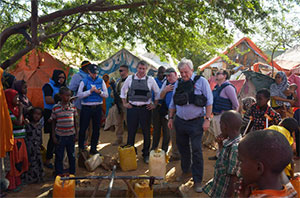 UN Emergency Relief Coordinator Visits Somalia. Credit: UN Photo/Tobin Jones
In recent years, conflicts have broken out across the world with no sign of slowing down or stopping. In times like this, millions of people globally are in dire need of humanitarian aid. Famine, warfare, natural disasters, and economic decline plague a host of nations, including Palestine, Sudan, Chad, Lebanon, and Haiti, to name a few. Humanitarian aid provides millions of people with critical services including healthcare, food, clean drinking water, psychosocial support, housing, and access to education. UN agencies such as the UNDP, UNICEF, the World Food Programme (WFP), UNHCR, UNRWA, and UNEP work with the UN Office for the Coordination of Humanitarian Aid (OCHA) and local organizations to come up with the best possible strategies to support affected communities. At the same time, humanitarian aid and those working on the frontlines are consistently threatened by both actors directly involved in conflict as well as those who are meant to contribute to the international humanitarian regime at large. The near-collapse of United States international aid structures in 2025, including the termination of 83% of USAID’s 6,300 global initiatives, has left millions of people without access to vital humanitarian assistance. 98 million people in 2025, only 65% of people targeted for humanitarian assistance, received the help they needed. In contrast, 123 million people received some form of humanitarian assistance in 2024, and OCHA’s 2026 Global Humanitarian Overview estimates that 239 million people are in need of assistance in 2026. IPS is well-positioned to discuss current initiatives to provide aid and relief through in-depth reporting and opinion content.

The Week with IPS

NEXT STOP - SDGs
Tracking global progress towards a sustainable world
Tracking global progress towards a sustainable world
