Languages
Sunday, November 22, 2026



News and Views from the Global South
Economy & Trade

Address Malnutrition, Not Just Food Security
Malnutrition remains a formidable challenge in most societies, with less than a tenth of countries in the world not experiencing at least one major malnutrition problem. In relatively more food secure countries, where almost everyone has enough to eat, and few live in fear of a sudden loss of access to food, micronutrient deficiencies and diet-related non-communicable diseases (NCDs) often still loom large.
2019 – A Devastating Year in Review
By any measure this has been a devastating year: fires across the Amazon, the Arctic and beyond; floods and drought in Africa; rising temperatures, carbon emissions and sea levels; accelerating loss of species, and mass forced migrations of people.
Industrial Energy Efficiency is a Climate Solution
At a time when the world is battling unprecedented drought, bushfires, rising sea levels and water shortages, reducing energy use across industry is one powerful way to fight climate change in the immediate term.
Haiti’s Cry for Help as Climate Change is Compared to an Act of Violence against the Island Nation
Haiti’s Environment Minister Joseph Jouthe has compared the climate emergency to a violent act and appealed to the international community for help to fight climate change.
Taking Bangladesh to Zero-Leprosy, One New Case at a Time
Sandhya Mandal has never felt so vindicated. For the past four years, the 36-year-old community health worker from Meherpur – a rural district bordering India – has been traveling 50 km every day along dusty roads on an old motorbike, searching for leprosy patients who needed urgent treatment. But in her community, instead of compliments, neighbours and relatives raised questions about her work and her character. “They ask why I come home so late and what is this ‘work’ that I really do. Some even imply that I might be doing something like prostitution,” Mandal tells IPS.
Building Momentum to Hold Companies to Account
Millions of adults and children around the world suffer abuses as workers who obtain raw materials, toil on farms, and make products for the global market. They are at the bottom of global supply chains, for everything from everyday goods like vegetables and seafood to luxury items like jewelry and designer clothing that end up on store shelves worldwide.
Accelerating SDG Progress in Asia – Pacific
“The 2030 Agenda is coming to life”, declared the Secretary General at the opening of the first SDG Summit, a quadrennial event for the follow up and review of the 2030 Agenda for Sustainable Development. As leaders from Asia – Pacific took the floor, they highlighted country progress of SDG implementation and reaffirmed commitment to achieve the 2030 Agenda. Statements reflected different approaches across the region. Yet all converged on one priority: accelerated actions and transformative pathways.
Why Is Growth Slowing in China?
China’s gross domestic product (GDP) grew by 14%. Since then, its growth rate has declined by more than half to 6.6% in 2018. The five-year moving average growth rate is at its lowest since reforms began in 1978, although annual growth briefly fell lower during 1989, the year of the Tian An Men incident.
South-South Cooperation Offers Solutions to Urgent Climate Challenges
Climate change is the defining challenge of our time, and developing countries are recognized as hotspots for climatic risks. Through solidarity, peer-to-peer learning and collective self-reliance, developing countries are collaborating among themselves to address the threat.
Social Summit Demands Stronger Commitments in Climate Talks
As the COP25 deliberations enter the decisive final week, representatives of environmental and social organisations gathered in a parallel summit are pressing the governments to adopt stronger commitments in the face of a worsening climate emergency.
Fostering Sustainable Urbanization and Rural-Urban Linkages
As urbanization continues apace, coupled with rapid population growth and rural to urban migration, the challenges for inclusive rural transformation continue, and the importance of fostering improved rural-urban linkages for better food systems becomes increasingly important.. According to the UN, by 2050 some 66% of the world’s population of 9 billion is expected to live in urban areas. Such rapid urbanization is increasingly shaping the rural space and rural livelihoods (through markets, demand for agricultural goods and labour, migration, and through the provision of services to rural areas). It is therefore critical for the increasing emphasis on urban development to take into account the importance of rural development.
Saved Seeds are Seeds of Resilience
People have a right to define their own food system. This includes which seeds they use. Last week, farmers in Nakuru County, Kenya, celebrated the launch of “Ten rich, underutilized crops,” a publication and documentary that capture their efforts to promote and sustain the varieties they grow.
Gains and Losses of Irregular Migration
While opening a newspaper or watching a TV program we are every day made aware of the plights of irregular migrants. Some recent examples among many – on 24 October, 39 Chinese nationals were found dead in a lorry trailer in Essex. They had apparently frozen to death within a refrigerator container with temperatures as low as -25C (-13F). This while tragedies occur almost daily on the Mediterranean Sea. On 26 November, a rescue vessel found a boat almost completely sunken. It had three dead bodies aboard. Fifty-five migrants were saved. Three of them were in a critical condition, and one died after reaching Melilla in Spain, where the migrants were brought in. Three children were among the survivors, though a further ten individuals were reported missing. Nowadays, such news items pass by almost imperceptibly. Every day, thousands of unfortunate human beings are trafficked all over the world to suffer underpaid, hazardous work, or prostitution.
India’s Electric Mobility Needs Enabling Infrastructure to Pick up Speed
Dogged by intractable air pollution debilitating large northern swathes from mainly urban vehicle emissions, India earlier this year announced targets for a 40 percent non-fossil component in its fuel-mix by 2030 as part of its Nationally Determined Commitments (NDC) to the Paris accord on climate change. It aims for full electrification of public transit systems and of one-third private vehicles by 2030.
Sustainable Fisheries are Key in Addressing Food Security — and Women can Play an Important Role
Experts gathered in November to discuss the importance of sustainable fisheries and its role in eradicating world hunger at a fisheries symposium in Rome.
The Adaptive Age: No Institution or Individual can Stand on the Sidelines in the Fight Against Climate Change
When I think of the incredible challenges we must confront in the face of a changing climate, my mind focuses on young people. Eventually, they will be the ones either to enjoy the fruits or bear the burdens resulting from actions taken today.
Travel Tourism Must Transform to Survive, Thrive
The travel and tourism sector, with its significant economic and social benefits, has no choice but to transform to survive and thrive in the face of climate change, said UN Climate Change Executive Secretary Patricia Espinosa at COP25 to industry representatives.
Fostering Jobs, Entrepreneurship, and Capacity Development for African Youth: The Time for Disruption Is Now!
“There is no greater asset to Africa than its youth,” a statement that has been repeatedly proclaimed, but the continent still has a long way to go. Despite robust economic growth over the past two decades, a 1 percent increase in growth between 2000–14 was associated with only 0.41 percent growth in employment. This figure suggests that employment stood at less than 1.8 percent a year, far below the nearly 3 percent annual growth in the labor force. If this trend continues, 100 million people will join the multitudes of the unemployed in Africa by 2030.
Indigenous Knowledge, a Lesson for a Sustainable Food Future
Local knowledge systems rooted in traditional practices and culture passed down generations provide sustainable solutions to food and nutritional insecurity on the back of climate change, a conference heard this week.
Fixing the Business of Food
Milan is the city where Leonardo da Vinci painted his iconic Last Supper. Frozen in time is the moment Christ told his disciples there was a traitor among them. Visitors to the painting can examine the expressions on the faces of the disciples and look the food they might have eaten – the bread and wine, and of course the spilt salt. As one delegate to the 10th International Forum on Food and Nutrition noted, the diet did not seem varied or healthy.African Development Bank launches digital tool to help African youth learn to code
The African Development Bank and technology firm Microsoft today launched the ‘Coding for Employment’ digital training platform, an online tool to provide digital skills to African youth, wherever they are across the continent.« Previous Page — Next Page »


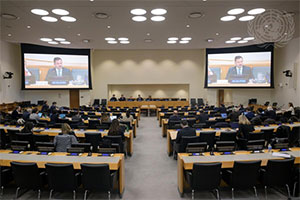 UN Commission on International Trade Law Holds Colloquium on Harmonizing Law in Age of Digital Trade and Finance. Credit: UN Photo/Manuel Elías
Trade has historically been a geopolitical tool that can both be used to propel development as well as entrench inequalities. In various nations in East Asia and Latin America, increased trade, as often seen in export booms, has allowed them to achieve influential standings within the global economy. On the other hand, many low-income countries in Sub-Saharan Africa, Asia, and Latin America struggle to maintain a robust trade performance, and oftentimes are subjugated to exploitative trade dynamics through intense extraction of their natural resources. In recent decades, international trade has reached a new era as emerging economies across the world are rising in economic preeminence. Stable international trade is crucial to world peace as global interconnectedness facilitates reliable diplomacy. Nevertheless, significant challenges are on the rise. Notably, a major wave of United States tariff escalations in January 2025 lifted US import taxes to their highest level since the 1930s, changing market dynamics and forcing renegotiations with global trading partners.These articles are aimed at informing readers about the complexities of trade and its varying effects on development, with a special focus on the consequences of the global economic crisis, the potential of fair trade and the gender implications of trade policies.
Updated by Yilan Batista and Shuli Wong August 2026

The Week with IPS

NEXT STOP - SDGs
Tracking global progress towards a sustainable world
Tracking global progress towards a sustainable world
